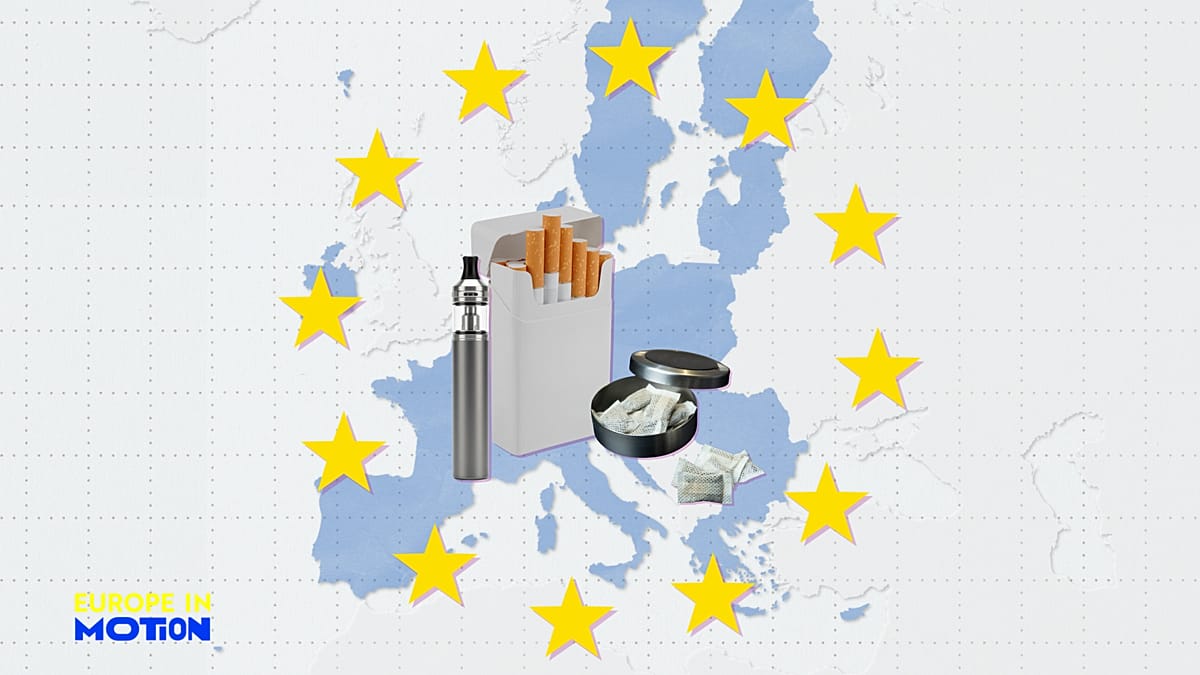
Despite decades of public-health campaigns and tightening regulations, the European Union is still far from its goal of a “Tobacco-Free Generation” by 2040. New data from Eurostat show that in 2025, roughly one in six people aged 16 or older across the bloc used tobacco or related nicotine products—cigarettes, e-cigarettes, or nicotine pouches—on a daily basis.
The figures reveal a persistent gender gap: 20.8% of men smoke or vape daily, compared with 12.6% of women. Both shares have edged down since 2022, when the equivalent numbers were 22.2% and 13.1%. The decline is real but slow, and it masks significant variation between member states.
Who smokes most in the EU?
Bulgaria tops the league table, with 26.3% of adults using tobacco or nicotine products every day. Sweden follows at 23.9%, and Croatia at 23.6%. At the other end of the scale, the Netherlands records the lowest share at 9.9%, followed by Ireland (11.7%), Belgium (13.6%) and Luxembourg (13.8%).
Between 2022 and 2025, 17 of the 27 EU countries saw a decrease in daily use. The sharpest drops were in Spain and Luxembourg, while Croatia and Lithuania went against the trend with notable increases. The reasons for these divergences are complex, ranging from pricing and taxation to cultural attitudes and the availability of alternatives like snus in Sweden.
Age patterns are relatively flat, but the 35–49 bracket shows the highest daily use at 21.3%, followed by 25–34-year-olds at 19.9% and 50–64-year-olds at 19.8%. This suggests that nicotine addiction is not just a young person’s problem—it persists across working-age groups.
The health toll and policy response
The human cost remains staggering. According to the World Health Organization, tobacco kills 1.1 million people in Europe each year, including 153,000 who die from exposure to second-hand smoke. Lung cancer deaths attributable to tobacco are 71% for men and 46% for women.
The EU has responded with a range of measures, including the Beating Cancer Plan, which aims to reduce tobacco use to less than 5% of the population by 2040. But progress is uneven, and Big Tobacco's lobbying efforts in Brussels continue to complicate the policy landscape. A proposed EU tax overhaul targeting vapes and nicotine pouches is part of the effort to keep pace with new products.
Yet awareness of the risks is not as widespread as one might expect. A study published in BMJ Open found that while more than 90% of Europeans know smoking causes lung cancer, only about 80% recognise heart disease as a consequence, and even fewer are aware of the stroke risk or the dangers of second-hand smoke. This knowledge gap has barely narrowed in two decades, despite graphic warnings on packs and repeated public-information campaigns.
The slow decline in smoking is a positive trend, but the rise of vaping and nicotine pouches complicates the picture. These products are often marketed as less harmful alternatives, and some evidence suggests they can help people quit—a recent review found nicotine vapes more effective than patches or gum. However, they are not risk-free, and their growing popularity among young Europeans raises new public-health questions.
As the EU pushes toward its 2040 target, the challenge is not just to reduce cigarette use but to address nicotine addiction in all its forms. The data from Eurostat show that while the battle against tobacco is being won, the war on nicotine is far from over.