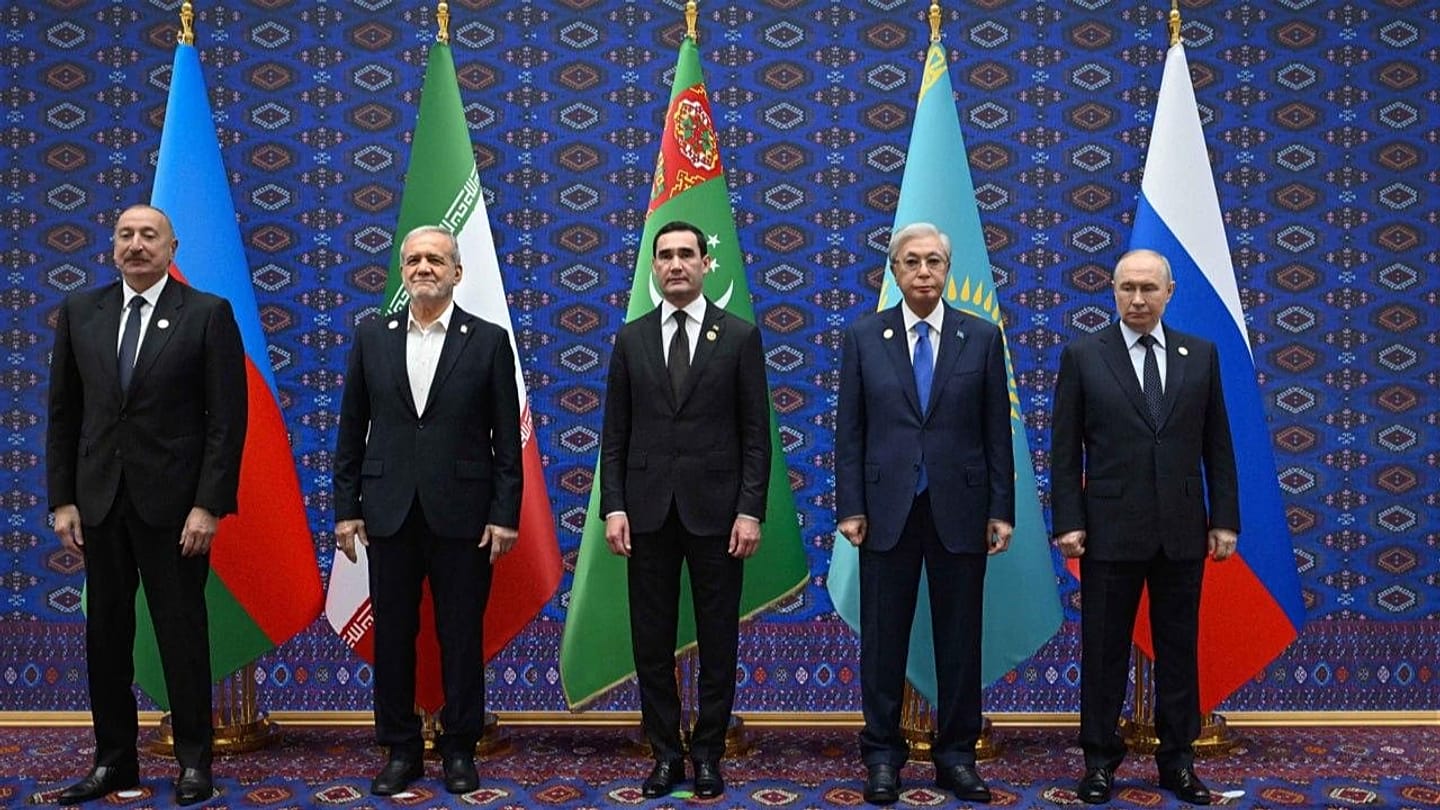
Ashgabat, the capital of Turkmenistan, played host this week to a rare cluster of diplomatic gatherings as leaders from across Eurasia convened for three summits focused on regional cooperation. The meetings, which drew delegations from Central Asia, the Caucasus, Russia, Iran, and beyond, were dominated by efforts to expand trade routes and transport links, but the deteriorating state of the Caspian Sea loomed large over the proceedings.
Turkmenistan, which holds the rotating chairmanship of several regional bodies, used the summits to push its vision of a modernised Silk Road. President Serdar Berdimuhamedow, who has sought to position his country as a logistics hub between Asia and Europe, called for new rail and road corridors that would shorten transit times for goods moving between China, Central Asia, and the European Union. The country's vast natural gas reserves, which already flow to China and Russia, were also on the agenda, with talks on expanding export capacity to new markets.
But the summits were not solely about commerce. The Caspian Sea, the world's largest inland body of water, is in the throes of an environmental crisis that scientists say is accelerating. Its level has fallen by more than two metres since the mid-1990s, and recent studies suggest that up to a quarter of its surface area could disappear by the end of the century. The causes are multiple: climate change, reduced inflow from the Volga River, and upstream dams that have starved the sea of fresh water. Pollution from oil extraction and agricultural runoff has compounded the damage, threatening fish stocks and the livelihoods of coastal communities.
In Ashgabat, the leaders acknowledged the urgency. A joint communiqué issued after the main summit pledged to strengthen cooperation on environmental monitoring and to develop a regional action plan for the Caspian's restoration. However, concrete commitments were thin on the ground. The five littoral states—Russia, Iran, Kazakhstan, Azerbaijan, and Turkmenistan—have long struggled to agree on how to manage the sea's resources, and their disputes over maritime borders and energy rights have stymied previous conservation efforts.
The Caspian's retreat has already had visible consequences, particularly along Kazakhstan's coast, where receding waters have exposed new islands and altered the shoreline. For Turkmenistan, the shrinking sea is a direct threat to its Caspian port city of Türkmenbaşy, a key node in its trade ambitions. The country has invested heavily in modernising the port and its rail links, but the environmental decline could undermine those investments if the sea becomes too shallow for large vessels.
Regional cooperation on transport was a more upbeat theme. The summits produced agreements to streamline customs procedures and to develop new multimodal routes that would connect Central Asia to the Caucasus and, ultimately, to European markets. These initiatives align with the EU's Global Gateway strategy, which seeks to boost sustainable connectivity with Central Asia. European officials have shown growing interest in the so-called Trans-Caspian International Transport Route, which bypasses Russia and offers an alternative to the northern corridor through Siberia.
For Europe, the stability and economic development of Central Asia carry strategic weight. The region's energy resources and its position as a transit hub for trade with China make it a key partner in diversifying supply chains. At the same time, the Caspian's environmental crisis has implications that extend beyond the region. The sea's decline could exacerbate water scarcity in neighbouring countries and contribute to regional instability, a concern that European diplomats have raised in bilateral talks.
The summits also touched on security, with leaders discussing joint efforts to combat terrorism, drug trafficking, and organised crime. Turkmenistan's policy of permanent neutrality, enshrined in its constitution and recognised by the UN, gives it a unique role as a mediator in regional disputes. The country has maintained cordial relations with both Russia and the West, and its capital has become a regular venue for multilateral meetings.
Yet the gap between rhetoric and action remains wide. Environmental groups have criticised the lack of binding targets in the communiqué, noting that previous pledges to protect the Caspian have yielded little progress. The sea's unique ecosystem, home to the sturgeon that produces beluga caviar, is under severe pressure, and conservationists warn that without urgent measures, several species could face extinction.
As the leaders departed Ashgabat, the summits were widely described as a success in diplomatic terms. But the real test will come in the months ahead, as the region's governments translate their commitments into concrete policies. For Turkmenistan, which is marking the 35th anniversary of its neutrality, the challenge is to balance its role as a regional convenor with the pressing need to address the environmental degradation at its doorstep. The country's modernisation drive depends on a stable and healthy Caspian, and the world is watching to see whether the promises made in Ashgabat will be kept.



