On Wednesday, 12 August 2026, the moon will pass directly between the sun and Earth, casting its shadow across a narrow corridor that includes parts of Greenland, Iceland, and northern Spain. Millions of Europeans in western regions will witness a deep partial eclipse, while those within the path of totality will experience up to two minutes and 18 seconds of daytime darkness.
The umbra—the moon's full shadow—will race along an 8,260-kilometre track, mostly over the Atlantic Ocean. It will begin near the North Pole, cross Siberia, and then sweep southward. Maximum totality will occur off Iceland's west coast, but by the time the shadow reaches a small patch of Portugal and then Spain, totality will have shortened to about a minute. The spectacle will end in the Mediterranean.
For Spain, this is a historic event: the last total solar eclipse visible from the mainland occurred in 1912, just two days before the Titanic sank. The Canary Islands have seen more recent ones, but for the Iberian Peninsula, this is a once-in-a-century opportunity.
Where to see the eclipse
In the United Kingdom, observers will be treated to a strong partial eclipse, with the sun 90 to 95 percent covered depending on location. Jake Foster, an astronomer at the Royal Observatory Greenwich, explains: "From here in the UK, we're going to actually be very fortunate. We are seeing a partial eclipse, but it is a very strong partial, between 90 and 95%." He adds that the eclipse will occur around sunset, making it a "golden hour eclipse" low on the western horizon. For the full experience, he advises travelling to Greenland, Iceland, or northern Spain, where the moon's shadow will be darkest.
The Royal Observatory Greenwich will host a watch party from its terraces, live streaming the event—weather permitting—as the sun is obscured over London's skyline.
This celestial alignment is possible because of a cosmic coincidence: the sun is about 400 times larger than the moon, but also about 400 times farther away, making them appear roughly the same size in the sky. When the moon passes exactly between Earth and the sun, it can block the sun's light completely, creating a total eclipse.
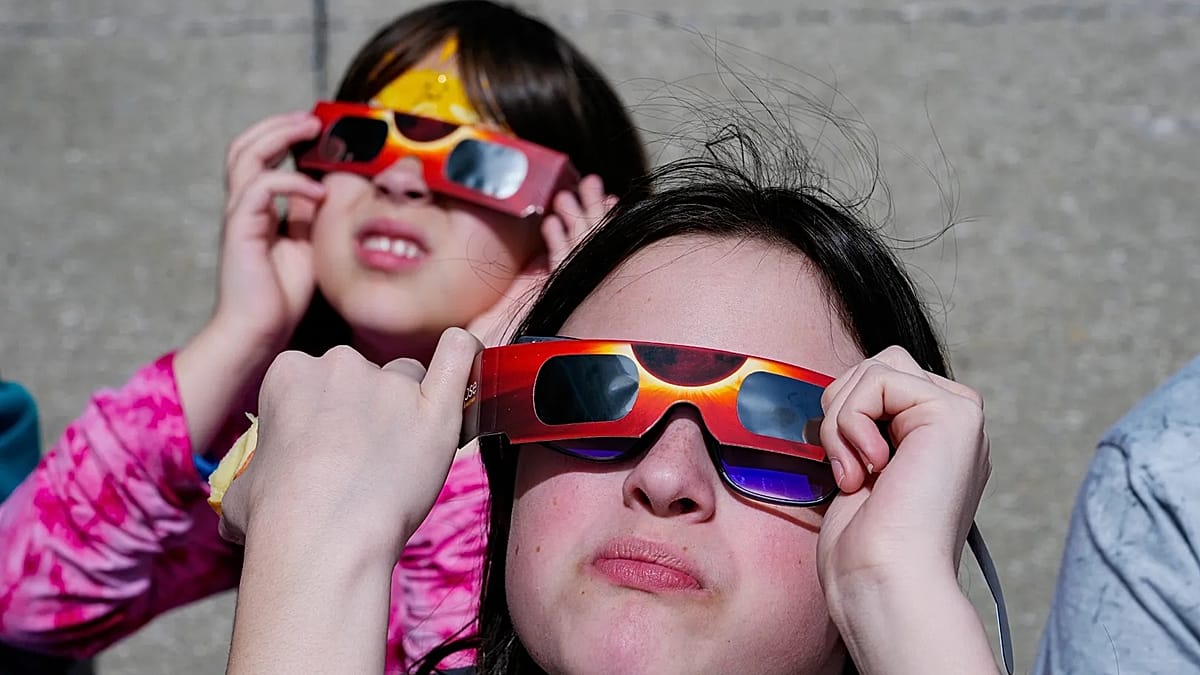
For those planning to watch, proper eye protection is essential. Solar eclipse glasses with special lenses that block 99.9999% of the sun's light are the safest way to view the event directly. Foster stresses the importance of ISO certification: "You've got to make sure that they are ISO certified so that they've been through the rigorous safety standards testing." Without such glasses, staring at the sun—even a sliver—can cause permanent eye damage.
Demand for certified viewing equipment has surged across Europe. In Paris, a specialist store saw customers queue for more than two hours to buy eclipse glasses and binoculars. Simon Noé, a 27-year-old video game researcher, said: "Two hours! Two hours for a pair of sunglasses. But for me, the eclipse is kind of a big deal. I remember when I was a child, I thought, What, there won't be another eclipse before 2026? 2026 seemed so far away. So this is a bit about making my inner child happy."
The eclipse will also have practical implications. Spain is offering free power to households that cut use during the eclipse, as solar output is expected to plunge. Portugal is also bracing for a solar output plunge. Grid operators have been preparing for weeks to manage the sudden drop in generation.
For scientists, the eclipse offers a rare chance to study the sun's corona, its outer atmosphere. Two of ESA's space telescopes, including the Proba-3 mission, will observe the eclipsed sun, though positioning may limit their view.
While total eclipses are predictable decades in advance, they remain a source of wonder. As Foster notes, "In order to see a total solar eclipse from the very same location more than once, you could be waiting over 200 years for that to happen." For many Europeans, this will be a once-in-a-lifetime experience.