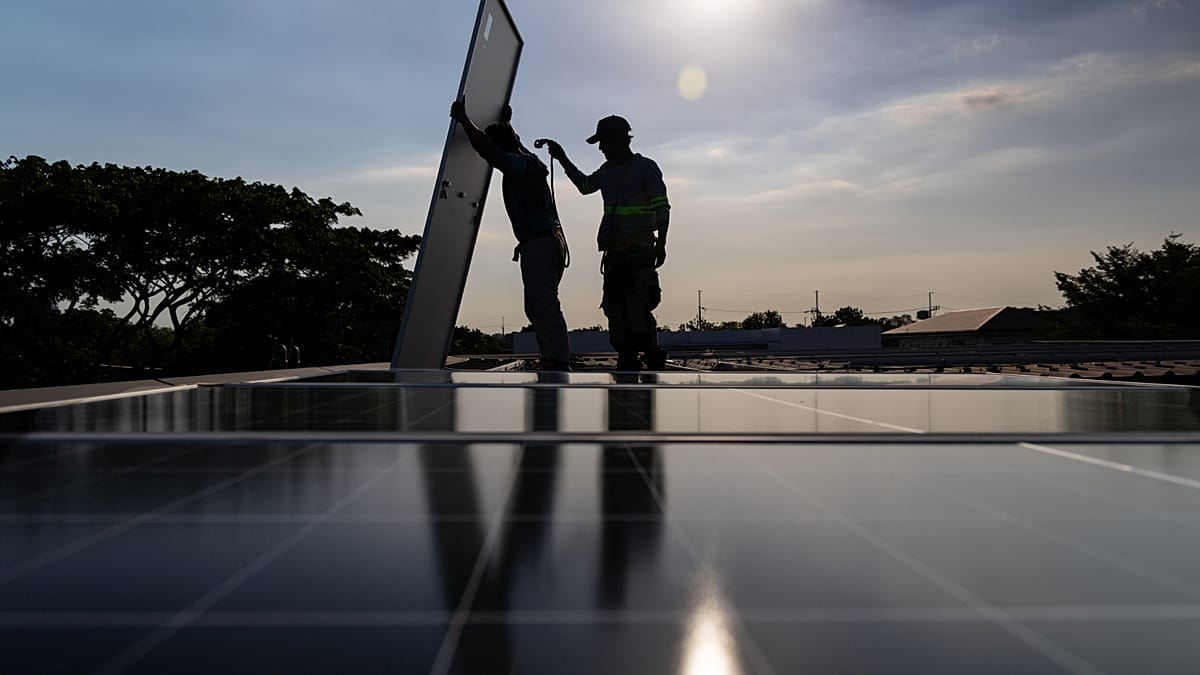
Europe is sweltering through its first major heatwave of the season, with London hitting 32.2°C and Paris enduring a “highly anomalous” heat dome. The sunny skies have triggered a record surge in solar power generation, pushing wholesale electricity prices below zero in France and parts of the Iberian Peninsula. Yet this apparent windfall for consumers does little to lower household bills and exposes deeper structural problems in the continent's energy system.
Negative prices become more frequent
On Sunday 24 May, solar met nearly half of Britain's midday electricity demand, according to NESO data. Two days later, at around 1pm on 26 May, hourly prices on France's Epex Spot exchange turned negative as the heat dome intensified. This is not an isolated event: analytics firm Montel reports that Spain recorded 397 hours of negative electricity prices in the first quarter of 2026, up from just 48 hours in the same period of 2025. Portugal saw 222 hours of sub-zero prices during those three months.
Negative pricing occurs when supply exceeds demand on the day-ahead market. Generators bid to avoid being curtailed, often because they still receive subsidies or have contracts that make it cheaper to produce at a loss than to shut down. Last year, Britain paid £1.47 billion (€1.67 billion) to turn down wind turbines and switch on gas plants—a stark illustration of the inefficiencies at play.
Grid bottlenecks and storage gaps
Europe's electricity grid was built for a handful of large, centrally located power plants, not for thousands of distributed solar panels and wind farms in remote areas. Investment in grid infrastructure has risen 47% over the past five years to roughly €70 billion annually, but a recent report from energy think tank Ember warns that more than 120 GW of planned renewable capacity—including 16 GW of rooftop solar affecting over 1.5 million households—is at risk due to insufficient grid capacity.
Battery storage is seen as a key solution. The EU installed 27.1 GWh of new battery energy storage systems (BESS) last year, marking twelve consecutive years of record growth. Yet according to a 2026 Solar Power Europe report, the bloc's total BESS capacity of 77 GWh remains far short of the 750 GWh needed by 2030 to meet climate targets. Germany and Italy lead the market, while Bulgaria has emerged as the fastest-growing adopter, followed by the Netherlands and Spain.
Some companies are experimenting with giving away free or discounted energy during surplus periods. Greg Jackson, CEO of Octopus Energy, has argued that such incentives should become permanent to encourage consumers to invest in electrification. The UK is considering similar measures.
Heatwave also harms other renewables
While solar output soars, the heatwave creates problems for other energy sources. Higher water temperatures in rivers used for cooling French nuclear reactors raise concerns about availability this summer. The heat dome also suppresses wind speeds: Bloomberg reports that below-normal wind generation was forecast last week in Germany, Spain, Italy, and France. French wind output dropped to around 0.5 GW at 1pm on 29 May, compared with an average of 7.4 GW so far this year.
Even solar panels are not immune to extreme heat. “It's a common misconception that more sun always equals more power,” says Ioanna Vergini, founder of wfy24.com, a platform analysing weather data and climate volatility. “Photovoltaic cells are semiconductors, and like all electronics, they lose efficiency as temperature rises.” Intense heat also increases strain on the grid as demand for cooling spikes.
The broader lesson is that Europe's renewable transition cannot rely solely on adding capacity. Without modernising grids, scaling storage, and managing the interplay between weather and energy supply, the continent risks wasting both power and money. As solar leads the way in cutting fossil fuel imports, addressing these bottlenecks becomes ever more urgent.