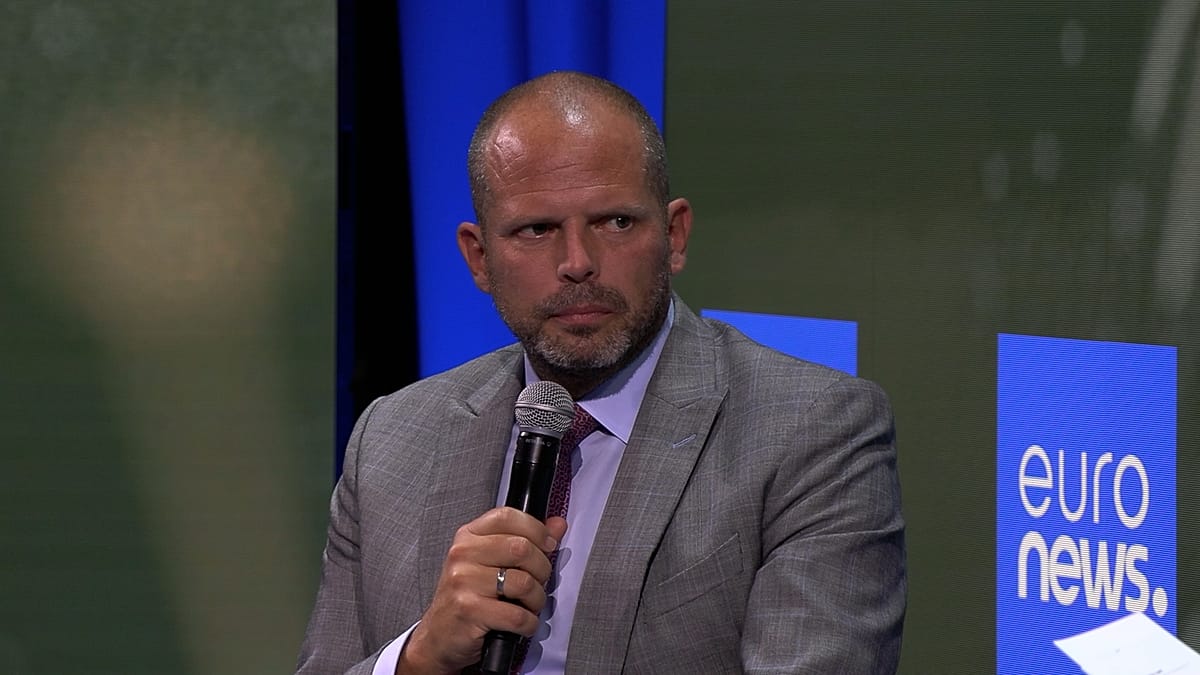
Europe's long reliance on soft power has left it dangerously short of the military capabilities and industrial capacity it now needs, Belgium's defence minister has warned, in remarks that cut to the heart of the continent's rearmament debate.
Theo Francken told Euronews that the continent had spent decades building generous welfare systems while neglecting the harder instruments of state power. "Europe has been very good at investing in soft power, in social security, and it's beautiful to have a pension system, to have social welfare systems," he said. "When somebody gets sick, when somebody has lost his job, we have everything. But when there's war or when there is a hybrid threat, we don't have anything."
His intervention comes as NATO's European members scramble to raise defence budgets and Brussels rolls out new measures to strengthen the bloc's defence industrial base. Francken acknowledged that momentum is building, but cautioned that the gap between ambition and capability remains wide.
Belgium's long spell as NATO's weakest link
Francken was unusually blunt about his own country's record. Belgium, he said, had been "the worst pupil in NATO class" for years, a consequence of a political culture that treated hard power as an afterthought.
"We are the founding father of NATO; we're the founding father of the EU," he said. "I think that we always were there for diplomacy, for soft power, but when we talked hard power in Belgium, everybody was looking in the other direction."
The numbers bear him out. Belgium's defence spending fell to just 0.97% of GDP in 2014, among the lowest in the alliance. In 2025, for the first time, the country crossed NATO's 2% threshold. But it is expected to stay at that level until 2029 because of a strained fiscal position — Belgium currently runs one of the widest budget deficits in the eurozone.
NATO's longer-term target is 3.5% of GDP by 2035, a goal that will require sustained political commitment across capitals. Francken was candid about the difficulty of reversing decades of underinvestment. "Now we doubled the budget; we reached 2%. I know that we add two more, but it's quite a process," he said. "We're doing so much, but I cannot undo in 18 months of being a minister what has been neglected for 40 years."
A wider European reckoning
Francken's diagnosis extends well beyond Belgium. Across the continent, governments are confronting the same arithmetic: welfare states built on the assumption of a benign security environment now face a far more dangerous neighbourhood, from Russia's war in Ukraine to hybrid attacks on undersea cables and energy infrastructure.
The debate over how to pay for rearmament is far from settled. Questions persist over whether Europe can shoulder the cost without cutting into the social spending that Francken himself described as one of the continent's proudest achievements. At the same time, industry voices warn that money alone will not solve the problem. As one Estonian MEP has argued, Europe's defence industry is not yet ready for the scale of rearmament being demanded.
Francken's remarks were made at a Euronews defence summit that also heard warnings about nuclear risks and hybrid threats, underlining the breadth of the challenge facing European capitals. The Belgian minister has previously urged Europe to accelerate its defence efforts amid warnings of a difficult winter ahead.
For Francken, the lesson is straightforward: soft power is not enough on its own. "It's beautiful to have a pension system," he said. But pensions and welfare systems, he implied, cannot deter a missile or a cyberattack. Europe's task now is to build the hard power it spent a generation assuming it would never need.