On the evening of August 12, 2026, a total solar eclipse swept across parts of Europe, turning day into twilight for millions of observers. The moon passed directly between Earth and the Sun, casting a shadow that crossed the Iberian Peninsula and then arced northeastward, offering a dramatic show for skywatchers from the Atlantic coast to the Baltic.
For many, this was a once-in-a-lifetime event. The next total solar eclipse visible from France is not expected until 2081, and the UK will have to wait until 2090. Germany's next opportunity comes even later, in the next century. Spain, however, is already looking forward to another total eclipse in 2027, a rare stroke of celestial luck for the country.
A continent under one shadow
In Spain, where the eclipse reached totality, crowds gathered in fields, on beaches, and atop ancient fortresses. In the central town of Berlanga de Duero, photographers captured the corona blazing around the moon's silhouette. Further north, the Gormaz fortress in Soria became a prime vantage point, its medieval walls framing the darkened sun.
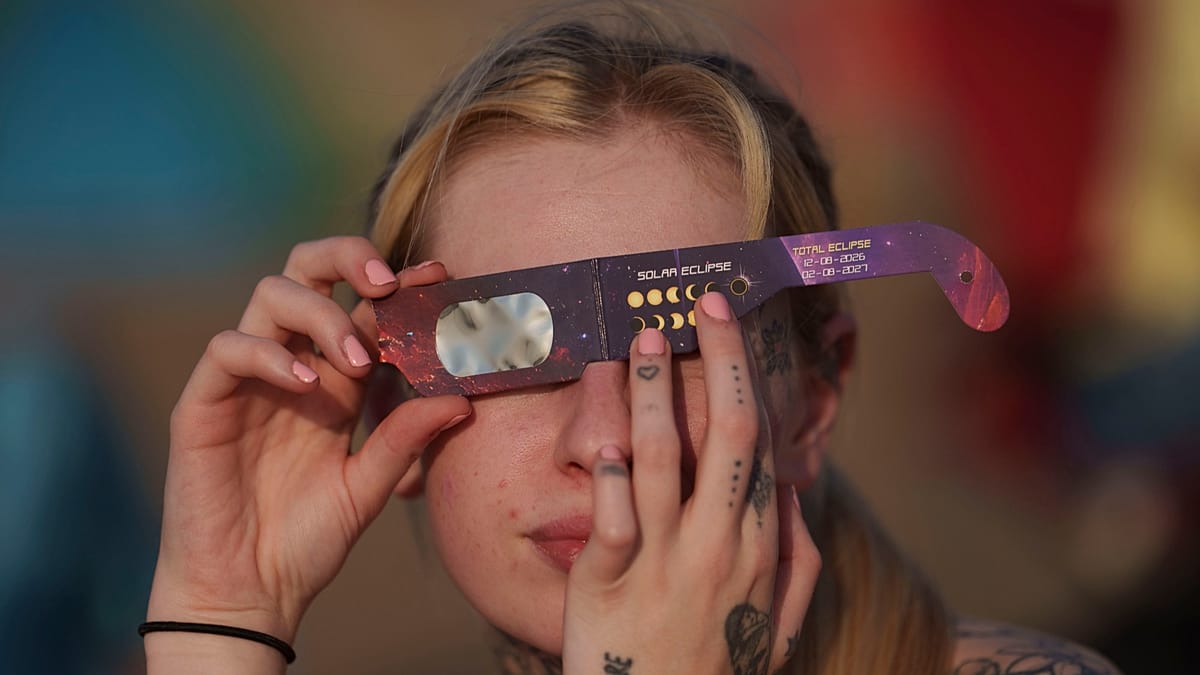
On the Mediterranean coast, beachgoers at Puerto de Sagunto near Valencia donned special eclipse glasses and watched the partial phases as the moon took a bite out of the sun. In Italy, near Pavia, the eclipse was seen over the dome of a church dedicated to the Virgin Mary, a striking juxtaposition of faith and astronomy.
Northern Europe also got a show, albeit a partial one. In London, crowds gathered at Primrose Hill and Northala Fields, while others watched from the banks of the Thames with the Houses of Parliament in the foreground. In Liverpool, observers on Crosby beach saw the moon cover more than 90 percent of the sun, a near-total experience.
From the Alps to the Gulf of Finland
Switzerland offered a unique perspective: from the summit of the Niesen mountain in the Bernese Oberland, photographers captured the moon obscuring the sun above the peak of Gantrisch. In Berlin, the eclipse was visible near the Molecule Man sculpture in the Spree River, a modern landmark against a celestial backdrop.
Further east, in St. Petersburg, Russia, onlookers gathered on the shore of the Gulf of Finland as the sun set in a partially eclipsed state. The low angle of the sun made for a particularly atmospheric scene, with the moon and sun seemingly touching the horizon.
In Denmark, the eclipse was observed over the calm waters of Mariager Fjord, a serene setting for a cosmic event. The images from across the continent show not just the science of the eclipse, but the shared human experience of looking up in wonder.
For those who missed it, or who want to relive the moment, the photographs serve as a reminder of the scale of the event. And for those concerned about the aftermath, there are practical considerations: millions of eclipse glasses may end up in landfills unless properly recycled. Health experts also remind viewers to watch for signs of retinal damage if they looked at the sun without protection.
As Europe looks back on this celestial spectacle, one thing is clear: the next total eclipse on the continent, in Spain in 2027, will be just as eagerly anticipated. For now, these images capture a moment when the sky united the continent in a shared, silent awe.