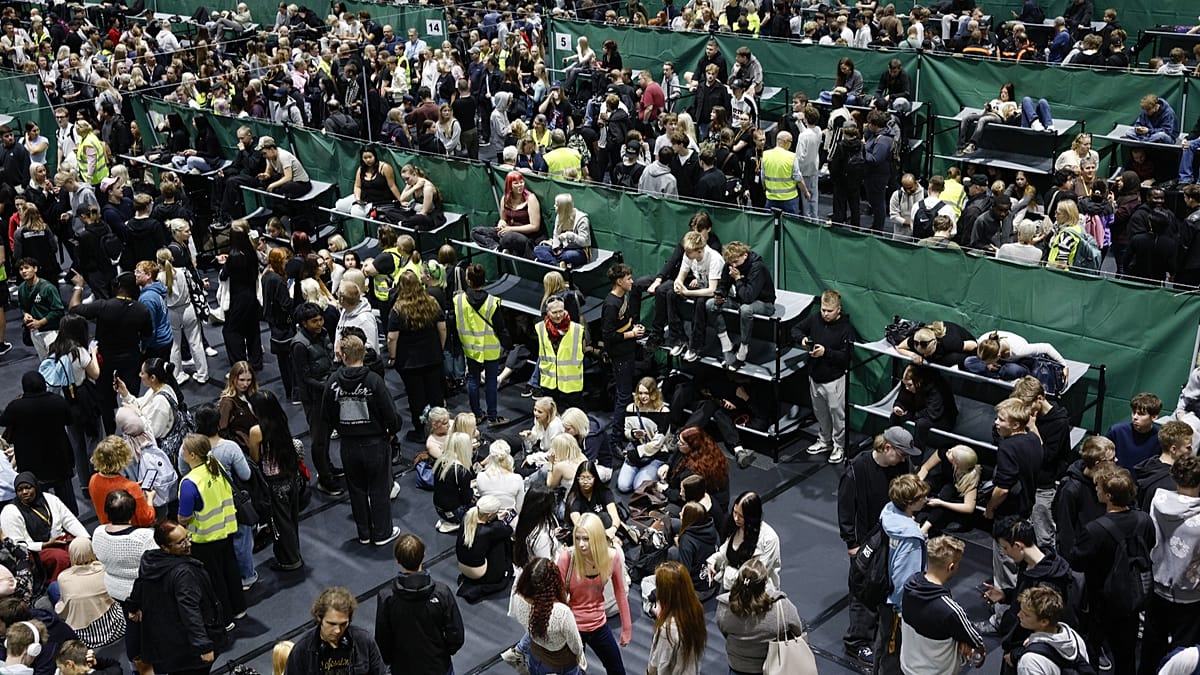
Deep beneath the Finnish city of Kuopio, in a shelter carved into solid rock and protected by doors built to withstand chemical, nuclear, or biological attack, two conscripts in hazmat suits measure radiation levels. Their task: transform a cavernous sports hall into a refuge for thousands. Around them, hundreds of volunteers and students bed down for the night on camp beds, part of a scenario that simulates a coordinated assault on Finland's critical infrastructure.
This is the largest civil defence exercise in Europe since the end of the Second World War, involving more than 2,000 people. The scenario is stark: cyberattacks have knocked out power and water supplies in Kuopio, and missile strikes from neighbouring Russia are imminent. The aim is to rehearse how local authorities and ordinary citizens would respond to a real attack.
But while underground bunkers offer protection from missiles, they are no defence against the shadowy campaign of sabotage and disruption that Western officials attribute to Russia. This campaign has included arson, attacks on water facilities and power stations, and drones penetrating EU airspace. As European Commission President Ursula von der Leyen has warned, such hybrid attacks are becoming the new normal.
Lessons from Ukraine
Finland shares a 1,300-kilometre border with Russia, stretching from the Baltic Sea to the Arctic Circle. In 2024, Helsinki and Stockholm joined NATO, ending decades of military non-alignment in response to Russia's full-scale invasion of Ukraine. Until then, Finland had prepared to defend itself largely alone.
Retired Army Colonel Asko Muhonen, who organised the Kuopio exercise, argues that Finland's defence rests not only on its military but on the "mindset" of its citizens. That mindset, he says, is cultivated through universal conscription, which Finland maintained even after the collapse of the Soviet Union. "It's our duty to serve and protect this country like people have before us. That's why we have our independence," said Jyry Pietikainen, a 23-year-old conscript trained to run the shelter overnight.
Muhonen also stresses the importance of learning from Ukraine. While Kuopio's largest shelter can hold 7,000 people, Ukrainians often have only minutes to reach a subway station or underground parking garage. "People need a shelter they can reach easily that offers some form of protection, not necessarily one that can withstand a nuclear attack," he said.
Dmytro Untila, a 20-year-old Ukrainian student at the University of Kuopio, was in Odesa when Russian missiles struck on 24 February 2022, the first day of the war. He sheltered in the entrance hall of his building because there was nowhere else to go. Training for such a situation would have helped, he said, "because nobody knew this could happen."
Energy infrastructure under threat
Juha Räsänen, CEO of the Savon Voima electricity company, says the biggest natural threats to energy infrastructure in the Kuopio region are heavy snowfall, storms, and bad weather. But since Russia's invasion of Ukraine and the company's decision to stop buying Russian biofuel, cyberattacks against the network have increased significantly. Last year, engineers found at least ten stickers placed on particularly vulnerable parts of the infrastructure. Other energy companies have reported similar findings, with no explanation for their origin. "If there was an explosion at that point, it could destroy a whole dam," Räsänen said. Drones have also been spotted over power lines, though the operators remain unidentified.
Räsänen acknowledges that it is impossible to guard against all threats. That is why, he says, it is crucial for people to be prepared to fend for themselves for at least 72 hours if the power goes out or water becomes undrinkable.
The Finnish Security and Intelligence Service (Supo) said it investigated "a wide range of observations" and found nothing of concern. Since 2022, increased vigilance has led to reports of reflective stickers related to land survey works, and drone sightings have "largely been explained by everyday occurrences."
Vuokko Lahtinen, a 32-year-old Kuopio resident, says "small things are happening all the time," including Russian jamming of GPS signals. For that reason, she believes "the best defence of Finland is to make it not worth attacking." That relies on the country's military and defence forces, but also on Finnish people who feel "we have something we want to fight for." Lahtinen points to a "general feeling of responsibility" that has grown out of local community groups and even recycling initiatives. "On a very simple daily level, if you do things that matter, then it has a butterfly-wing effect," she said.
As Europe faces an era of heightened hybrid threats, Finland's exercise in Kuopio serves as a reminder that civil defence is not just about bunkers and shelters, but about the resilience of ordinary citizens. The country's approach, rooted in conscription and a culture of preparedness, offers a model for other European nations grappling with similar challenges. With European unity against Russian hybrid attacks growing, Finland's example may prove increasingly relevant.