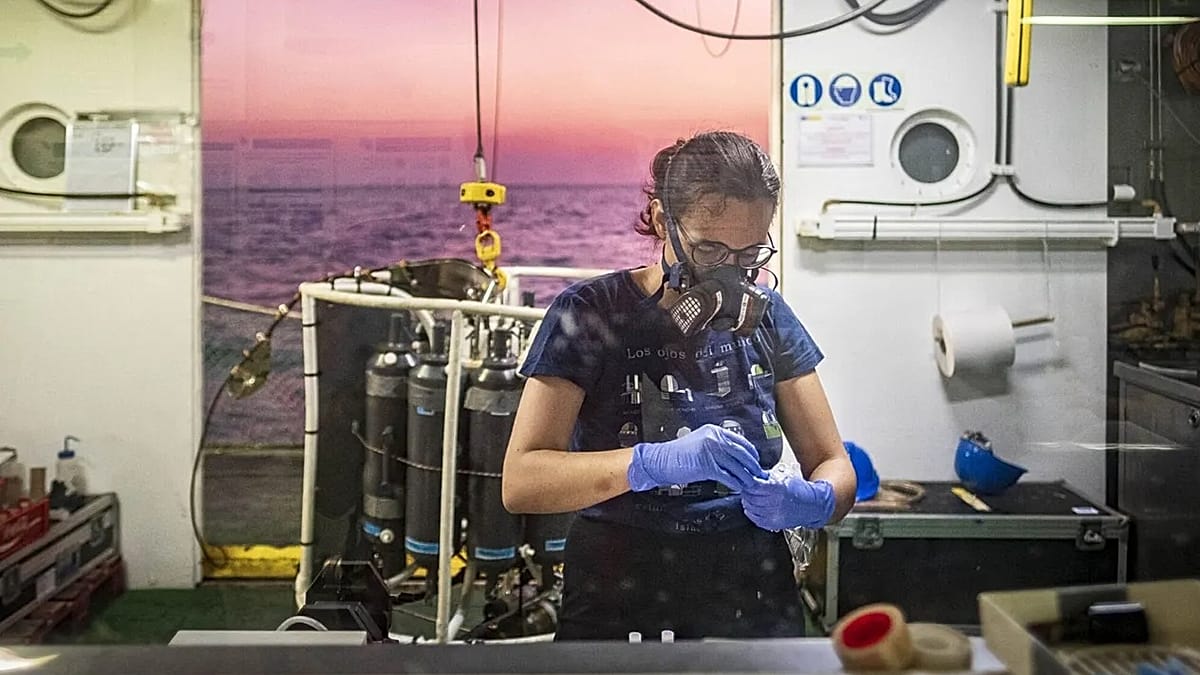
For more than forty years, oceanographers have crisscrossed the Mediterranean, measuring its temperature, salinity, oxygen, and acidity. Now, for the first time, those scattered records have been brought together into a single, coherent database—offering an unprecedented look at how Europe's inland sea is responding to a warming planet.
Researchers from the Spanish Institute of Oceanography (IEO-CSIC) in A Coruña and the Balearic Islands, working with colleagues across Europe and the United States, have compiled data from 46 oceanographic campaigns conducted between 1976 and 2018. The result is Carimed, a publicly accessible dataset that allows scientists to compare measurements taken decades apart and track the evolution of key indicators such as temperature, oxygen, pH, and carbon content.
Until now, much of this information was scattered across national archives, stored on aging tapes, or locked in local repositories. Recovering it was a painstaking effort, as Marta Álvarez, a chemical oceanographer at the A Coruña centre and coordinator of the research group, explains: “A considerable part of the data was recovered from fragmented historical records or locally stored archives, thereby consolidating measurements that were previously inaccessible.”
Making four decades of measurements comparable
But simply gathering the data was only half the battle. Comparing a measurement from the 1970s with one taken in 2018 is fraught with pitfalls: instruments have changed, sampling protocols have evolved, and even the routes of research vessels have shifted. To avoid mistaking methodological differences for real changes in the sea, the team subjected every measurement to rigorous quality control.
“Thanks to the rigorous 2QC process, systematic biases in biogeochemical variables were minimised and a more coherent dataset was obtained,” says Maribel García-Ibáñez, a researcher at the Balearic Islands Oceanographic Centre. This harmonization is crucial for detecting long-term trends that would otherwise be obscured by noise.
The Mediterranean is particularly sensitive to climate change. It is a semi-enclosed basin, with limited exchange with the Atlantic, making it a natural laboratory for studying the effects of warming, acidification, and oxygen loss—phenomena that are also unfolding in the world's oceans but are often more pronounced here.
Already, the data reveal a sea in flux. Water temperatures have risen, oxygen concentrations have declined in some layers, and pH levels have dropped, indicating acidification. These changes can disrupt marine ecosystems, from the microscopic plankton that form the base of the food web to commercially important fish stocks.
The Carimed database also allows scientists to investigate how the Mediterranean's deep-water circulation has changed over time. Deep-water formation, which occurs in the Gulf of Lion and the Adriatic, is a key driver of the basin's overturning circulation. Shifts in this process could have far-reaching consequences for nutrient distribution and carbon storage.
Beyond its immediate findings, Carimed is a tool for the future. It can be used to refine the climate models that project how the Mediterranean will evolve under different emissions scenarios. It is also open to the scientific community, and new observations can be added, extending the record into the coming decades.
The timing is apt. As European leaders grapple with the simultaneous climate crises that Ursula von der Leyen has warned about, having a detailed picture of how the Mediterranean has already changed is essential for planning adaptation measures. The sea's rising temperatures have also been linked to flash-flood risks in southern Europe, as warmer waters fuel more intense rainfall events.
For the scientists involved, Carimed is more than a dataset—it is a bridge between the past and the present. “Recovering the past to understand the present,” as Álvarez puts it, is the project's guiding principle. By connecting four decades of observations, researchers can now see the Mediterranean not as a static backdrop but as a dynamic system responding to the pressures of the Anthropocene.
The database is expected to become a cornerstone for future research, enabling scientists to ask questions that were previously impossible to answer. How fast is the Mediterranean acidifying? Where are oxygen minimum zones expanding? How is the carbon cycle shifting? With Carimed, these questions can finally be addressed with the confidence that comes from long-term, harmonized data.