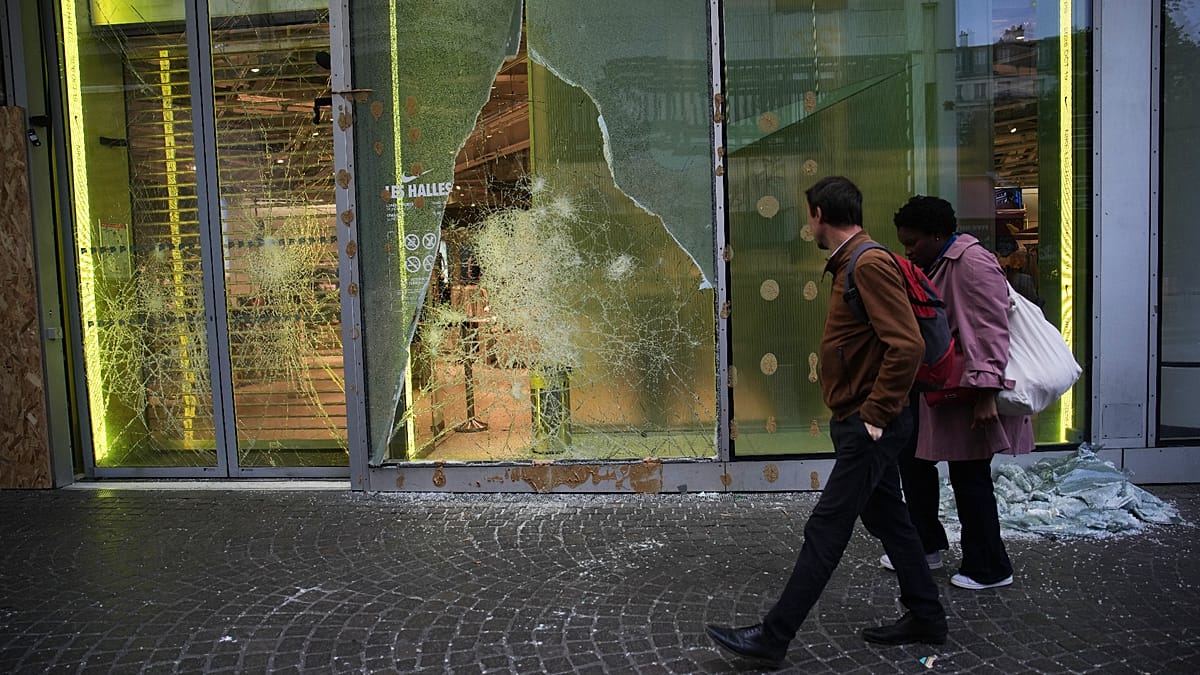
The scale of destruction from France's weekend riots is proving far larger than initially feared. At least 3,000 shops were damaged or looted, according to the government, double the figure cited just a day earlier. The carnage has left insurers facing a hefty bill, though they have yet to put a number on it.
France Assureurs, the country's insurance federation, told European Pulse that its members were "fully mobilised to support affected policyholders." However, it could not provide an initial estimate of losses or say how many claims had been filed. Its crisis team is now coordinating with public authorities across the country following what it described as "extremely violent events."
Markets feel the heat
The financial fallout was immediate. On Monday, France's CAC 40 closed 1.1% lower, underperforming the broader Euro STOXX 600, which fell 0.9%. Carrefour shares dropped 2.2% after the retailer reported damage at 50 stores, including 20 that were looted. Luxury group LVMH slipped 1.8% after a Louis Vuitton boutique in Marseille was broken into.
Insurance stocks also took a hit. AXA shed 1.3% and reinsurer SCOR lost 0.9% in Paris, while in Milan Generali fell 2.3% and Unipol dropped 3.2%. French government bonds came under selling pressure, with the yield on 10-year bonds rising about eight basis points to 4.94%, widening the spread over German bunds to roughly 148 basis points.
A costly precedent
France has a recent benchmark for what such unrest can cost. The riots that swept the country in June and July 2023 resulted in €793 million in insured losses, according to France Assureurs. Insurers handled around 17,000 claims, averaging roughly €46,600 each. Two-thirds of that total—about €523 million—went to shops and business premises, while a quarter went to local authorities whose town halls, schools, and buses were attacked. Cars accounted for the remaining 7%.
Those figures did not capture the full extent of the damage. A subsequent Senate inquiry estimated property damage at closer to €1 billion, as some losses were never declared and others only partly covered. The comparison is particularly relevant now because the number of shops affected appears to be higher. CCI France counted around 2,500 vandalised businesses during the 2023 unrest; this weekend's government tally has already exceeded that.
New riot insurance scheme not yet in force
France sought to address the insurance gaps exposed by the 2023 riots in its 2026 budget law. The legislation makes riot damage cover compulsory in certain property insurance policies and creates a national fund to help insurers absorb major losses. Insurers would finance the fund through contributions of up to 1.5% of relevant premiums, while the state would provide guarantees of up to €4 billion a year.
But the scheme has yet to take effect. It still needs European Commission approval and a government implementing decree. For businesses hit by this weekend's violence, compensation will depend on their existing insurance contracts.
Insurance may cover damage, but what about lost sales?
Most French policies for shops and buildings include "riot and civil commotion" cover, according to France Assureurs. That usually pays for fire, theft, vandalism, and smashed shopfronts, as well as the plywood boards and security guards a gutted store needs in the days afterwards. But lost trade is where many shopkeepers will come up short.
Compensation for a full or partial closure depends on optional business interruption cover. It pays on lost gross profit, not lost sales, and normally only when physical damage covered by the policy forced the shop to shut. Some contracts go further and pay out even if the premises were untouched, but that applies only "in the circumstances expressly specified in the policy," the federation said. Policyholders generally have five days to notify their insurer, and filing a police complaint is a prerequisite for some types of cover.
The state's share of the bill
Prime Minister Sébastien Lecornu said on Monday that businesses hit by the unrest would be able to put staff on activité partielle, France's state-funded furlough scheme, from Tuesday. He also asked local officials to impose targeted curfews, and said a state of emergency would follow "if necessary." President Emmanuel Macron refused the resignation of Interior Minister Laurent Nuñez, as the number of arrests passed 2,400.
Every euro of support lands on a budget expected to post a deficit of 5.4% of GDP this year, with public debt at 119% of GDP. The local curfews are part of a broader effort to restore order, but the economic scars will take far longer to heal. As shopkeepers count the cost, the question of who ultimately pays—insurers, the state, or the businesses themselves—remains unresolved.