Saudi Arabia reported intercepting a fresh wave of Houthi ballistic missiles on Thursday, hours after France pledged to deploy military assets to help protect the strategic Red Sea oil terminal of Yanbu. The attacks, which triggered brief alerts in Mecca, Taif, Jeddah, and Tabuk, mark the latest escalation in a conflict that has drawn in regional and international powers.
The Saudi-led coalition, which has been fighting the Houthis in Yemen since 2015, said its air defences shot down six missiles, thwarting strikes on Taif and Yanbu. Coalition spokesperson Turki al-Maliki said on X that "escalations and violations by the terrorist Houthi militia will be dealt with firmly."
The alerts, issued by the Saudi Civil Defence, were lifted within minutes. In recent weeks, such warnings have often preceded Houthi attacks, which have intensified since a fragile truce collapsed in July, dragging Yemen deeper into the wider Middle East conflict.
Yanbu is a linchpin of Saudi Arabia's energy infrastructure. It serves as the kingdom's primary crude export terminal on the Red Sea and is connected to oil-producing regions near the Gulf coast by the East-West pipeline, known as Petroline. The terminal also hosts major storage and refining facilities, offering an alternative route for crude and petroleum products bound for European markets.
France's military pledge
French President Emmanuel Macron said in an interview with TF1 and France 2 that Paris would "send military assets, meaning soldiers, radars and defence systems to protect" Yanbu. He stressed that the deployment was defensive: "Not to engage in any conflicts but to protect this site."
The announcement underscores Europe's growing concern over the security of Red Sea shipping lanes, which are vital for global energy supplies. France has previously been involved in maritime security operations in the region, and Macron's move signals a more direct role in safeguarding Saudi infrastructure.
The pledge comes amid heightened tensions across the Middle East, with Iran-backed Houthi forces tightening their grip on Yemen's Red Sea coast. Their gains have cemented Tehran's influence over the Bab al-Mandab strait, a chokepoint for oil shipments from the Gulf.
Iranian President Masoud Pezeshkian denied that Tehran was directing Houthi operations. "The Houthis are responsible for their own actions. They don't take directions from us," he told Fox News, according to a translation. "Those who are resisting in the region act based on the situations imposed on them."
Last week, Riyadh accused the Houthis of targeting Mecca for the first time since 2017 with a drone that was shot down, a claim the group denied. Days later, the Houthis struck Riyadh, the first such attack on the Saudi capital in years, marking a significant escalation.
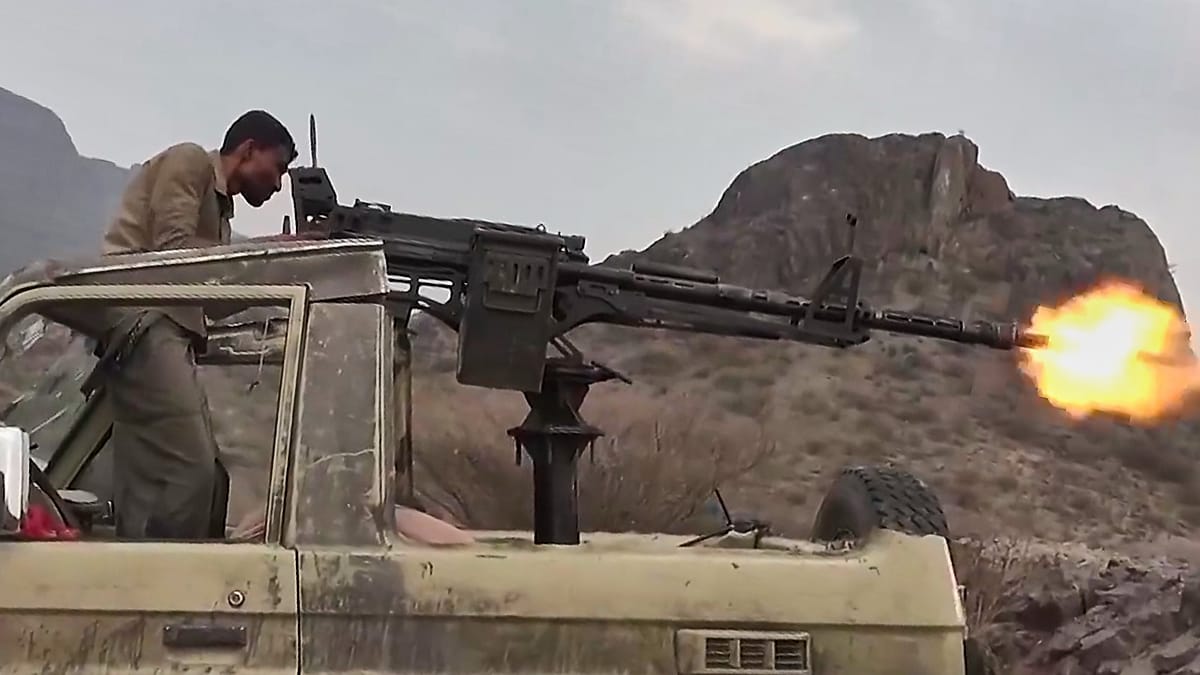
On Thursday, as missiles flew toward Saudi Arabia, fierce ground battles raged in Yemen. At least 150 Houthi fighters and pro-government forces were killed in the previous 24 hours, according to sources on both sides cited by AFP. The fighting centred on hilltops overlooking the Bab al-Mandab strait, where the Houthis are seeking to consolidate control over newly seized territory.
The Houthis claimed a complex barrage of ballistic missiles and drones targeting command centres and weapons depots in southern Saudi Arabia, saying Yemeni and Sudanese fighters were among those killed. They also said they struck Aramco infrastructure in Yanbu and an unnamed site in Riyadh.
At least 52 Houthi fighters were killed in other clashes, according to two sources from the group. Many on both sides died in the Kahboub Mountains and in areas between Lahj and Taiz, as the Houthis push to dominate highlands overlooking the strait.
The escalating violence threatens to destabilise the region further, with European nations watching closely. France's military commitment to Yanbu reflects a broader European interest in maintaining the free flow of energy and preventing a wider conflagration. As Macron has engaged in constructive talks with Washington on Red Sea security, the situation remains volatile.
For now, the focus is on deterrence. But with each new missile and each new casualty, the risk of a direct confrontation between regional powers and their international backers grows. Europe, reliant on Red Sea routes for energy imports, has a vested interest in seeing the conflict contained.