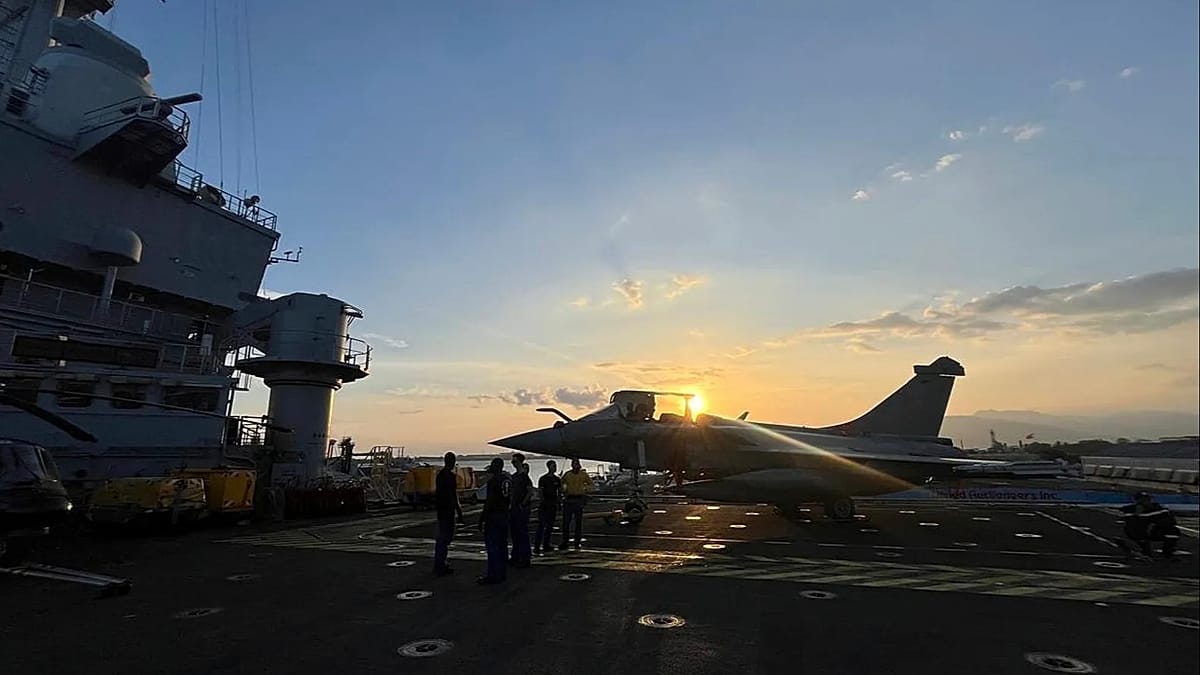
France’s nuclear-powered aircraft carrier Charles de Gaulle and its escort vessels have repositioned south of the Suez Canal, entering the Red Sea as part of preparations for a possible joint mission with the United Kingdom to reopen the Strait of Hormuz. The French armed forces confirmed the move on Wednesday, marking the latest phase of a Middle East deployment announced by President Emmanuel Macron on 3 March, the day before Iran shut the strategic waterway.
The strait, through which roughly one-fifth of the world’s oil normally passes, has been effectively closed to commercial traffic since early March. Iran’s decision followed joint US-Israeli strikes that killed Supreme Leader Ayatollah Ali Khamenei on 28 February. War-risk insurance premiums have since surged four to five times above pre-conflict levels, and an estimated 2,000 vessels remain stranded in the Gulf.
Positioning for a Conditional Operation
Colonel Guillaume Vernet, spokesman for the French armed forces chief of staff, said the southward transit is a new step for the French navy. “Going south of Suez is new for us,” he noted. “Geographically, it’s closer to the Strait of Hormuz and will therefore enable us to react faster, once the conditions are met.”
Vernet stressed that the broader Hormuz coalition—drawn up by France, Britain, and more than 50 nations—will not begin operations until two conditions are satisfied: the threat to shipping must diminish, and the maritime industry must feel confident enough to use the strait again. Even then, any mission would require the consent of neighbouring countries. “Today the Strait of Hormuz is stuck because of the threat and the insurance premiums are so high. Not a single ship will jeopardise their trip or go there,” he said.
The French-British initiative is distinct from “Project Freedom,” the US-led escort mission launched on Sunday, which has already drawn Iranian fire and threats to the 8 April ceasefire. “It’s a mission that is distinct from the US mission,” Vernet said, describing the European-led plan as defensive and consistent with international law.
Macron and British Prime Minister Keir Starmer co-hosted a Paris summit on 16 April with representatives from over 50 countries, and military planners from more than 30 nations later finalised operational details at a UK-hosted conference. “Planning has been done and is ready to go,” Vernet added.
The Charles de Gaulle was ordered from the Baltic on 3 March as part of what France called an “unprecedented” naval mobilisation that also includes eight frigates and two Mistral-class amphibious assault ships. The carrier’s southward move places French air assets within striking range of the strait without entering the Gulf, where the US Navy has maintained a blockade of Iranian ports since 13 April.
France also operates an airbase at Al Dhafra in the United Arab Emirates under a long-standing defence pact with Abu Dhabi. French Rafale fighters based there have been intercepting Iranian drones and missiles over the UAE since the conflict began.
Vernet did not specify a date for the joint operation, saying the carrier was being positioned to be close enough to act if and when the conditions are met. The situation remains fluid, with diplomatic efforts continuing alongside military preparations. For more context on the broader crisis, see our coverage of the US pause on its Hormuz escort mission and Iran’s threats to European military bases.