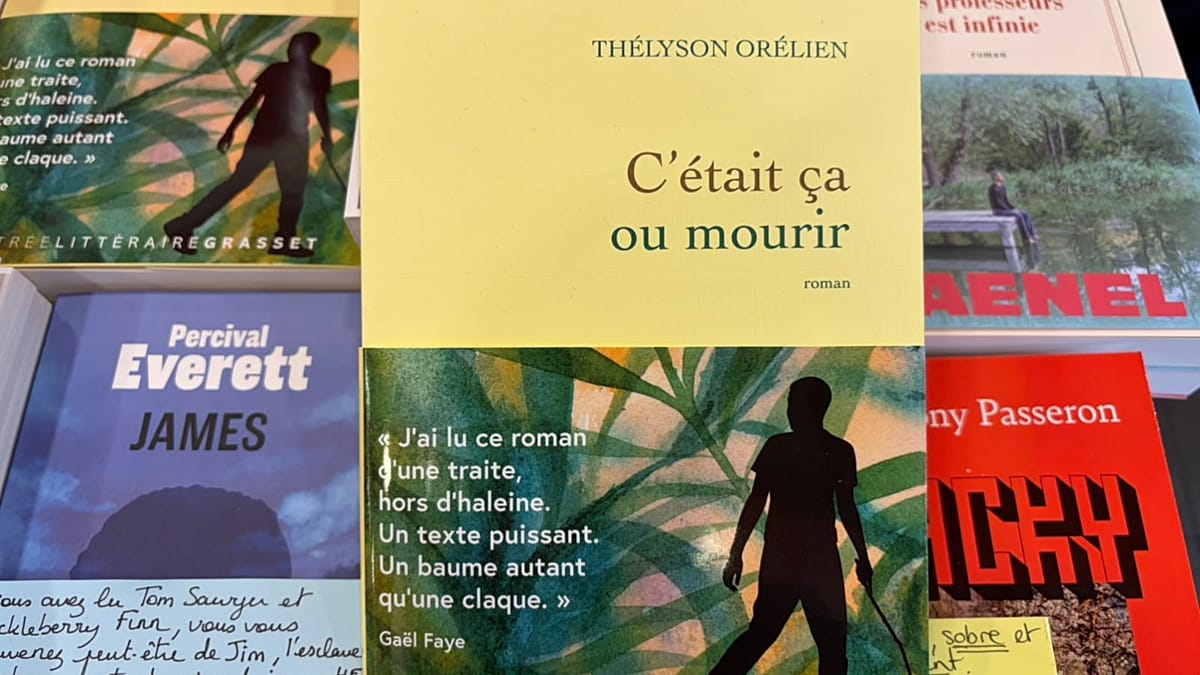
The French literary world is abuzz with controversy as Thélyson Orélien, a Quebec-based writer of Haitian origin, faces accusations that his acclaimed debut novel was largely written by artificial intelligence. The book, C'était ça ou mourir, has been a standout of the autumn publishing season, selling over 35,000 copies and earning a spot on the longlists for several of France's most prestigious literary awards, including the Goncourt, Femina, Médicis, and Renaudot.
The allegations surfaced on 21 September when an anonymous X account, “Balance ton Claude,” claimed that an AI-detection tool called Pangram had analyzed passages from the novel and found them to be “100% AI.” The account asserted that Pangram is “by far the most reliable AI detector,” with a false-positive rate of just 0.0041%. The post quickly went viral, with many users on X—and even some on English-language platforms—treating the accusation as fact.
A novel rooted in Caribbean tradition
Orélien, 38, has firmly rejected the claims. In a statement released through his publisher, Grasset, he explained that the “repetitions” flagged by the detector are actually a hallmark of his Haitian and Caribbean literary heritage, a poetics that draws on orality and rhythm. “People can argue about my style, but turning its devices into proof of artificial intelligence has nothing to do with literary criticism,” he said.
The author also addressed the broader context, telling Libération that he has faced “numerous racist attacks” since arriving in France. In his statement, he thanked readers who “make room in their lives” for his book, adding: “In a world where some people always want to check where you come from before listening to what you say, this welcome moves me deeply.”
Grasset, the prestigious Parisian publishing house, initially dismissed the allegations as “fake news,” noting that AI-detection tools are themselves AI systems that “fantasise that the Bible was written artificially.” The publisher also pointed out that while dozens of AI-written novels are available on Amazon, none have achieved success because they lack distinctiveness—unlike Orélien's work, which they describe as “the exact opposite.”
The controversy has sparked a wider debate about AI in literature. Some commentators, like journalist Jérôme Colombain, questioned the fuss, writing: “I don't understand what would be problematic about using AI to write a book in 2026. Not using it would be the stupid thing.” Others, such as writer François Negroni, who openly uses AI for his own books, argued that detectors like Pangram may be biased against non-standard French. He noted that Orélien writes in a “creolised” French, mixed with Haitian Creole, Spanish, and Portuguese, which could confuse the software.
Christophe Boutry, another writer, acknowledged that bias in AI detectors has been documented for English, but cautioned that it is not yet proven for Pangram's handling of Haitian French. The debate has also drawn attention to the broader issue of AI's role in creative fields, a topic that resonates across Europe as institutions grapple with the impact of technology on cultural production.
This is not the first time Orélien's work has faced scrutiny. Earlier this month, a reader on the book platform Babelio expressed disappointment, claiming the entire book seemed AI-generated, while writer Fabrice Colin pointed to “stylistic tics” and “end-of-chapter aphorisms” that he found off-putting. Yet many critics and readers have rallied behind the author, praising the novel's originality and emotional depth.
The novel follows Jonas, a young Haitian teacher forced to flee his country due to violence, on a journey across the Americas. It was first published in Quebec last winter, and Grasset acquired the rights for French-speaking Europe. Orélien, who previously published poetry, has seen his novel translated into more than 20 languages, a testament to its resonance.
As the literary world watches, the case raises important questions about authorship, authenticity, and the limits of AI detection. For now, Grasset has reaffirmed its “absolute confidence” in Orélien, standing against what it calls “any machine or attempt to measure, standardise or silence writing that is forever free.” The controversy also echoes broader European debates about cultural identity and political tensions, as well as the challenges of maintaining unity in the face of external pressures.