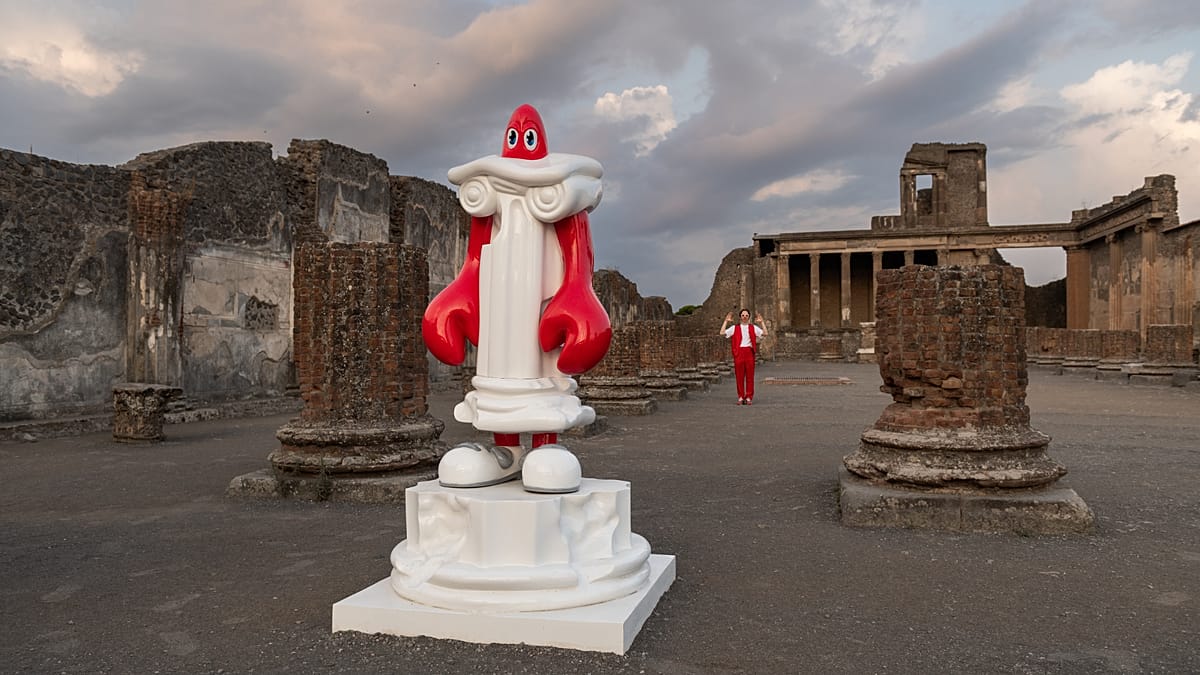
Visitors wandering through the ancient streets of Pompeii this summer might do a double take: towering stainless-steel lobsters now stand among the ruins of Roman villas and temples. The surreal sight is part of Philip Colbert in Pompeii: Pop Mythology, the British artist's largest-ever exhibition, which opened last week at the UNESCO-listed archaeological park.
Colbert, known for his cartoonish lobster alter ego, has installed more than 30 monumental sculptures across the site, from the Forum to the House of the Faun. The exhibition, which runs through October, is the first contemporary sculpture show in Pompeii in three decades and the first time an artist has displayed works inside the ancient city's houses.
A dialogue between past and present
For Colbert, Pompeii is not just a backdrop but a partner in conversation. "Pompeii is, for me, the ultimate city of antiquity — a place that exists beyond time," he said in a statement. "I can't think of a more powerful setting in which to create a sculptural dialogue about time, identity and the ways art can transcend its limitations."
The installation draws direct inspiration from the famous lobster mosaic in the House of the Faun, a 2,000-year-old floor decoration that has long puzzled archaeologists. Colbert's response includes 12 new sculptures created specifically for the site, alongside works that depict futuristic robotic lobster warriors in black steel, which he calls "future mythological relics."
The artist, often described as an heir to Andy Warhol, has staged large-scale public installations in London, Venice, Seoul, Singapore and Shanghai. But Pompeii marks his most ambitious takeover yet, transforming one of Europe's most visited archaeological sites into a pop-art playground.
Rather than treating the ruins as a frozen monument, Pop Mythology presents Pompeii as a living cultural landscape where classical mythology and contemporary visual culture can coexist. Themes of mortality, civilisation, memory and humanity's relationship with technology run throughout the exhibition, inviting visitors to reflect on how societies preserve their histories while imagining their futures.
The project extends beyond the main archaeological park, with sculptures placed at Longola, Boscoreale, Oplontis, Villa San Marco, Villa Arianna and the Real Polverificio Borbonico, creating a contemporary art trail across Campania's most significant ancient sites. The programme also includes workshops with local schools and community associations, aiming to connect the art with the region's residents as much as with international tourists.
Pompeii has been a magnet for cultural experiments in recent years, from restorers reconstructing a frescoed banquet hall ceiling to new visitor routes that link the site with other ancient landmarks. Colbert's lobsters add a playful, provocative layer to that ongoing conversation.
Whether seen as whimsical or thought-provoking, the giant crustaceans offer a striking reminder that even one of history's best-preserved ancient cities can still become a canvas for new artistic narratives. As Colbert puts it, "The ruins of Pompeii embody both tragedy and beauty, and the city itself feels suspended between past and present."
For those planning a visit, the exhibition is a highlight of Europe's top sightseeing stops this summer, and it pairs well with a broader exploration of the region's archaeological treasures, such as the Antikythera mechanism in Athens or the ancient relics emerging from the Danube.