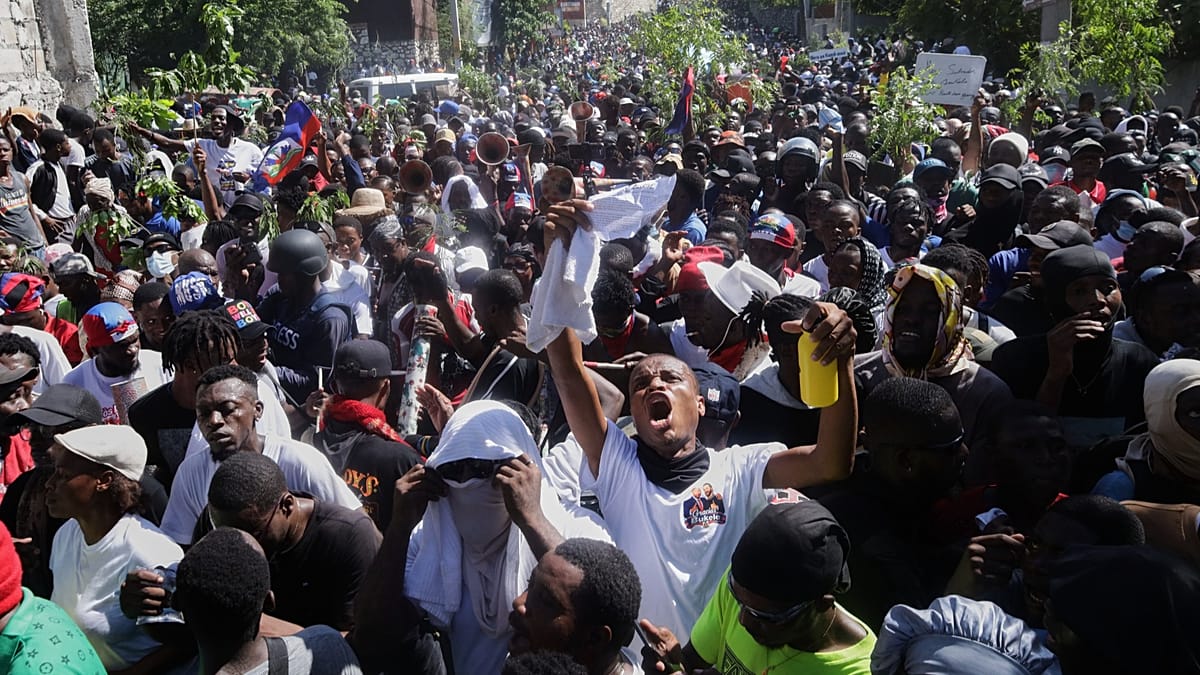
Haiti's government has formally approved a cooperation agreement with El Salvador, deepening a security partnership that has seen Salvadoran troops deployed to Port-au-Prince to combat armed gangs. The announcement came on the same day that thousands of Haitians took to the streets of the capital to express support for President Nayib Bukele and his soldiers.
The Haitian executive announced the decision on Facebook, describing it as "a new stage in strengthening bilateral relations and cooperation." The agreement was approved by the Council of Ministers on Tuesday.
Photographs from an AFP journalist showed demonstrators carrying signs reading "Thank you, Bukele" and "Long live Bukele." Some chanted "Bukele, the country belongs to you! Do whatever you want with it," reflecting the desperation of a population long subjected to gang violence that controls large parts of the capital.
Bukele has sent more than 2,000 troops to Haiti since late October, following the disappearance of four Salvadoran soldiers during a mission with the UN-backed Gang Suppression Force (GSF). The new deployment operates separately from the GSF but has been welcomed by Haitian authorities, who have repeatedly asked for reinforcements.
Mixed signals on coordination
Multiple armed forces are now active in Haiti, including the national police and army, the multinational GSF, foreign mercenaries, and the newly arrived Salvadoran contingent. The level of coordination between these groups remains unclear, raising concerns about overlapping mandates and potential friction.
Bukele, whose aggressive crackdown on gangs at home has earned him popularity but also accusations of human rights abuses, appears to be expanding his role in Haiti. On 10 November, he announced the destruction of the "headquarters" of one of Haiti's main gangs, posting video footage of a helicopter attack. Since then, his forces have taken over a football stadium in the capital with the support of Haiti's national police.
The Office of the UN High Commissioner for Human Rights on Tuesday called on all security forces to protect civilians and to use lethal force only as a last resort. The appeal comes amid a mounting toll: in the first ten months of 2026, the UN recorded 4,595 deaths and 2,050 injuries from armed violence in Haiti.
Support beyond the streets
Support for Bukele extends beyond Port-au-Prince. In Miami, home to a large Haitian diaspora, fans at a CONCACAF Nations League match between Haiti and the United States waved Salvadoran flags and chanted "Bukele! Bukele!" despite Haiti's 6-0 defeat.
"All I can say is 'Viva Bukele!'," said Guito Ledix, a 41-year-old Haitian fan. "He is the only one trying to see if there's any possibility of getting rid of the gangs."
Stephanie Jeanty, a 28-year-old Haitian living in Miami, worries about her family still in Haiti. "Before I was a bit more stressed, but now, seeing the Salvadoran delegation that is working to restore peace, it's something, things are better," she said. "I would really like to go back to my country. For now, no."
Haiti, the poorest country in the Americas, has been mired in a deep political and security crisis for years. Gangs have seized control of much of the country through a campaign of murder, kidnapping, and rape. The arrival of Salvadoran troops has offered a glimmer of hope for some, but the long-term effectiveness of the mission remains to be seen.
As Europe watches these developments, the situation in Haiti underscores the challenges of international security cooperation in fragile states. The EU has its own debates about security partnerships, as seen in Europe asserting its own role in shaping continental security and US push to expand AI alliance into security pact meets EU resistance. The Haitian case offers a stark reminder of the human cost when security vacuums persist.