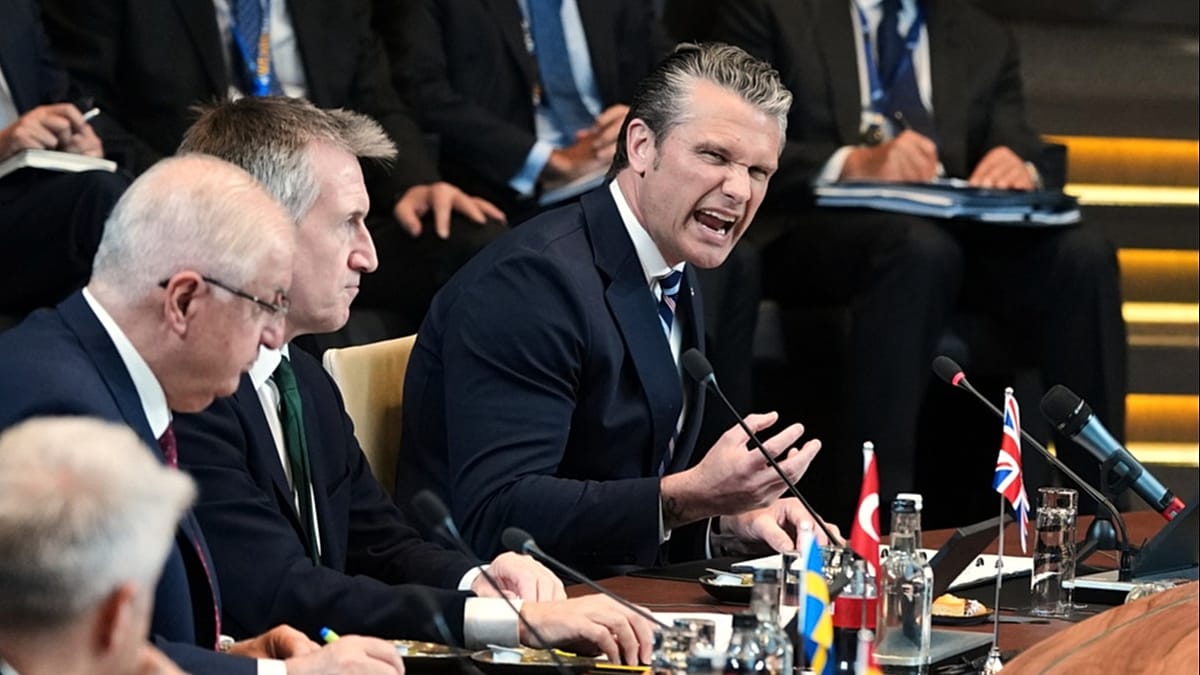
US Defence Secretary Pete Hegseth stunned NATO allies on Thursday by announcing a six-month Pentagon review of American forces stationed across Europe, the outcome of which will hinge on how quickly European nations assume primary responsibility for their own security. The move, delivered during a rare appearance at NATO headquarters in Brussels, adds fresh uncertainty to transatlantic relations already strained by President Donald Trump’s confrontational approach.
Hegseth made clear that the review is not merely procedural. “This will be a real review. It will be designed to ensure that NATO is moving fast and irreversibly toward Europe leading, stepping up to take primary responsibility for the defence of Europe,” he told defence ministers gathered in the Belgian capital. He added that “some countries will fail and others will pass with flying colours.”
The announcement follows months of contradictory signals from Washington about the size and purpose of the US military footprint in Europe. Troop reductions have already begun in Germany, Spain and Italy after earlier clashes between Trump and those countries’ leaders. The Pentagon has also threatened to annex Greenland, a semiautonomous territory belonging to NATO ally Denmark, further unsettling European partners.
In a speech that drew sharp contrasts with the alliance’s traditional consensus-building style, Hegseth lambasted European allies for what he called a misplaced focus on “gender equity and climate change” instead of tanks, fighters and air defences. “Europe’s borders flew wide open, welfare states expanded, defence budgets cratered, along with Europe’s belief in itself and its civilisation,” he said, echoing the rhetoric of Vice President JD Vance from a year earlier.
Hegseth also criticised allies for denying US forces predictable access to bases and overflight rights for operations against Iran, calling it “shameful” and a risk to American lives. “These allies put America’s sons and daughters at risk by denying them the predictable access, basing and overflight that never should have been in question at all,” he said. The review will assess whether the US has full access “when we need it.”
European Reactions and the Path Ahead
German Chancellor Friedrich Merz acknowledged that allies have long anticipated a US drawdown. “We know that we must do more and we are doing it,” Merz said, reflecting a growing consensus among European capitals that the continent must bolster its own defence capabilities. NATO Secretary-General Mark Rutte sought to deflect the criticism, as reported in Rutte Deflects Hegseth's Scathing Critique of NATO Allies, emphasising progress on burden-sharing.
Hegseth did not stay for the full meeting, departing before Ukrainian President Volodymyr Zelenskyy arrived to press allies for more weapons. Zelenskyy’s visit, part of a broader push for commitments on air defence and sanctions, underscores the high stakes for Ukraine as European security architecture faces its most serious test in decades. The Ukrainian leader’s agenda in Brussels is detailed in Zelenskyy Arrives in Brussels with New G7 Commitments on Air Defence and Sanctions.
Speaking to reporters at Brussels airport before flying home, Hegseth claimed the meeting was productive. “It was great to hear country after country say, ‘We’re going to meet our target. We’re going to meet our target.’ There are still a few outliers, and we will be clear with them as we do this review.”
The review’s outcome will be closely watched in European capitals, particularly ahead of a scheduled NATO leaders’ summit in Turkey early next month. The uncertainty created by Hegseth’s remarks may complicate efforts to present a united front, even as European nations accelerate their own defence investments. The broader context of shifting US priorities is explored in Hegseth: Europe Must Lead on Building 'NATO 3.0' as US Shifts Focus.
For now, European allies face a stark choice: accelerate defence spending and integration, or risk a significant reduction in the American military presence that has underpinned continental security for seven decades. The coming months will test whether the EU’s twenty-seven member states, along with the UK, Switzerland, Norway and the Balkans, can translate political will into concrete capabilities.