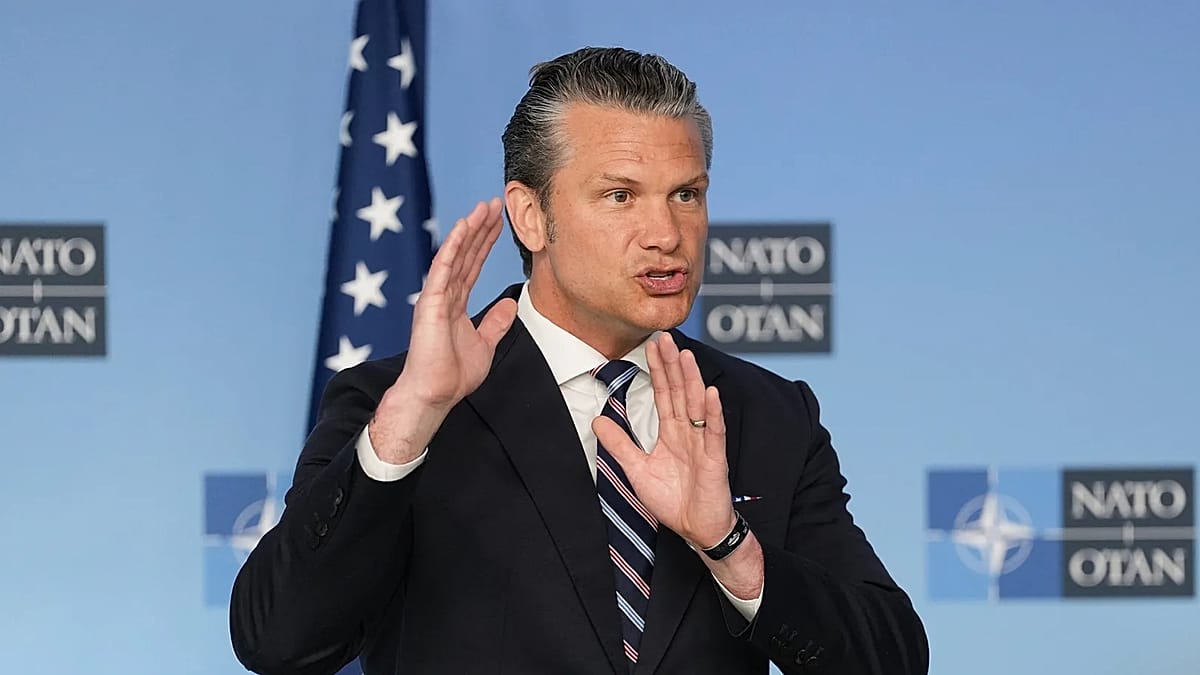
NATO Secretary General Mark Rutte sought to defuse tensions after US Secretary of War Pete Hegseth launched a blistering attack on European allies during a defense ministers' meeting in Brussels. Hegseth accused countries like Spain, Italy, and France of being 'shameful' for refusing to grant the US military access to bases and airspace for operations in Iran, and warned that Washington would reassess its troop deployments in Europe within six months.
Hegseth outlined what he called 'NATO 3.0,' a revamped alliance framework that ties US financial contributions directly to allies' progress toward the 5 percent of GDP defense spending target agreed at last year's summit. 'Our annual NATO dues will be contingent on other countries meeting their defence spending targets,' Hegseth said on Thursday. 'Where other allies do not spend with urgency our due contributions will go down.' He also cautioned that the US would be monitoring laggards closely.
The Pentagon chief's remarks came amid broader US frustration with Europe's reluctance to join the Iran conflict. While Germany granted full access to Ramstein Air Base, Chancellor Frederic Merz's public criticism of the war strategy as 'ill-conceived' prompted President Donald Trump to announce the withdrawal of 5,000 US troops from Germany. The White House had earlier signed a memorandum of understanding aimed at ending hostilities in Iran, raising hopes for a thaw, but Hegseth's speech dashed any optimism.
Hegseth's Broader Critique of European Society
Echoing Vice President JD Vance's earlier condemnations, Hegseth accused Europe of prioritizing climate change and gender equality over defense, and blamed immigration for what he termed a 'civilisational collapse.' 'Instead of tanks and fighters and air defences, the focus has been on gender equity and climate change and defence austerity,' he said. 'Europe’s borders flew wide open, welfare states expanded, defence budgets cratered. Along with Europe’s belief in itself and its civilisation.'
Rutte, in a press conference after the meeting, attempted to reframe the confrontation as constructive. He noted that Hegseth had acknowledged allies' increased spending—over €90 billion in extra defense outlays in 2025 alone—and argued that the US pressure was beneficial. 'But you’ll still find some allies holding back a bit, and what [Hegseth] tried to do today was keep the pressure on, and that’s good,' Rutte said. 'I’m happy he does this, because we need to speak the truth to each other.'
Behind the scenes, NATO officials and member states widely interpret the US moves as punitive, aimed at punishing Europe for its lack of support over Iran. In recent weeks, Washington informed allies it would restrict access to key wartime capabilities through NATO's Force Model, including deep strike assets like B-2 and B-52 bombers, as well as naval assets such as missile-launching submarines and aircraft carriers, redirecting them to other theaters.
The episode underscores a deepening rift within the alliance, even as European nations grapple with their own security challenges. For instance, Ukraine continues to strike Russian oil infrastructure, while Russian drone attacks intensify on Kharkiv, highlighting the ongoing need for robust NATO coordination. Meanwhile, misinformation campaigns targeting European leaders further complicate the political landscape.
Rutte is expected to travel to Washington soon to mend ties ahead of the July summit in Ankara, but the path to reconciliation remains uncertain. Hegseth's speech has left European allies questioning the reliability of US commitments, even as they scramble to meet the 5 percent spending target by 2035.