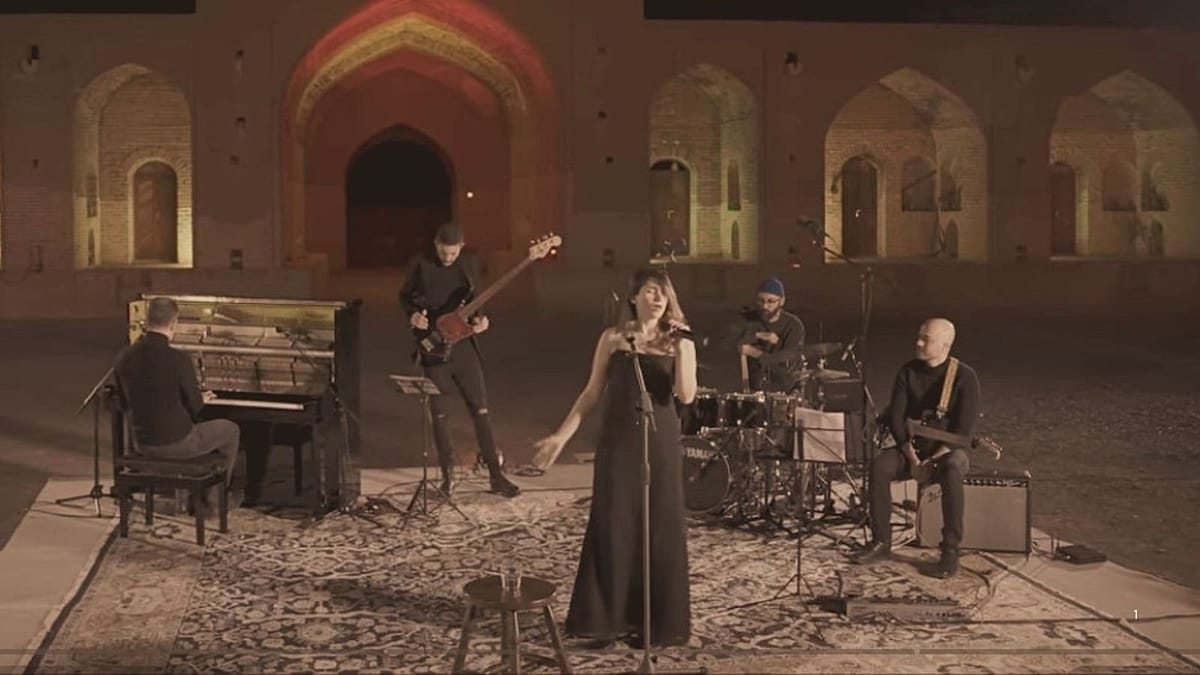
Iranian authorities have carried out flogging sentences against pop singer Parastoo Ahmadi and four members of her concert team, her lawyer confirmed on Monday. The punishment stems from a December 2024 performance near the holy city of Qom, in which Ahmadi sang without a hijab in a venue with no live audience.
Lawyer Mostafa Nili told the Emtedad news channel that the Qom prosecutor's office enforcement team administered the lashes to Ahmadi in the early hours of Monday. The same day, band members Sohail Faghih-Nasiri, Amin Taheri, Amirali Pirnia, and concert organiser Mohsen Lashkari were also flogged, Nili said.
A criminal court in Qom province had sentenced nine members of the concert team to 74 lashes each, a two-year ban on leaving the country, and a two-year ban on artistic activity. The judiciary also sealed off the Deyr Gachin Caravanserai, the historic venue where the concert took place.
A concert without an audience
Ahmadi performed at the caravanserai on the evening of 11 December 2024, with no audience present. The performance was streamed live on YouTube and attracted around three million views in the following days. Ahmadi described it as a “hypothetical concert,” writing on her YouTube channel: “I want to sing for the people I love. This is a right that I could not give up, that is, singing for the land that I love passionately.”
The court charged the group with “offending public decency by producing and disseminating vulgar and immoral content online.” Under Islamic Republic law, women are banned from singing in public spaces where men are present. Although criminal law does not explicitly criminalise women's singing, female performers often face charges of encouraging corruption and prostitution, failing to observe hijab, or offending public decency.
Authorities have used such charges in recent years to shut down many Instagram accounts belonging to Iranian female singers. Appearing in public without a hijab is punishable by between ten days and two months in prison, up to 74 lashes, or a fine.
International condemnation
Amnesty International called in June for the sentences to be quashed, describing flogging as “a cruel, inhuman and degrading punishment” that violates the absolute prohibition on torture and other ill-treatment. The organisation urged Tehran to abolish compulsory veiling and corporal punishment and to end the criminalisation of freedom of expression.
The sentences against Ahmadi and her collaborators stand in stark contrast to scenes from pro-government rallies held during US and Israeli military strikes on Iran earlier in 2026, when images circulated widely showing women at the gatherings without mandatory hijab. A performance by Lebanese singer Julia Boutros was also broadcast at a pro-government gathering in Tehran, where Boutros also did not wear a hijab.
This case also echoes the broader crackdown that followed the Woman, Life, Freedom protest movement in 2022, which erupted after the death of Mahsa Amini, a 21-year-old who died in custody of Tehran's morality police. Ahmadi had performed the protest song “Az khun-e javanan-e vatan” (“From the blood of the nation's youths”) during that period. After it was widely shared on social media, her home was searched by security forces and she was ordered to report to the security prosecutor's office in Tehran.
The flogging of Ahmadi and her colleagues highlights the continued enforcement of strict dress codes and artistic censorship in Iran, even as authorities appear to tolerate violations at regime-organised events. The case has drawn attention from human rights groups and international observers, who see it as part of a wider pattern of repression against artists and women.