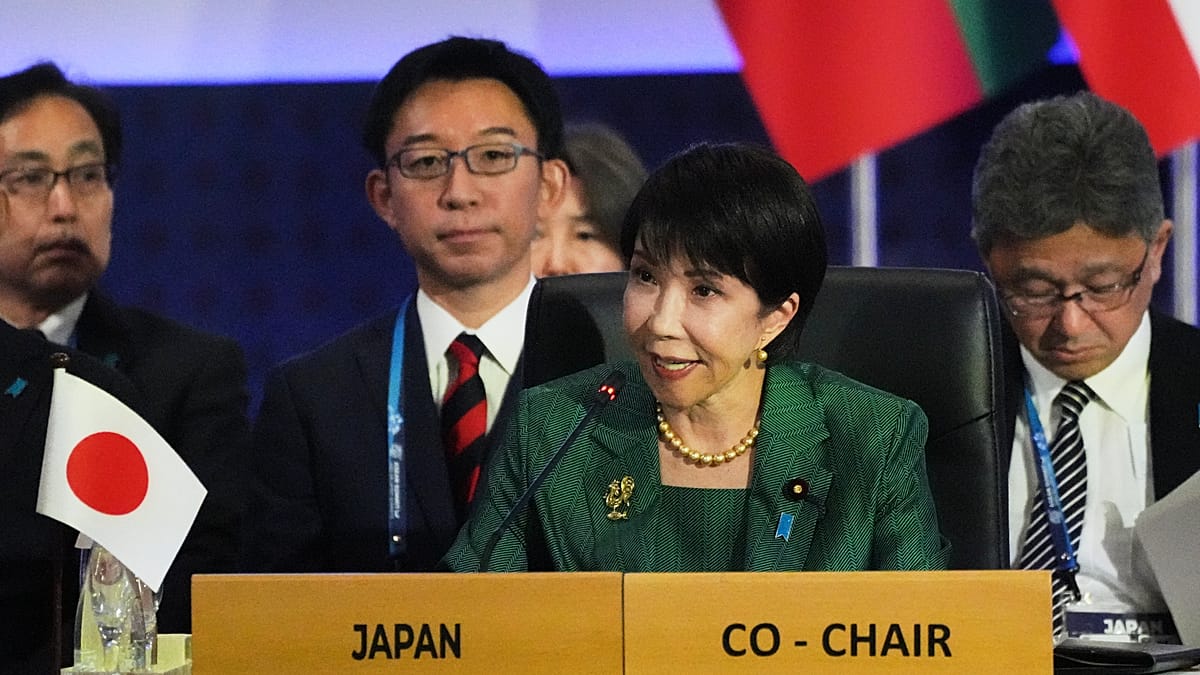
Japan has moved to shore up energy security across Asia by launching a regional task force aimed at helping countries build emergency oil reserves and coordinate joint responses to supply disruptions. The initiative, announced by Prime Minister Sanae Takaichi at the Asia Zero Emission Community leaders' meeting in Manila, comes as the Iran war continues to interrupt shipments from the Gulf.
The task force, established jointly with the International Energy Agency (IEA), will work with the Economic Research Institute for ASEAN and East Asia to assess reserve levels and explore how countries could synchronise their responses to shortages. Tokyo has also proposed using unused storage tanks, including those at closed refineries, to hold reserves for other Asian nations, creating a network of shared oil storage across the region.
According to the IEA, roughly a quarter of the world's seaborne oil trade passed through the Strait of Hormuz in 2025, with about 80% of those shipments heading to Asia. The disruption has pushed import-dependent economies to reconsider their vulnerability to supply shocks.
An 'Asian version of the IEA'
Japan and the IEA have also outlined plans for an oil security centre in Tokyo, supported by the agency's teams in Paris and Singapore. The centre would help countries develop storage systems, share market intelligence, and prepare for emergencies. "We would like to position this as an Asian version of the IEA," Takaichi said.
The IEA coordinates emergency oil releases among its members, and countries such as Japan are required to hold stocks equivalent to at least 90 days of net oil imports. In response to the Iran war, IEA members agreed on 11 March to release 400 million barrels from their emergency reserves, the largest coordinated release in the agency's history.
The move reflects a broader trend of energy security becoming a priority for Asian economies, many of which have limited domestic production and rely heavily on Gulf imports. For Europe, the developments are a reminder of the interconnected nature of global oil markets, as disruptions in one region can quickly affect prices and supply chains across the continent.
Singapore, Indonesia, and Malaysia have expressed support for the storage proposal, according to Cristina Roque, the Philippines' trade secretary. The United Arab Emirates has also shown interest in storing oil in countries with available facilities, she added. However, arrangements that would allow countries to draw on one another's reserves have yet to be agreed.
Japan and the Philippines have signed a three-year agreement to help Manila develop its own emergency oil reserves, covering cooperation on storage facilities, financing, and rules for managing and releasing supplies. The bilateral deal is seen as a model for wider regional cooperation.
Analysts note that the task force could also complement efforts to diversify energy sources, including Japan's push into advanced aviation technology and broader investments in clean energy. Yet oil remains a critical part of the energy mix for most Asian economies, and the immediate focus is on ensuring reliable access.
The initiative comes as global markets remain volatile, with the tech-driven sell-off adding to economic uncertainty. For European readers, the story underscores how geopolitical shocks in the Gulf can have ripple effects on energy prices and industrial competitiveness across the continent.