From the Alpine passes of the Great St Bernard to the volcanic uplands of Lazio, five of Europe's most significant walking routes traverse Italy, each certified by the Council of Europe. Known collectively as the Antichi Cammini d'Italia, these paths are not merely trails but living arteries of European history, faith, and identity. And, as the saying goes, all roads lead to Rome.
This gravitational pull toward the Eternal City is nothing new. For over a millennium, pilgrims from England, Germany, the Baltic states, and across the Mediterranean have walked these routes, carrying ideas, trade, and cultural exchange. Today, the same ancient roads remain waymarked and walked, offering a profound alternative to modern travel.
Slow travel—the philosophy that the journey itself matters as much as the destination—has become one of the fastest-growing segments of cultural tourism in Europe. Italy, with its five transnational routes, makes a compelling case for being the continent's premier walking destination. As Europe claims all top 10 spots in the 2026 Global Walking Cities Ranking, these ancient paths stand out for their historical depth and scenic variety.
The Via Francigena: A Medieval Archbishop's Blueprint
The Via Francigena, or 'the road from France,' is the most internationally recognized of the five. Certified as a Council of Europe Cultural Route since 1994, it follows the travel diary of Sigeric, Archbishop of Canterbury, who in 990 AD recorded every stage of his return journey from Rome to England. More than a thousand years later, walkers cover the same ground. Within Italy alone, the route spans 1,000 kilometers across 45 stages, from the Great St Bernard Pass through Aosta Valley, Piedmont, Lombardy, Emilia-Romagna, Liguria, Tuscany, and into Lazio. The final stages follow ancient Roman roads into the capital, ending at St. Peter's Basilica.
The Via di Francesco: In the Footsteps of a Saint
Few figures are as tied to landscape as Francis of Assisi (1182–1226). The route that bears his name, the Via di Francesco, traces the ground he knew best. Running in two directions, both ending in Assisi, the Southern Way is slightly longer—300 kilometers in 13 stages from Rome, through the Sabine countryside and the Rieti Holy Valley. Four sacred sites connected to Francis's life mark key stops, including Greccio, site of the world's first nativity scene from 1223. Those who complete the full route receive the Testimonium at the Basilica of Saint Francis in Assisi.
The Cammino di San Benedetto: Silence and Stone
The Cammino di San Benedetto, or the Way of Saint Benedict, is perhaps the least-known of the five internationally. Benedict of Norcia, the Father of Western Monasticism, left his mark on three places in central Italy: Norcia, where he was born around 480 AD; Subiaco, where he lived for over thirty years and founded thirteen monasteries; and Montecassino, where he established the abbey that bears his order's name. The route links all three, roughly 300 kilometers in 16 stages through Umbria and Lazio. It features unspoilt landscapes, including Subiaco, where the Abbey of Santa Scolastica housed Italy's first printing press in 1465. Benedict has been Patron of Europe since 1964. For walkers seeking solitude, this is arguably the most compelling of the five.
The Romea Strata: Italy's Newest and Most Ambitious Route
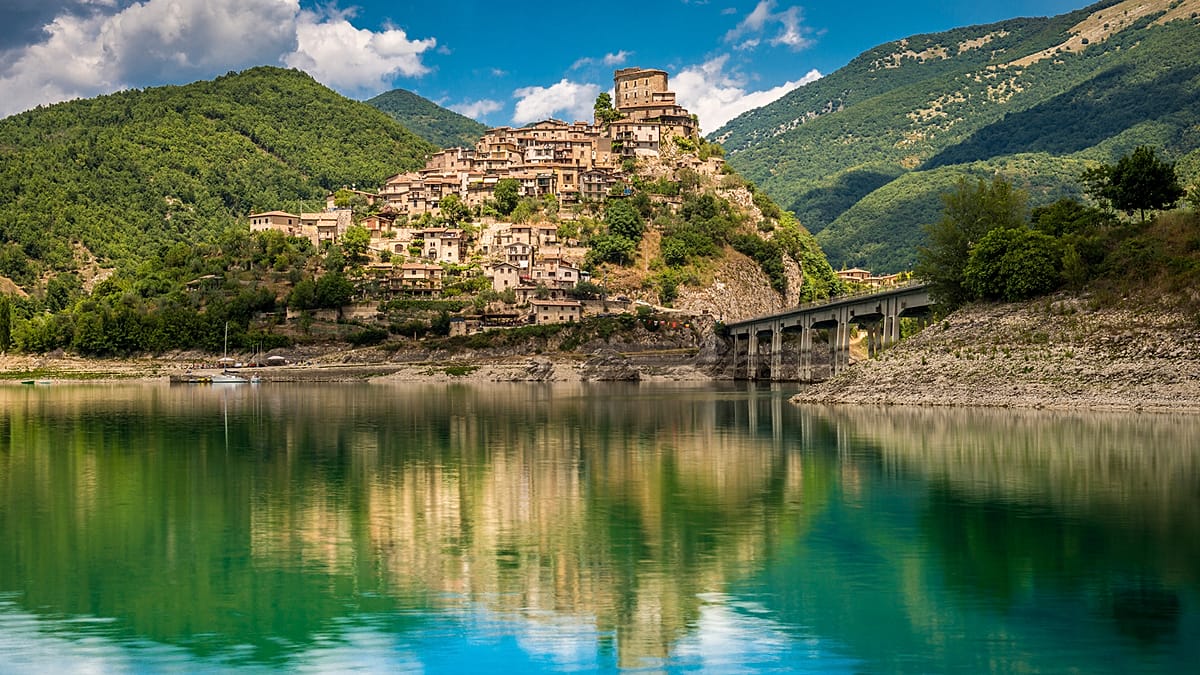
The Romea Strata is the most recently certified, receiving its Council of Europe designation on 17 June 2025. It has the largest footprint: more than 4,000 kilometers across seven countries (Italy, Austria, Czechia, Poland, Lithuania, Latvia, and Estonia), 245 stages, and over 50 UNESCO sites. This route reconstructs the web of roads that once carried pilgrims from the Baltics to Rome. The main Italian section is approximately 1,000 kilometers, divided into 47 stages from Tarvisio to Lazio. In its final approach, it joins the Via Francigena and shares its closing passage to Rome through the Tuscia of Viterbo, the volcanic uplands north of the capital that feel worlds away from the city below.
The Via Romea Germanica: A Medieval Abbot's Road
The Via Romea Germanica has one of the great origin stories in European walking. Its route is based on a journey recorded by Abbot Albert of Stade in his Annales Stadenses of 1236, a medieval itinerary that still holds up across some 2,200 kilometers from Stade in northern Germany to Rome. The Italian section enters at the Brenner Pass and descends for around 1,050 kilometers before joining the Via Francigena near Montefiascone. This route offers a deep dive into the heart of Lazio, passing through landscapes shaped by volcanic activity and centuries of pilgrimage.
These five routes, each with its own character and history, collectively offer Europe's ultimate slow travel experience. They invite walkers to step back in time, to move at a human pace, and to rediscover the continent's shared heritage. As short-haul summer travel surges across Europe, these ancient paths provide a sustainable, immersive alternative to crowded tourist hubs. Whether following the footsteps of saints, abbots, or archbishops, the Antichi Cammini d'Italia remind us that the journey itself is the destination.