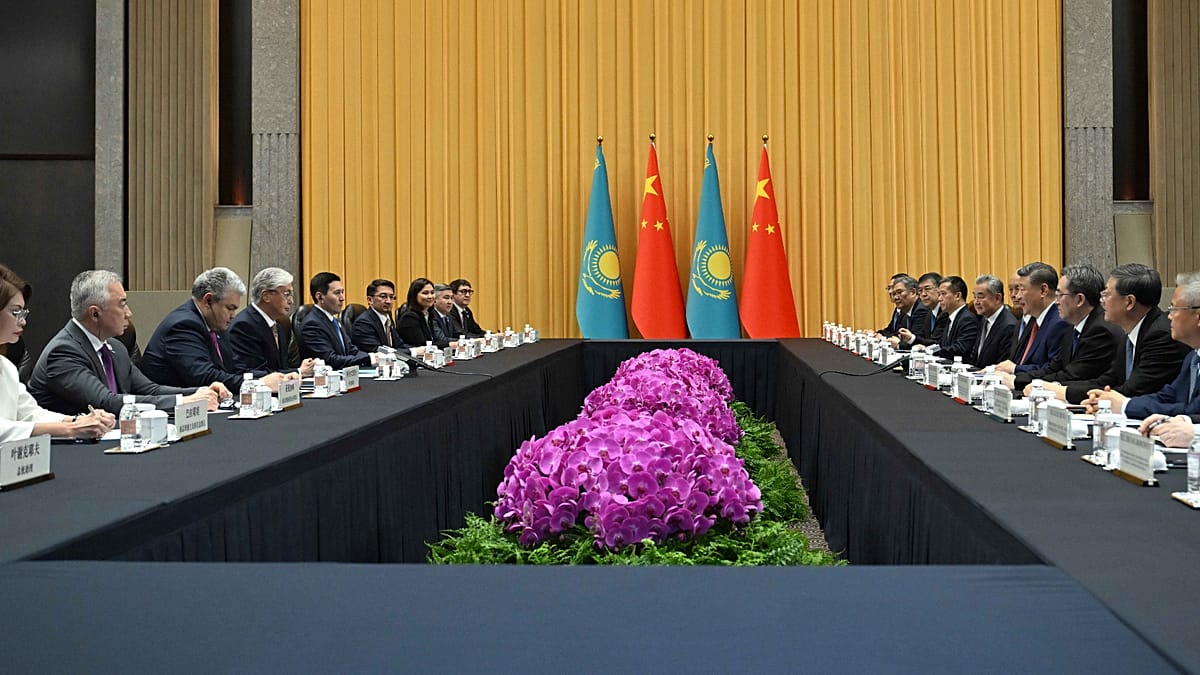
When Kazakhstan's President Kassym-Jomart Tokayev visited China in late June, the headlines focused on the numbers: more than 70 commercial documents worth over $15 billion (€13.2 billion), a record bilateral trade of €42.9 billion in 2025, and cumulative Chinese investment of €26.3 billion. Yet beneath the familiar statistics, analysts detected a qualitative shift in how Astana is positioning itself — not merely as a supplier of oil, metals, and uranium, but as a full-cycle economic platform for the new economy.
The two sides signed a programme for trade and economic cooperation through 2030, which Tokayev called the start of a new “golden 30 years” of relations. Alongside it came agreements spanning battery production, artificial intelligence, and logistics. The All China Review notes that Kazakhstan now accounts for over a third of all Chinese investment in Central Asia, with 8,500 Chinese-owned companies operating in the country. Some 62 joint projects worth €7.6 billion have been completed, creating 11,000 jobs; another 55 projects worth €11.8 billion are in development.
From Raw Materials to Integrated Chains
For two decades, China came to Kazakhstan primarily for oil, metals, and uranium, as well as transit routes. During the Shanghai meetings, Astana presented itself as an infrastructure platform for the new economy — a hub that can house entire processes from mineral extraction to final high-tech products and logistics for distribution to distant markets. This is a different level of positioning, one that elevates traditional trade to building complementary chain economies.
The most telling deal was the confirmation by Contemporary Amperex Technology Co Limited (CATL), the world leader in car battery production, to build a car battery plant in Kazakhstan. It should be the largest such operation in Central Asia. What made the agreement significant, analysts say, is not just CATL's expansion beyond its existing plants in Germany and Hungary, but the scope of the operation. Tokayev proposed a full cycle — from minerals and ore processing to final production — something neither the German nor Hungarian plants do.
“This is where the line between the two models lies,” wrote RD Media, a Kazakh portal. “A 'battery plant' can mean assembling modules from imported cells, or it can mean producing the cells themselves, cathode and anode materials, and chemically processing minerals. The economic value of these differs dramatically. With the assembly model, Kazakhstan gains jobs and a tax base, but the added value and technology remain with the supplier. A full cycle — with raw material processing, material production, and engineering expertise — establishes the industry itself in the country, while assembly leaves only a platform.”
The logic is coherent: critical minerals fuel battery production; batteries are used in electric vehicles and energy storage; energy supplies data centers; data centers host AI computations; logistics corridors deliver products to foreign markets. Kazakhstan has or is about to have all the elements.
Why Beijing Is Accommodating This Approach
In the past, China might have been wary of losing added value and displacing its own economy. But circumstances have changed. Domestic consumption is falling, and demand for Chinese goods in the US dwindled after President Donald Trump imposed tariffs. Chinese companies exported €113 billion ($130 billion) less goods to the US in 2025 than the year before. The solution has been focusing on other markets: South-East Asia, Africa, Europe, and Central Asia. The shift paid off, with massive demand for affordable Chinese products emerging in countries seeking to restrain inflation.
For Europe, the implications are twofold. First, Kazakhstan's emergence as a full-cycle hub could reshape supply chains for critical minerals and batteries, potentially offering European companies an alternative to Chinese-dominated processing. Second, as China deepens its economic footprint in Central Asia, EU policymakers — already debating how to respond to Beijing's influence — will need to weigh the benefits of cooperation against strategic concerns. The Franco-German push for a joint stance on China trade and the EU's labelling of China as a critical long-term strategic challenge suggest the bloc is watching closely.
Kazakhstan's pitch is not just about batteries. It is about positioning itself as a node in the global economy that can offer Chinese investors full service — from raw materials to final products to logistics — while capturing added value. Whether this model succeeds will depend on execution, but the direction is clear: Astana is no longer content to be a raw-material supplier. It wants to be a manufacturing and logistics hub for the 21st century.