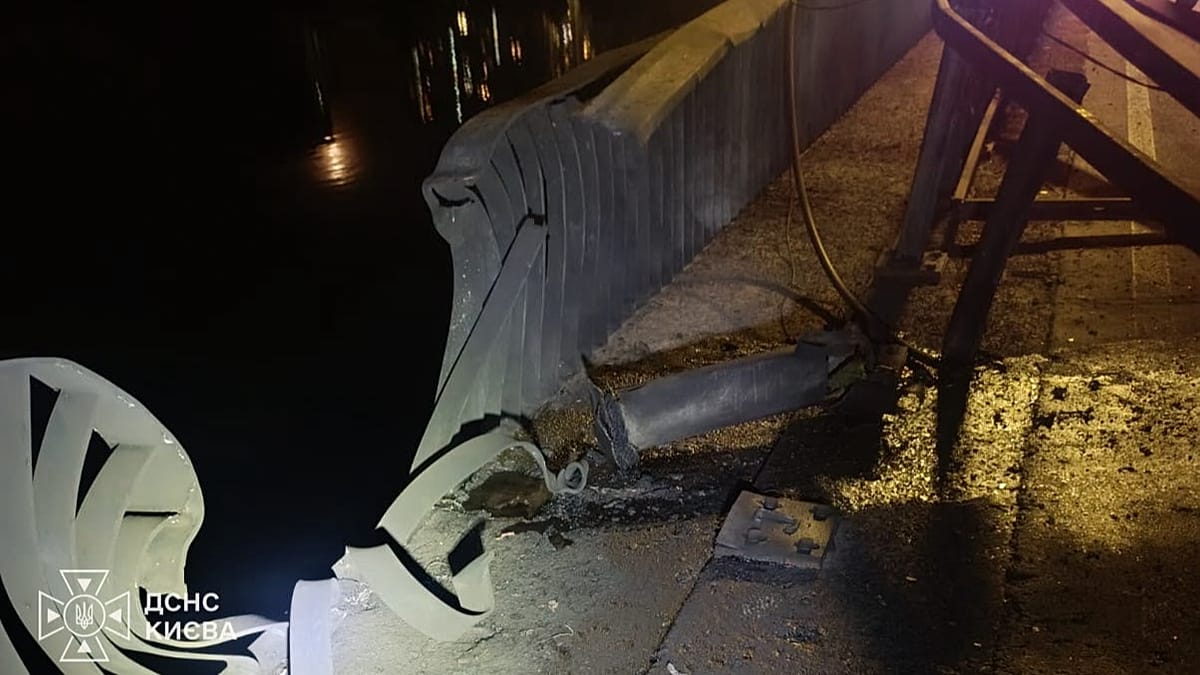
Kyiv woke up to a city in gridlock on Friday after one of its main bridges over the Dnipro River was shut down following another night of Russian drone attacks. The Southern Bridge, a vital artery connecting the capital's eastern and western banks, was closed in both directions, leaving commuters stranded in long queues of cars and buses on main roads.
Mayor Vitali Klitschko said the Paton Bridge, further north, remained open in one direction only, though there were no reports of it being hit. The closures came after Russian drones struck the Southern Bridge's support structures on Thursday, forcing a temporary shutdown while engineers assessed the damage. The bridge reopened briefly, but further strikes overnight and into Friday morning damaged a pier, the road surface, and a protective concrete barrier along the subway line, Klitschko said.
Ukraine has long feared attacks on its major transport links since the full-scale invasion began in February 2022. The Southern Bridge is one of eight crossings over the Dnipro in Kyiv, and its closure has a ripple effect across the city's already strained infrastructure.
Daily life under aerial threat
Kyiv has faced intensifying aerial bombardment in recent months, with air raid sirens sounding almost around the clock. The city's estimated 3 million residents have grown accustomed to frequent shelter alerts, but the repeated strikes on transport infrastructure are taking a toll on daily life. Trains and petrol stations have also been hit, further disrupting movement.
Friday's attacks killed one person and wounded at least two others when a 25-storey residential building in southeast Kyiv was struck. Firefighters found the victim as they battled the blaze caused by the blast.
President Volodymyr Zelenskyy used the occasion to renew his appeal to international partners, urging them to tighten sanctions to prevent Russia from manufacturing its new jet-powered drones. These faster, harder-to-intercept weapons are, in his words, "critically dependent" on foreign components.
"Every Russian drone can actually be stopped right at the production line," Zelenskyy wrote on social media. "What is needed is the political will of these countries. If the Kremlin has chosen more strikes, sanctions must work and must be strengthened."
The call comes as European allies debate how to respond to Russia's escalating tactics. The EU recently closed Ukraine's 2026 funding gap after weeks of negotiations, but questions remain about the bloc's long-term commitment to Kyiv's defence.
Ukraine has also been showcasing its own innovations in counter-drone technology. At a recent expo in Tallinn, Ukrainian firms displayed new interceptors and electronic warfare systems, some of which Kyiv has offered to share with allies. The offer, made by military intelligence chief Kyrylo Budanov, reflects Ukraine's growing expertise in a domain where it has been forced to adapt quickly.
For now, the immediate challenge is keeping Kyiv moving. Engineers are working to assess the structural integrity of the Southern Bridge, but no timeline has been given for its reopening. In the meantime, residents are finding alternative routes, and the city's metro is running extra services where possible.
The attacks are a stark reminder of the war's impact on civilian infrastructure, and of the broader European stakes. As winter approaches, Ukraine's energy grid is already under strain, and the recent Russian strikes on power stations have raised fears of a difficult season ahead. The closure of a key bridge only adds to the sense of a city under siege, yet Kyiv's resilience remains evident in the daily determination of its people to carry on.