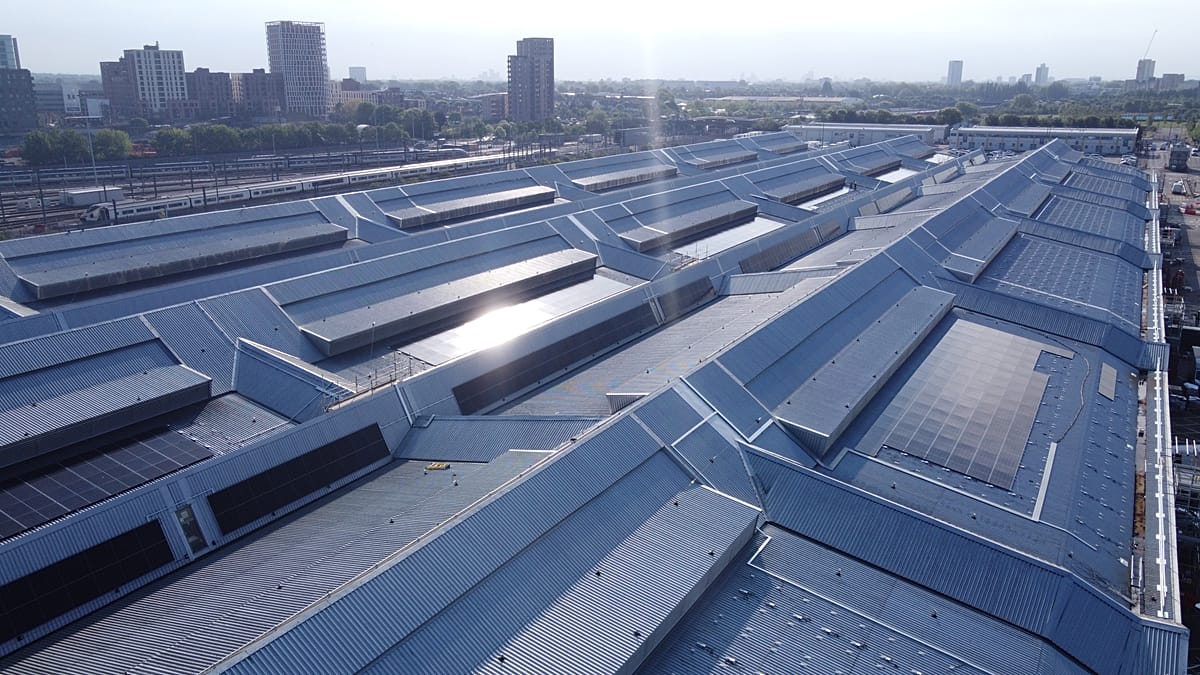
One of Britain's biggest wholesale markets for fruit, vegetables, and flowers has turned its sprawling rooftops into a power station. New Spitalfields Market in Leyton, East London, now hosts the capital's largest rooftop solar installation, a 2,730-panel system spread across five roofs.
The 1.4 megawatt-peak (MWp) array is expected to generate around 1.27 gigawatt-hours of electricity annually—enough to supply roughly 470 typical homes. For a market that operates around the clock, with 130 traders moving more than 15,000 products daily, that means a significant slice of its electricity will now come from the sun.
A blueprint for commercial renewables
Managed by the City of London Corporation, New Spitalfields is one of the most energy-intensive food markets in the capital, relying heavily on lighting and refrigeration. Generating power on-site will reduce its dependence on the grid and cut carbon emissions by an estimated 225 tonnes per year—equivalent to the annual electricity use of about 50 households.
The £1 million (€1.17 million) investment is among the most substantial renewable energy projects undertaken by the City Corporation to date. Officials hope it will serve as a model for integrating large-scale solar into critical commercial infrastructure across London and beyond.
“As the UK experiences periods of extreme heat and volatile energy prices, projects like this show how essential infrastructure can become more resilient and sustainable,” said a City Corporation spokesperson. The installation aligns with the authority's goal of reaching net zero across its own operations by 2027.
The market's location in East London, an area with a growing focus on green industry, makes the project particularly symbolic. It also comes as the UK government pushes to expand rooftop solar, though planning rules and grid connection delays remain hurdles for many commercial sites.
For the traders at New Spitalfields, the benefits are tangible: lower energy bills and a smaller carbon footprint. The market, which supplies restaurants and shops across the capital, can now advertise its produce as coming from a facility powered partly by renewable energy.
Similar initiatives are emerging elsewhere in Europe, from Romania's ambitious solar farm plans to Portugal's solar sector, though the pace of adoption varies widely. In the UK, the focus on rooftop arrays—rather than large ground-mounted farms—reflects the scarcity of available land in urban areas.
The project also highlights the growing role of municipal authorities in driving the energy transition. The City of London Corporation, which oversees the historic Square Mile, has committed to ambitious climate targets, and this installation is a concrete step toward meeting them.
As London looks to cut emissions from its buildings and transport networks, the success of the New Spitalfields array could encourage other market operators and logistics hubs to follow suit. With energy costs remaining a concern for businesses across the continent, the financial case for such investments is becoming harder to ignore.