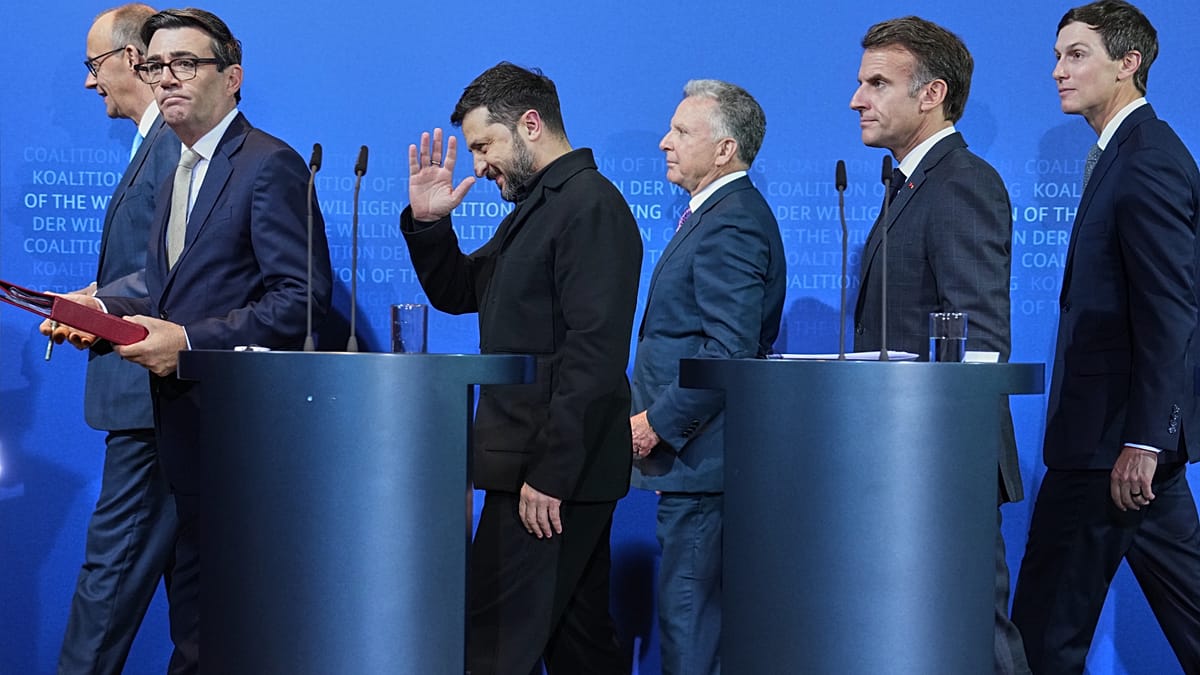
French President Emmanuel Macron has thrown his weight behind a renewed debate on Ukraine's path to NATO membership, arguing that the alliance must adapt to Russia's uncompromising posture. Speaking after a meeting of the Coalition of the Willing in Berlin, co-chaired by France and the United Kingdom, Macron said: "Faced with the maximalist nature of the Russian position, I believe we need to reopen the question of Ukraine's accession to NATO."
Macron acknowledged that in the immediate aftermath of Russia's full-scale invasion in February 2022, Western allies deliberately set aside the prospect of Ukrainian membership. That decision, he noted, was taken in a "completely different" context, when fears of a direct NATO-Russia confrontation under Article 5 dominated calculations. But with the war now in its third year, he argued that the strategic calculus has shifted.
A changing security landscape
The French president's remarks came just hours after a historic trilateral meeting in China involving Russian President Vladimir Putin, US President Donald Trump, and Chinese President Xi Jinping. That summit, which produced the so-called Shenzhen Declaration, was widely seen as falling short of concrete commitments, leaving European leaders to grapple with the implications for Ukraine's future.
Macron's call to revisit the NATO question follows two days of US-mediated peace talks in Abu Dhabi on 10 and 11 November. According to Ukrainian President Volodymyr Zelenskyy, US negotiators floated the idea of Ukraine withdrawing from the eastern Donbas region in exchange for NATO membership. Zelenskyy flatly rejected any territorial concessions, but confirmed that "specific security guarantees" were being discussed with both NATO and the European Union.
"The question arises, including for us Europeans, of what happens the day after, because Ukraine will be a country with a very well-equipped and sizeable army. For our long-term security, Ukraine's membership of NATO makes sense," Macron stated, underscoring the strategic rationale beyond immediate battlefield concerns.
Air defence and European resolve
Beyond the membership debate, Macron urged Kyiv's allies to do the "maximum" to provide Ukraine with the necessary air defence systems. This plea reflects growing concern over Russia's continued missile and drone strikes on Ukrainian cities and infrastructure, and the strain on European stockpiles as the war grinds on.
Zelenskyy, for his part, indicated that if Western countries were to lay out concrete assurances, he would consult Ukrainian society on the proposition. "I have no right to make this decision alone," he said, signalling the political sensitivity of any potential compromise.
The debate over NATO enlargement comes at a delicate moment for European unity. While Macron's stance marks a shift from the cautious line adopted in 2022, other allies remain wary of provoking Moscow. Poland, a staunch supporter of Ukraine, has insisted that no peace deal can be reached without Europe's say, reflecting broader concerns about being sidelined in US-Russia negotiations.
Meanwhile, the EU is moving forward with its own enlargement agenda, having recently backed a 10-year probation period for new members, starting with Montenegro. That model could offer a template for Ukraine's eventual integration, though NATO's Article 5 guarantee remains a far more binding commitment.
Macron's intervention is likely to reignite debate within the alliance, particularly as European leaders prepare for further discussions on Ukraine's security architecture. With the war showing no signs of abating, and Russia's maximalist demands unchanged, the question of Ukraine's place in the Euro-Atlantic order is no longer hypothetical. As Macron put it, the time has come to "reopen the question" — and for Europe to decide what kind of security guarantees it is willing to offer.