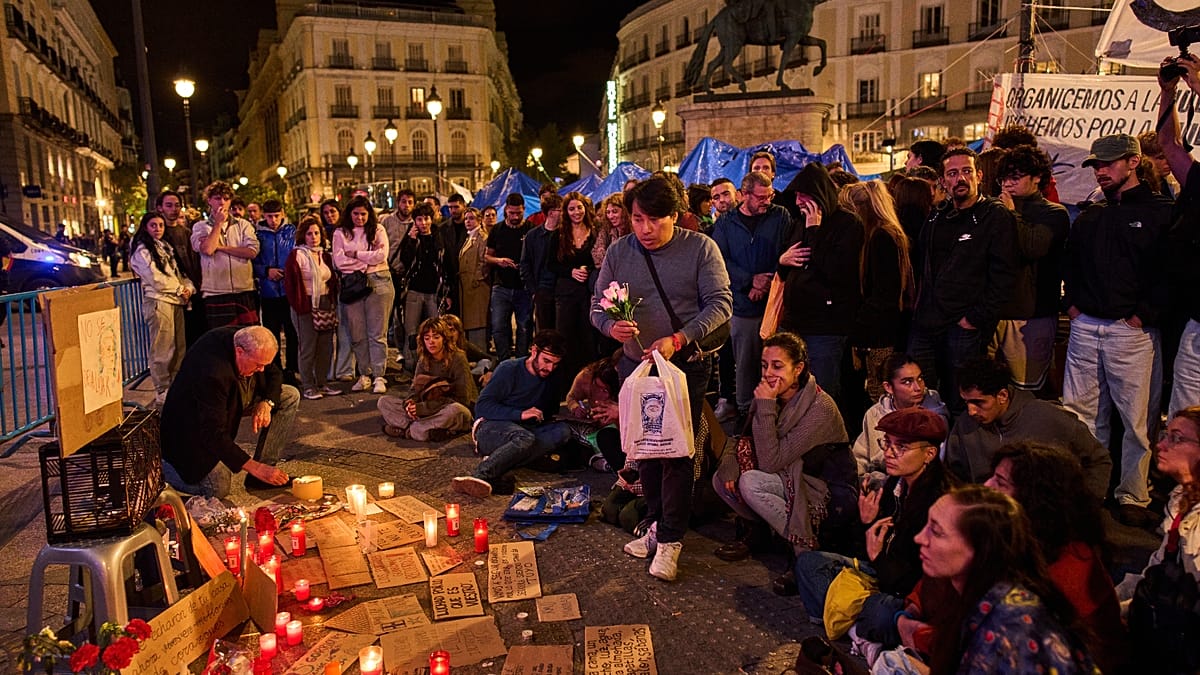
Hundreds of demonstrators assembled near the Spanish Parliament in Madrid on Tuesday evening to pay tribute to Maricarmen Abascal, an 87-year-old pensioner who died in hospital a month after being evicted from the home she had lived in for decades. The crowd placed candles and flowers beside a handwritten sign reading “Adios Maricarmen” and raised their arms in a gesture of solidarity, chanting slogans demanding housing justice.
Abascal’s death has become a rallying point for a movement already galvanized by Spain’s deepening housing crisis. In the capital’s Puerta del Sol square, a protest camp remains in place, its tents, banners and flyers a persistent reminder of the issue’s urgency. Demonstrators are calling on authorities to take concrete action to guarantee the right to housing, a demand that has resonated across the country.
A crisis with deep roots
Spain has one of the highest rates of eviction in the European Union, driven by a combination of soaring rents, stagnant wages, and a shortage of social housing. According to data from the General Council of the Judiciary, more than 25,000 evictions were carried out in 2024, a figure that has barely budged despite government pledges to reform housing policy. The situation is particularly acute in Madrid and Barcelona, where rents have risen by over 40% in the past five years, far outpacing income growth.
For many, Abascal’s story encapsulates the human cost of this crisis. She had lived in her Madrid apartment for over 50 years, but after her landlord sold the building to a real estate investment fund, she was served an eviction notice. Despite her age and health problems, the courts upheld the eviction, and she was removed from her home in September. She died a month later, an event that has sparked outrage not only in Spain but across Europe.
“This is not just about one woman; it’s about a system that treats housing as a commodity rather than a right,” said María González, a spokesperson for the Plataforma de Afectados por la Hipoteca (PAH), which has been at the forefront of anti-eviction protests. “Maricarmen’s death is a tragedy, but it is also a wake-up call. We cannot continue like this.”
Protests and political pressure
The protests in Madrid are part of a broader wave of discontent that has swept across Europe in recent months. In France, student demonstrations over school conditions and the cost of living have drawn parallels to the housing movement, with some activists pointing to similar frustrations in Paris. Meanwhile, in Germany, debates over rent caps and property speculation have intensified, though the scale of protest remains smaller.
In Spain, the main trade unions, UGT and CCOO, have announced a general strike for November 11, citing housing costs and stagnant wages as the primary grievances. The strike is expected to disrupt transport and public services, and it has already drawn support from left-wing parties and grassroots organizations. “We are seeing a convergence of struggles,” said José María Martínez, a sociologist at the Complutense University of Madrid. “Housing, wages, and public services are all part of the same crisis of affordability.”
The government of Prime Minister Pedro Sánchez has pledged to increase the supply of social housing and to strengthen rent controls, but critics argue that these measures are too slow and too limited. The recent passage of a housing law that caps rents in designated stress zones has been welcomed, yet its implementation has been patchy, with many regions controlled by opposition parties refusing to apply it.
European dimension
The housing crisis is not unique to Spain. Across the EU, the average rent has increased by 18% over the past decade, while homeownership rates have declined among younger generations. The European Commission has called on member states to address housing affordability, but policy remains largely a national competence. In Brussels, some MEPs have pushed for a European framework on housing rights, but progress has been slow.
As the protests in Madrid continue, the memory of Maricarmen Abascal has become a symbol of the broader struggle. Her name was chanted in the streets, and her face appeared on banners alongside slogans like “Housing is a right, not a privilege.” The camp in Puerta del Sol shows no sign of disbanding, and organizers say they will remain until the government responds to their demands.
“We are here for Maricarmen, but we are also here for all those who have been evicted, and for all those who fear they might be next,” said one protester, who gave her name only as Lucía. “The government cannot ignore us forever.”
The general strike on November 11 will be a key test of the movement’s strength. If it succeeds in shutting down major cities, it could force the government to take more decisive action. But for many, the stakes are even higher. As one banner in Puerta del Sol read: “They are taking our homes, but they will never take our dignity.”