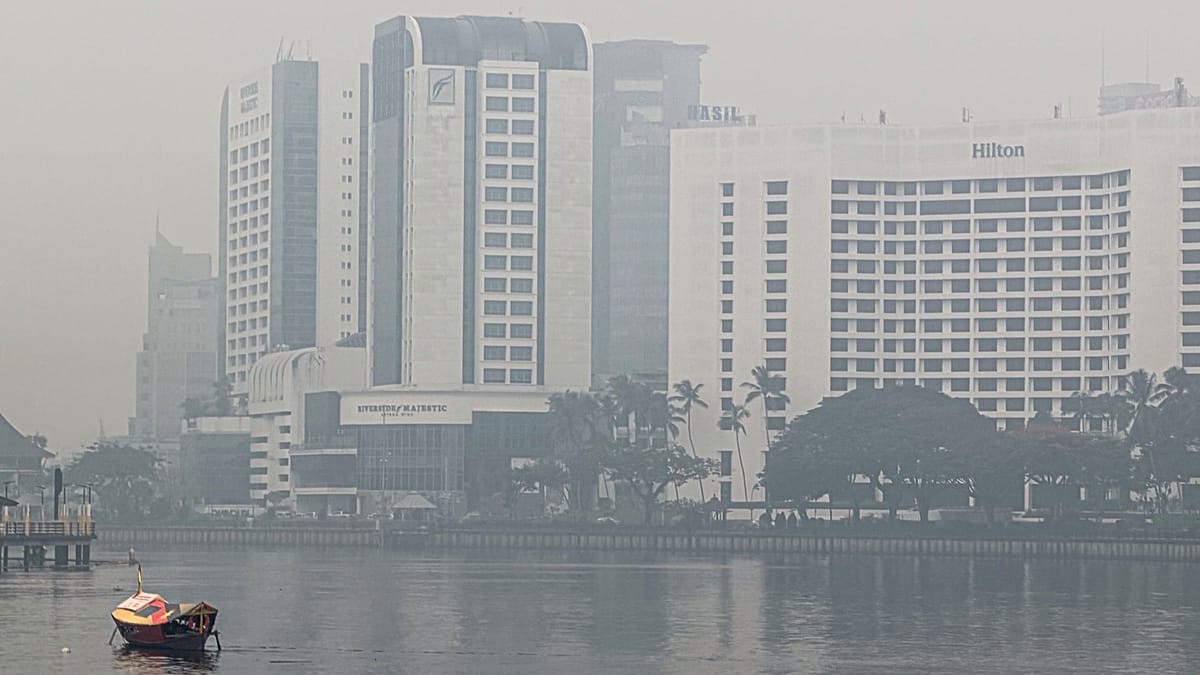
Malaysia declared an emergency in the Sarawak town of Serian on Friday after air pollution levels breached the country's emergency threshold, as smoke from forest and peat fires in neighbouring Indonesia continued to blanket parts of Borneo.
The Air Pollutant Index in Serian, an agricultural town of nearly 90,000 people near the border with Indonesia's Kalimantan region, surged to 521 on Friday, according to Malaysia's environment department. The much larger state capital, Kuching, also recorded a hazardous reading of 311.
King Sultan Ibrahim Iskandar has consented to the emergency declaration, which allows authorities to take more effective measures, Prime Minister Anwar Ibrahim's office said in a statement. While details were not provided, officials have indicated that readings above 500 could trigger a halt to nonessential work and outdoor activities. Schools in the region have already been closed as the index exceeded 200.
Recurring transboundary haze
Haze is a recurring seasonal problem in Southeast Asia, where smoke from forest and peat fires in Indonesia can drift across national borders, affecting Malaysia, Brunei, and Singapore. This year, the haze has been particularly severe, with elevated fire activity in several Indonesian provinces, including Kalimantan, and prolonged dry conditions worsening pollution across parts of Borneo.
Sarawak has been the worst-affected Malaysian state, with several areas experiencing hazardous air quality in recent days. Satellite data from Indonesia's Forestry Ministry detected 717 hot spots nationwide since 1 August, with 103 active in the past 24 hours alone.
Indonesian authorities have deployed firefighting resources and attempted cloud-seeding to induce rain. The national police announced on Friday that they have arrested 112 people suspected of starting forest and peatland fires in ten provinces on Sumatra and Borneo. The suspects are local farmers accused of deliberately burning land to clear it at lower cost.
Indonesia has also suspended the business licenses of five companies over alleged forest and land fires within their concessions in Kalimantan. Pipit Subiyanto, a senior police official at Indonesia's National Police criminal investigation agency, said authorities are investigating 167 cases involving the deliberate burning of some 4,700 hectares of land across nine provinces.
The crisis has drawn attention to the broader issue of land-clearing practices in Indonesia, which often rely on fire due to its low cost. Environmental groups have long called for stronger enforcement and sustainable alternatives. The situation also echoes concerns in Europe, where Algeria's president has moved to reinstate the death penalty for arsonists after deadly fires, highlighting the global challenge of fire management.
As the haze persists, Malaysian authorities are urging residents to stay indoors and wear masks when outdoors. The emergency declaration in Serian is a stark reminder of the health and economic impacts of transboundary pollution, a problem that requires regional cooperation to address effectively.