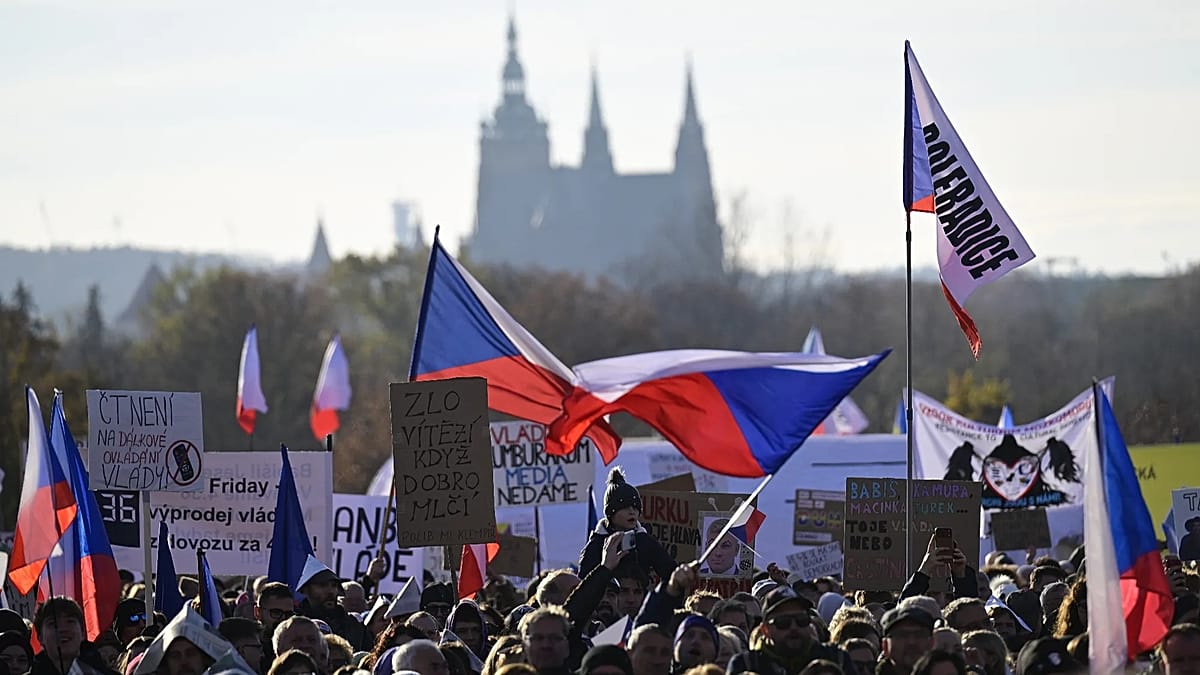
Prague's Letná plain, the city's largest open space, became the stage for an extraordinary show of civic defiance on Sunday as hundreds of thousands of Czechs rallied against government plans to overhaul the financing of public service broadcasting. Organisers and media estimates put the crowd at between 350,000 and 400,000, making it the largest protest since the Velvet Revolution against the current three-party coalition led by Prime Minister Andrej Babiš.
The demonstration, called by the civic group Million Moments for Democracy under the slogan “Never again 4:36,” referenced the early-morning moment in mid-October when the government majority in the Chamber of Deputies forced through a first-reading vote on a controversial media funding amendment. The vote came after the coalition cut short debate, preventing more than 60 opposition MPs from speaking. That procedural move, critics say, epitomises a broader disregard for democratic deliberation.
Funding shift sparks fears of political capture
At the heart of the dispute is a proposal to replace the current household licence fees—150 koruna (€6) per month for television and 55 koruna (€2.20) for radio—with direct financing from the state budget. The government argues this would modernise the system and ease the burden on households. But opponents, including journalists, academics, and cultural figures, warn that state funding would make Czech Television and Czech Radio vulnerable to political pressure, undermining their editorial independence and impartiality.
Publicly available figures show that the proposed state subsidy would be significantly lower than the current fee revenues: Czech Television collects 6.73 billion koruna (€270 million) annually, while Czech Radio receives 2.47 billion koruna (€99 million). The gap raises concerns about the long-term viability of public service broadcasting, which many see as a cornerstone of democratic discourse.
“Public media cannot be the property of politicians, the government, or the state,” speakers at the rally repeatedly stressed. “They belong to everyone and must reflect the views of all significant sections of society.” The crowd, which included families, students, and pensioners, echoed these sentiments with chants and banners demanding the coalition respect media freedom.
Broad coalition of support
The protest drew support from an unusually broad swath of Czech society. Student organisations from universities across the country, dozens of theatres, prominent writers, leading athletes, churches, healthcare workers, and international journalists' associations all expressed solidarity with the public broadcasters. The event was broadcast live by the public news channel ČT24, the CTK news agency, and several independent outlets, underscoring the media's own stake in the outcome.
Beyond the funding issue, demonstrators sharply criticised the government's overall policy direction and demanded that the coalition partner Freedom and Direct Democracy (SPD), led by Tomio Okamura, who also serves as speaker of the Chamber of Deputies, be removed from the government. The far-right party's presence in the coalition has been a source of contention since the election, and Sunday's rally gave voice to those who see its influence as a threat to democratic norms.
The protest comes amid a wider climate of social unrest across Europe, from France's repeated demonstrations to Portugal's housing protests. While each country's grievances differ, the Czech rally highlights a common anxiety about the erosion of institutional safeguards and the rise of populist governance.
Government dismisses critics
The government has dismissed the protest as the work of a minority. In a television debate, Radek Vondráček of ANO, the strongest governing party, condemned the organisers and Million Moments for Democracy, calling them “an association of professional agitators.” Such rhetoric has done little to mollify opponents, who point to the sheer scale of Sunday's turnout as evidence of widespread public opposition.
For now, the amendment remains in the legislative pipeline, with further readings expected in the coming weeks. The protest has put the government on notice that any attempt to bring public media under state control will face sustained resistance. As one demonstrator told Czech Radio, “We are here to say that the fourth estate is not for sale.”
The outcome of this standoff will be watched closely across Europe, where the independence of public service broadcasters is increasingly seen as a bellwether for democratic health. With technical glitches in EU border systems and other cross-border challenges already straining public trust, the Czech Republic's defence of its media could set a precedent for the continent.