On 28 August, the MTG-I2 satellite—the second imager in Europe's Meteosat Third Generation constellation—lifted off from Europe's Spaceport in Kourou, French Guiana, aboard an Ariane 6 rocket. It was the launcher's ninth mission and its first to a geostationary transfer orbit. With this launch, the European Space Agency (ESA) and Eumetsat complete the first operational trio of satellites positioned 36,000 kilometres above the equator, keeping a permanent watch on weather over Europe, the Mediterranean, and North Africa.
To understand what this new satellite really changes, we spoke with Panos Giannopoulos, a meteorologist at the Hellenic National Meteorological Service (HNMS) and a weather presenter at SKAI Media Group in Athens. He has spent decades interpreting satellite images in his daily work.
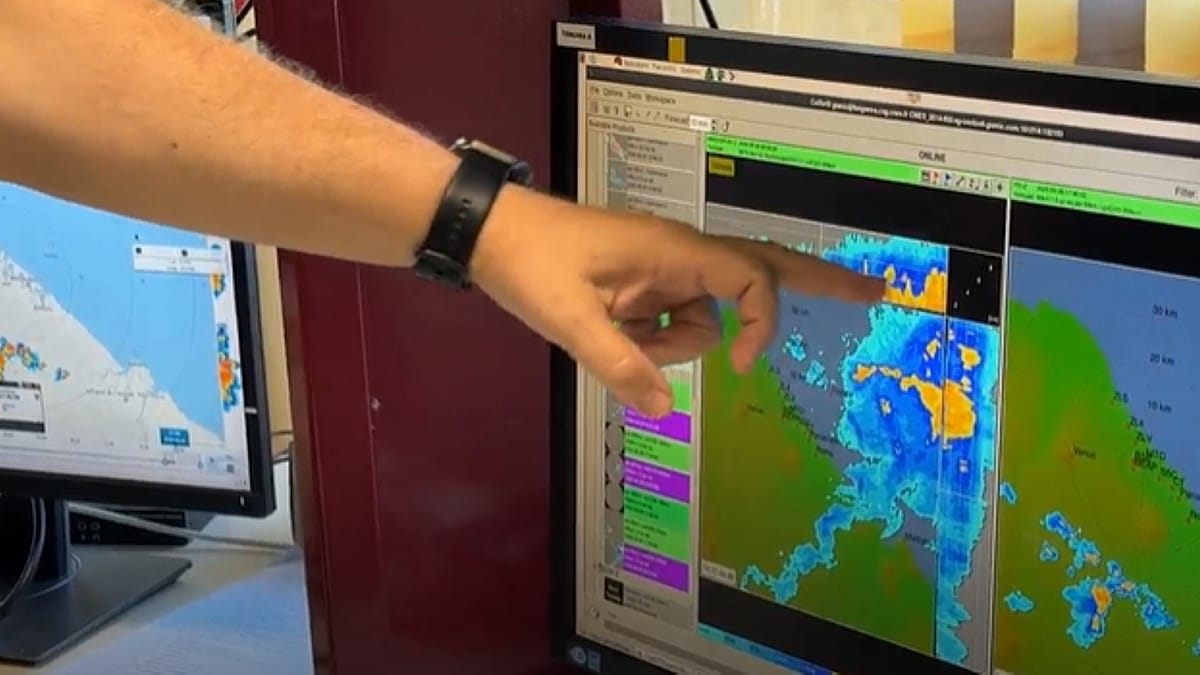
“When I started working, 25 years ago, we only had one image every 30 minutes, with three channels; it was the first generation of Meteosat,” he recalls. The second generation brought a clear improvement: 12 channels and images every ten minutes—every five over Europe—allowing forecasters to combine channels to detect fog, dust, volcanic ash, and track storms from birth to dissipation.
With the third generation, the leap is even greater. The new satellite will scan the upper quadrant of the Earth, centred on Europe, every two and a half minutes—something, Giannopoulos says, “has never been achieved before anywhere in the world, not even in the United States.” That frequency may outpace human analytical capacity. “I do not know whether meteorologists on our own can make full use of all this information, but with the help of artificial intelligence, these images every 2.5 minutes could greatly improve very short-term forecasting,” he adds.
A lightning detector and a sounding partner
This new generation also includes a lightning detector—a first for Meteosat—capable of taking 1,000 samples per second in a very narrow band of the spectrum. It does not work alone: MTG-S, the sounding satellite in the same family, has been operating in orbit since its launch in 2025, measuring humidity and temperature profiles in the atmosphere. “Up to now we have relied mainly on weather balloons released every 12 hours from a limited number of locations. That satellite has been providing data for less than a year, and these are already being fed into global forecasting models,” Giannopoulos notes.
MTG-I2 will still need about six months of commissioning before it is integrated and calibrated alongside its two sister satellites. From around April 2027, the three will operate as a single system. For Giannopoulos, the balance sheet is clear: “This third generation of Meteosat will have an impact both on very short-term forecasting (the next two or three hours) and on the usual one-to-ten-day range.”
The improved data could also help with wildfire alerts and other extreme weather events, which have become more frequent across the continent. As Europe faces heatwaves that strain national budgets, faster and more precise forecasts are increasingly valuable.
Giannopoulos, who has presented weather on Greek television for years, is optimistic about the practical benefits. “The ability to see storms developing in near real-time will be a game-changer for public safety,” he says. “We will be able to issue more accurate warnings for flash floods, hail, and wind gusts.”
The MTG-I2 launch also marks a milestone for the Ariane 6 rocket, which had a rocky start but is now proving its reliability. The satellite was encapsulated in its fairing at the Ariane Encapsulation Facility on 21 August, and the launch went smoothly.
For European meteorology, the new constellation represents a step change. The combination of rapid imaging, lightning detection, and atmospheric sounding will give forecasters a more complete picture of the atmosphere than ever before. As Giannopoulos puts it, “We are moving from snapshots to a continuous movie of the weather.”