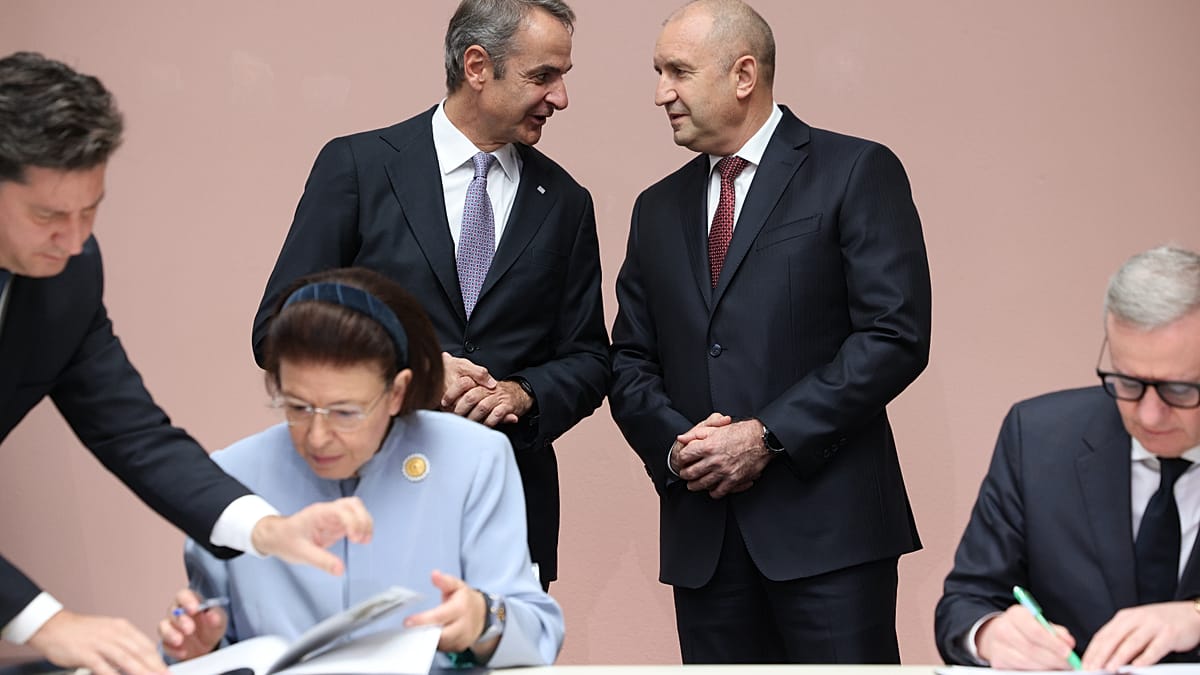
Speaking in Thessaloniki on Saturday, Greek Prime Minister Kyriakos Mitsotakis used the occasion of a historic artefact exchange with Bulgaria to reiterate his government's firm stance on the Parthenon Sculptures, rejecting any notion of a loan arrangement.
"Monuments and historic artefacts cannot be treated as spoils of war, nor as victims of circumstances that arose after their creation and their inherent nature as unified works," Mitsotakis said at the Museum of Byzantine Culture.
"It is precisely this same principle, the principle of a monument's integrity, that underpins our ongoing effort to reunite the Parthenon Sculptures. Because they are not lifeless objects from the past. They are evidence in a living and unbroken connection with the natural and cultural landscape that gave birth to them," he added.
The Greek leader described the Parthenon as a "unique and self-contained case" that cannot be "imprisoned within the confines of legal or technical issues." He stressed that the goal is to restore the aesthetic and semantic integrity of a "truly universal monument which, unfortunately, remains violently dismembered."
"My country will not accept arrangements that imply recognition of foreign ownership, nor will it borrow, supposedly, its own treasures. On the contrary, it now believes that the time has come for truth, for reason, for justice, but also for morality," Mitsotakis concluded.
Historic exchange with Bulgaria
The event marked the formal handover of artefacts under a bilateral agreement signed earlier. Bulgarian President Rumen Radev, who attended the ceremony, said the two countries had "left the shadows of the past behind us" and built a relationship of mutual respect and friendship.
"I am pleased that our two peoples have managed to move beyond confrontation and today we enjoy a very high level of economic, political and cultural co-operation," Radev said. He expressed hope that the agreement would further consolidate the strategic partnership, calling it "an axis of stability, security, prosperity and development."
As part of the exchange, Greece returned the remains attributed to Tsar Samuel, a ruler of the First Bulgarian Empire who died in 1014. The bones, discovered in 1965 at the Basilica of Saint Achilleios in Prespa by Professor Nikolaos Moutsopoulos, had been kept at the Museum of Byzantine Culture in Thessaloniki.
In return, Bulgaria handed over 48 ecclesiastical artefacts that were removed by Bulgarian troops from churches and monasteries in northern Greece during the First World War. The items, taken in 1917, had been held at the National History Museum in Sofia for over a century.
The artefacts come from the Holy Monastery of Panagia Eikosifoinissa, the Holy Monastery of Timios Prodromos of Serres, and the Holy Metropolis of Serres and Nigrita. They will be displayed at the Museum of Byzantine Culture until 5 November 2026 before returning to their original locations.
The exchange reflects a broader trend of cultural diplomacy in the region. Greece has also been active in other cultural initiatives, such as showcasing Uzbek treasures in Doha, while Bulgaria has faced challenges like rising fuel costs that affect daily life.
Mitsotakis's remarks on the Parthenon Sculptures come amid ongoing discussions with the British Museum, which holds the majority of the surviving sculptures. Greece has long argued for their permanent return, while the museum has offered a loan arrangement—a proposal Athens has consistently rejected.
The Greek government has also been dealing with other pressing issues, such as proposing to suspend EU asylum rights during migration surges and pressing Brussels for fiscal leeway amid the energy crisis.