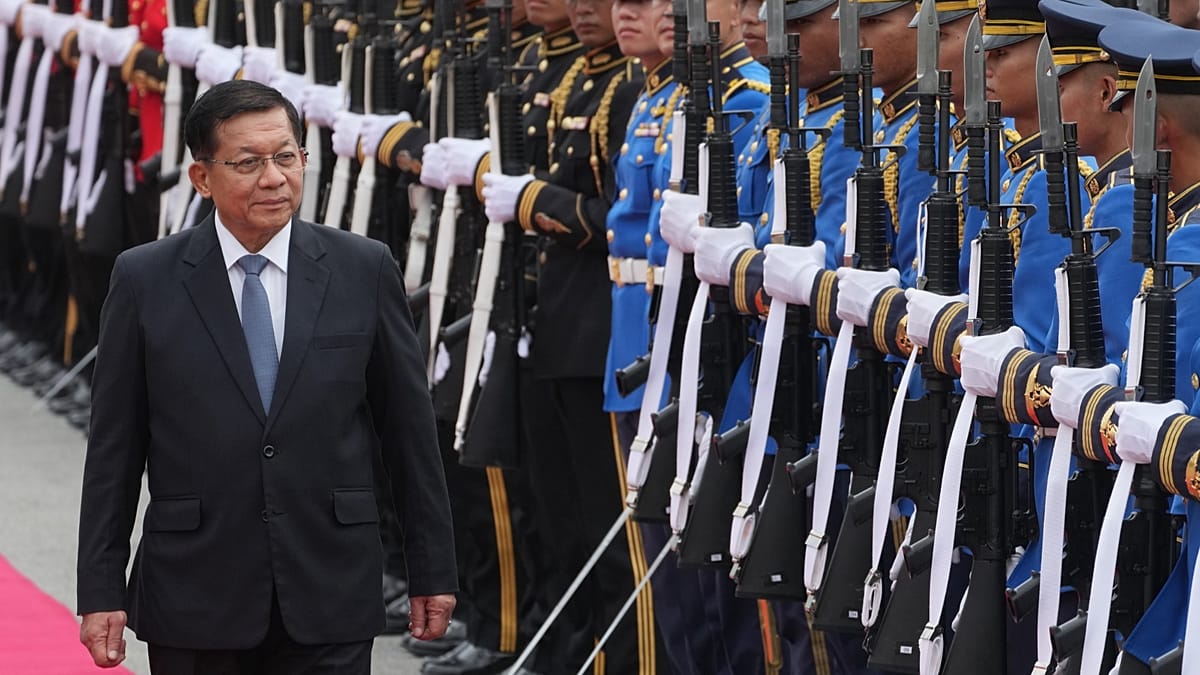
Myanmar's former junta chief Min Aung Hlaing arrived in Bangkok on Thursday for his first official visit to Thailand since trading his military uniform for civilian attire. The trip marks a concerted effort by the pariah state to re-enter the diplomatic mainstream, nearly five years after the coup that ousted Aung San Suu Kyi and plunged the country into civil war.
Min Aung Hlaing, who was installed as president in April following elections widely dismissed as a sham, is scheduled to meet Thai Prime Minister Anutin Charnvirakul at Government House, attend a business forum, and sign a memorandum of understanding on labour cooperation. The visit underscores Thailand's role as the leading advocate within the region for re-engaging with Myanmar's military-backed government.
A bid for regional acceptance
Since assuming the presidency, Min Aung Hlaing has embarked on a diplomatic offensive, visiting India, China, and Laos. His outreach aims to secure recognition and legitimacy, particularly from the Association of Southeast Asian Nations (ASEAN), which has excluded Myanmar's leadership from high-level summits since the 2021 putsch. However, Myanmar's foreign minister did attend an informal ASEAN meeting in Bangkok last month, a sign of gradual thaw.
Morgan Michaels, a Myanmar specialist, said that if ASEAN were to invite Myanmar back, it would open "a pathway for normalisation of relations with others, including western countries that have remained opposed to the military regime." Yet he noted that recognition from India, China, Russia, and Thailand already provides a foundation, making restored ASEAN ties a "nice to have" rather than essential.
Independent analyst David Mathieson told AFP that Myanmar's campaign for re-entry into ASEAN is a matter of "pure status" for Min Aung Hlaing. "He wants to be seen as a responsible member of ASEAN in one way, then paradoxically to totally reject the five-point consensus," Mathieson said, referring to the bloc's peace plan that calls for dialogue with all parties to the conflict.
Thailand's pragmatic calculus
Bangkok has its own reasons for courting Naypyidaw. The civil war has spilled across the long border, with fighting between the military and myriad rebel factions displacing millions into Thailand. The volatile borderlands also harbour cyberscam networks and illicit drug trafficking, which Thailand wants to curb.
Thai Foreign Minister Sihasak Phuangketkeow told reporters on Monday that Thailand believes Myanmar, along with Cambodia, could "do a lot more" to combat scam networks, and the issue would be raised during Min Aung Hlaing's visit. In a statement, he also welcomed the rare meeting between Aung San Suu Kyi and a Red Cross envoy earlier this week, expressing hope that authorities "will undertake further positive steps towards lasting peace and stability in Myanmar."
Critics, however, accuse Bangkok of legitimising a leader wanted by the International Criminal Court for crimes against humanity. Several Western nations have imposed sanctions on Min Aung Hlaing, and human rights groups have condemned the visit as a whitewash.
Despite the controversy, the visit signals a pragmatic shift in regional diplomacy. For Min Aung Hlaing, the trip is a step towards shedding his pariah status. For Thailand, it is an attempt to manage a destabilising neighbour. Whether it leads to genuine peace or merely a veneer of normalcy remains to be seen.