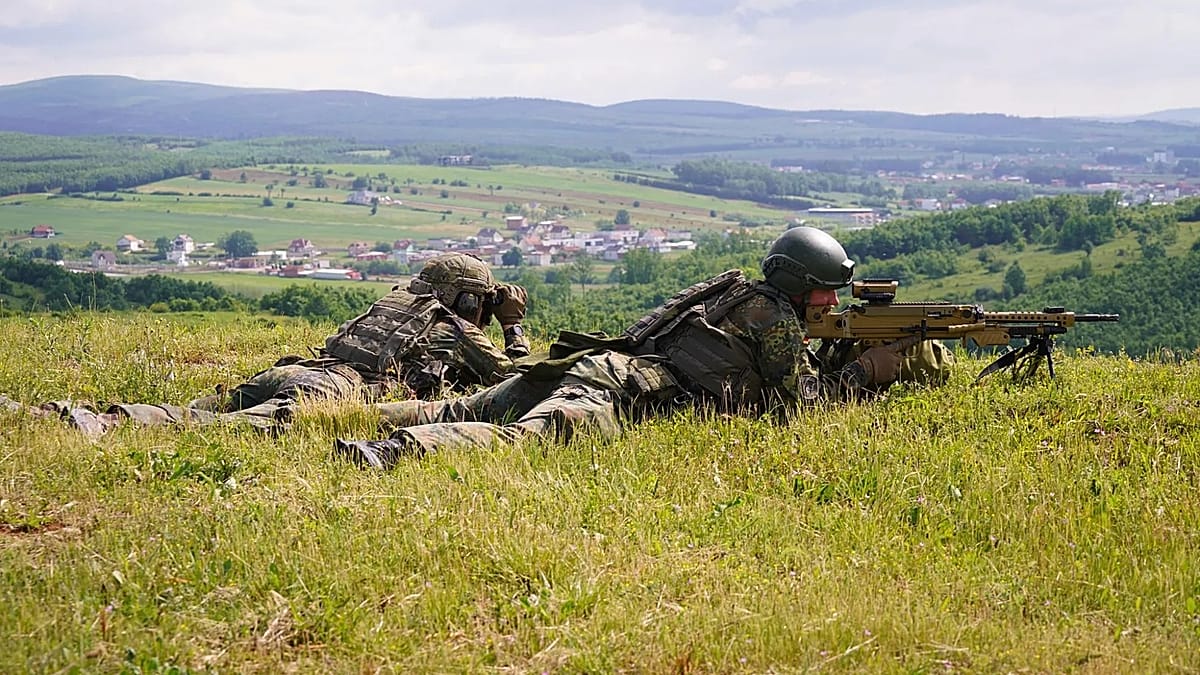
NATO has announced plans to reduce the number of troops deployed in Kosovo over the coming year, citing an improved security environment. The decision, outlined on Friday by US Air Force General Alexus G. Grynkewich, NATO's Supreme Allied Commander Europe, marks a shift in the alliance's long-running peacekeeping mission in the Western Balkans.
Currently, around 4,600 soldiers serve under the Kosovo Force (KFOR), a mission established in June 1999 after NATO air strikes ended the Kosovo war and forced the withdrawal of Yugoslav forces under Slobodan Milošević. KFOR's original mandate was to prevent renewed conflict, maintain public order, and oversee the demilitarisation of the Kosovo Liberation Army.
Gradual Drawdown with Conditions
“The current conditions provide an opportunity to optimise KFOR’s size and posture further,” Grynkewich said in a press release. He added that NATO and KFOR remain “fully committed to safety and security in Kosovo” and that their presence has “led to increased stability” as local security institutions have become more capable.
The reductions will be carried out “gradually and in line with conditions on the ground,” NATO stated. The alliance also stressed that the cuts are reversible: any deterioration in security could prompt a reversal of the drawdown.
This is not the first time NATO has adjusted its footprint in Kosovo. In 2023, the alliance deployed up to 1,000 additional troops to the region—the largest reinforcement of KFOR in a decade—after tensions flared between Serb gunmen and local police in northern Kosovo. That incident underscored the fragility of peace in an area where ethnic Serb and Albanian communities remain divided.
The decision to reduce numbers comes amid broader European security debates. Germany's defence spending and shifts in Russian influence across the continent are reshaping how NATO and EU member states view their commitments in the Balkans. Kosovo itself faces political uncertainty: the country is heading to its third election in a year as political paralysis deepens, complicating the path toward normalisation with Serbia.
KFOR's presence has long been a cornerstone of stability in Kosovo, which declared independence from Serbia in 2008—a status recognised by most EU and NATO members but not by Serbia, Russia, or China. The mission currently includes troops from 28 NATO and partner nations, with the United States, Italy, Germany, and Turkey providing the largest contingents.
Analysts note that the drawdown reflects a broader trend: as local security forces in the Western Balkans mature, international peacekeepers are gradually scaling back. However, the situation remains sensitive. The 2023 violence in northern Kosovo, where Serb-majority municipalities resist Pristina's authority, showed how quickly tensions can escalate.
NATO's announcement comes as the alliance also grapples with other security challenges, from the war in Ukraine to drone incidents near the Romanian port of Constanța. For Kosovo, the reduction in troop numbers is a vote of confidence in local institutions—but one that could be reversed if the ground shifts.