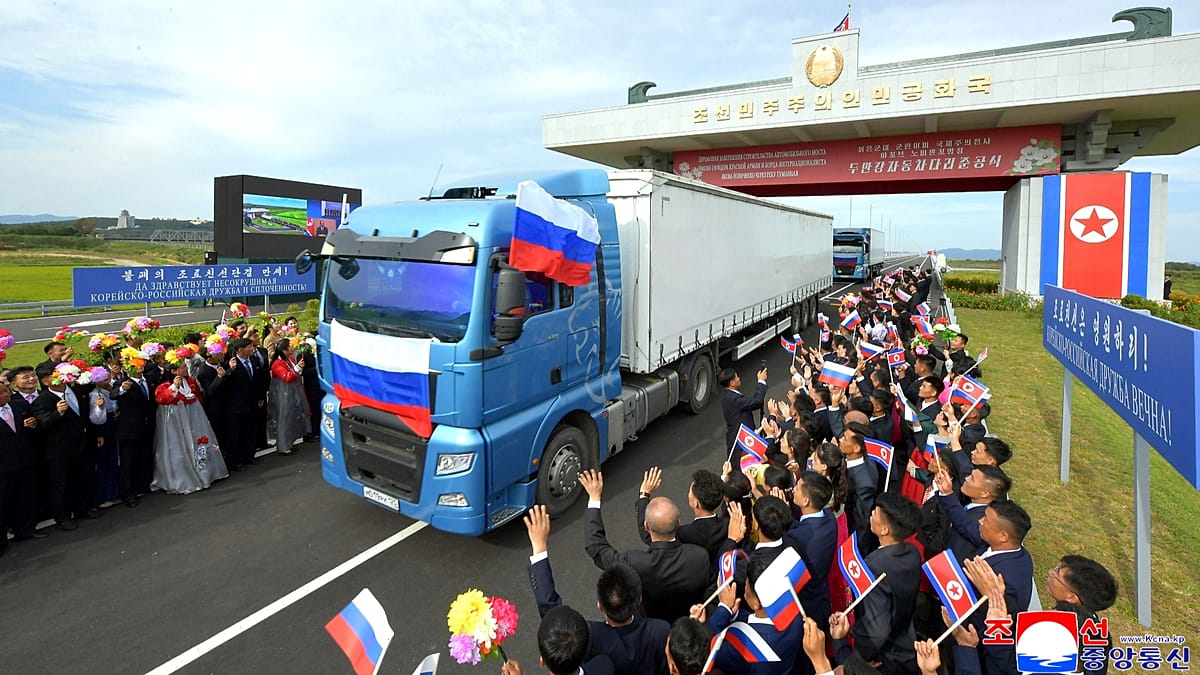
North Korea has opened its first road bridge across the narrow Tumen River border with Russia, a development Pyongyang's state media on Tuesday described as a concrete sign of tightening bonds between the two neighbours. The ceremony on Monday came as Moscow and Pyongyang have dramatically expanded military and economic cooperation since Russia's full-scale invasion of Ukraine in 2022.
The bridge, designed to handle up to 300 vehicles daily, is intended to accommodate growing freight traffic and complements existing rail and air connections. Experts say the new crossing, along with a separate span to China that is still under construction, gives Western-sanctioned North Korea the kind of strategic and economic options it has long sought.
A strategic pivot
Lim Eul-chul, a professor at Kyungnam University in Seoul, noted that the bridges will allow North Korea to "simultaneously secure two major overland routes linking it with Russia and China, allowing it to encourage competition between the two countries and maximise its gains." He added that the infrastructure also "can be a message to the United States that North Korea has no reason to beg Washington for sanctions relief or make concessions on denuclearisation in order to negotiate."
The opening ceremony was attended by North Korean official Pak Thae-song, who was quoted by the Korean Central News Agency (KCNA) as saying: "The completion of the bridge is a significant event adding a new dynamic movement to the overall bilateral cooperation."
Russia has framed the bridge as a practical upgrade to cross-border logistics, but Ukrainian human rights group Truth Hounds has warned it could become "a direct artery for moving North Korean troops, construction brigades and military officials into Russia, with Russian technology and resources flowing in the opposite direction."
North Korea has already sent thousands of troops to Russia to help repel a Ukrainian incursion into the Kursk region, and Kyiv has accused Moscow of using North Korean missiles in its regular bombardments. The deepening relationship has drawn concern across Europe, where Berlin is planning a digital shield against Russian hybrid threats and EU custodians are exploring ways to unlock frozen Russian assets for Ukraine's benefit.
South Korea's central bank estimated in July that North Korea's economy grew by more than 3% for a third consecutive year in 2025, citing expanded economic cooperation with Russia as a "major drive." A bank official said gross national income also "received a boost from a sharp rise in foreign currency earnings" linked to the deployment of North Korean troops to Russia.
The new bridge is part of a broader infrastructure push. North Korea and China are already connected by the Sino-Korean Friendship Bridge, which carries passenger trains but has limited capacity. After a long halt, that bridge partially reopened earlier this year and restored daily passenger services with China, though tourism visas for Chinese citizens—who once made up the bulk of North Korea's overseas visitors—have not yet resumed.
North Korea has long maintained tight control over foreign visitors and effectively sealed its borders at the start of the COVID-19 pandemic six years ago. The New Yalu River Bridge, intended as an alternative and eventual replacement for the Sino-Korean Friendship Bridge, is expected by experts to be completed this year.
Lim said the completion of the bridge "sends a political and geopolitical message demonstrating the formation of a 'North Korea-China-Russia continental triangular bloc.'" That alignment, he argued, gives Pyongyang leverage it has rarely enjoyed, allowing it to play Moscow and Beijing against each other while signalling to Washington that it sees no need to negotiate on its nuclear programme.
For European observers, the bridge is another reminder of how Russia's war in Ukraine is redrawing alliances across Eurasia. As Latvia becomes the first EU state to ban Russian and Belarusian print imports and Kyiv endures round-the-clock drone attacks, the Kremlin's growing partnership with Pyongyang adds a new dimension to Europe's security calculus.