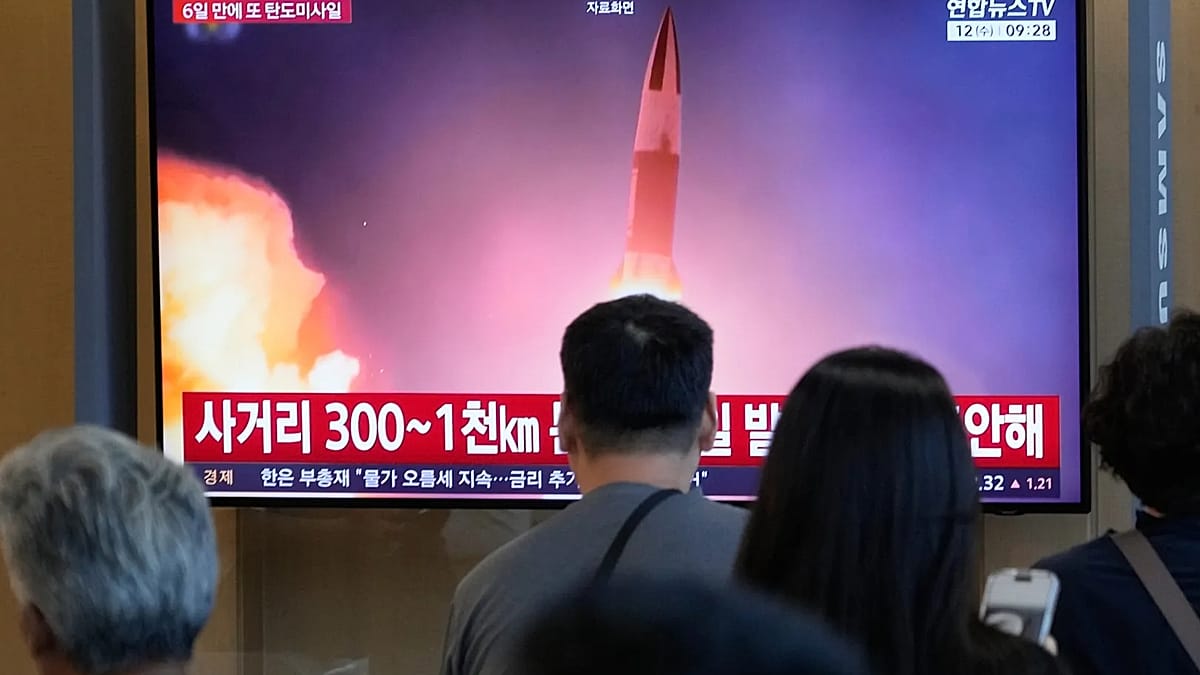
North Korea carried out its second ballistic missile test in under a week on Wednesday, according to South Korean media, in what appears to be a protest against the upcoming joint military exercises between Seoul and Washington. The launch, detected around 6 a.m. local time from the eastern coastal city of Wonsan, saw the missile travel more than 700 kilometres before landing in the sea between the Korean Peninsula and Japan, South Korea's Joint Chiefs of Staff reported.
South Korea's military condemned the test and reiterated its readiness to repel any provocation in coordination with the United States. The country's national security council labelled the launch an "act of provocation" and demanded that Pyongyang cease such actions immediately.
Japan's Defense Ministry also confirmed the launch, stating that the weapon fell outside its exclusive economic zone. Defense Minister Shinjiro Koizumi told reporters that Tokyo lodged a strong protest through diplomatic channels in Beijing, calling the test "a serious problem that affects the safety of the Japanese people."
Escalation ahead of Ulchi Freedom Shield
The latest missile comes just two days after South Korea and the United States announced they would begin their annual large-scale military drills on 17 August, known as Ulchi Freedom Shield. These exercises are designed to enhance readiness against North Korean threats, but Pyongyang has long viewed them as rehearsals for an invasion.
North Korea has historically responded to such exercises with provocative weapons tests and harsh rhetoric. However, analysts suggest that Pyongyang often uses the drills as a convenient pretext to advance its own weapons development programme. The United States and South Korea have repeatedly stressed that their training is defensive in nature.
Last year, after the start of Ulchi Freedom Shield, North Korean leader Kim Jong Un accused Washington and Seoul of demonstrating a "will to ignite a war" and claimed their actions had become more provocative, prompting the North to respond with "proactive and overwhelming" countermeasures.
Wednesday's launch follows a short-range ballistic missile test on 6 August, which was detected by South Korea, the United States, and Japan. That was the North's first ballistic weapons activity since late June, marking a resumption of testing after a brief pause.
The recent flurry of launches underscores the persistent stalemate in denuclearisation talks, which have remained dormant for years. North Korea has refused to return to negotiations with the United States and South Korea, while continuing to expand its missile and nuclear capabilities.
For Europe, the developments carry broader implications. The Korean Peninsula remains one of the world's most volatile flashpoints, and any escalation could have global security and economic consequences. The European Union has consistently supported denuclearisation and called for dialogue, while also maintaining sanctions on Pyongyang. The bloc's foreign policy chief has repeatedly urged North Korea to refrain from provocations and return to talks.
Meanwhile, the ongoing war in Ukraine has highlighted the growing military cooperation between North Korea and Russia. Ukrainian President Volodymyr Zelenskyy has warned of more North Korean troops and missiles heading to Russia, and has reported that North Korean missiles were used in a deadly strike on Zaporizhzhia. These reports, if confirmed, would mark a significant deepening of the Pyongyang-Moscow axis, with direct implications for European security.
As the region braces for the upcoming military exercises, the international community will be watching closely for further North Korean reactions. The pattern of tit-for-tat escalation remains a dangerous cycle, and the prospects for a diplomatic breakthrough appear as distant as ever.