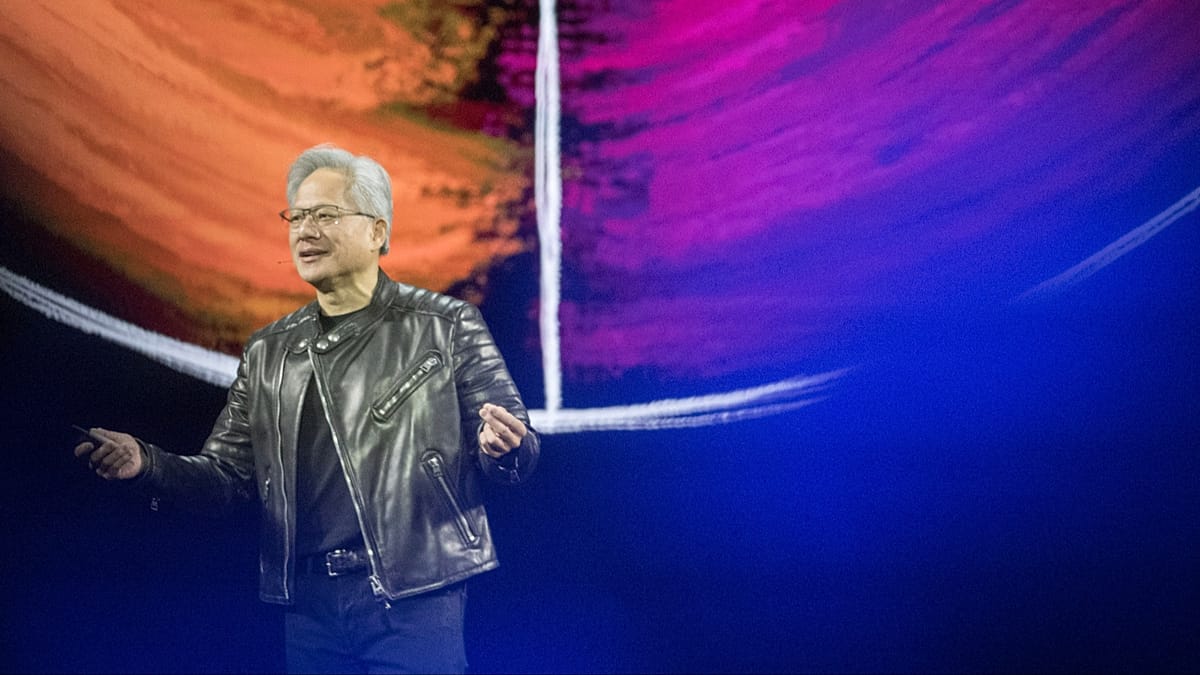
Nvidia delivered another blockbuster quarter on Wednesday, posting revenue of $96.2bn (€82.4bn) for the three months to the end of July, comfortably above the $92.2bn (€79bn) analysts had pencilled in. Chief executive Jensen Huang said artificial intelligence had reached a turning point, and the company guided third-quarter revenue to $108bn (€92.5bn) — again ahead of Wall Street's expectations.
"AI has reached its inflection point," Huang said in a statement. "It's doing useful work. Its tokens are productive and profitable. Now, compute is revenue, and demand is accelerating."
The results underscore Nvidia's outsized role in global markets. With a market capitalisation above $5tn (€4.3tn), the chipmaker is worth more than the entire economy of Japan, the world's fourth-largest. Its quarterly earnings have become a bellwether for the tech sector and the broader AI boom.
Yet the market reaction was muted. Shares slipped 1.8% in after-hours trading, following a 1.6% decline in the regular session. This has become a familiar pattern: Nvidia beats expectations, and the stock still falls. After the first-quarter beat earlier this year, shares dropped nearly 5% in the following days. The dynamic means the company must significantly outperform an already-bullish consensus — or offer an even stronger outlook — to move its share price higher.
The concentration problem
The central question for Nvidia is not whether it can grow, but for whom. The company still derives the bulk of its revenue from a handful of hyperscale customers — Amazon, Google and Microsoft — each of which is now designing its own chips to reduce dependence on Nvidia. The latest disclosures show just how large that reliance remains.
Huang's commentary on demand into 2027 therefore carries more weight than any single figure. The concern has sharpened since July, when markets wobbled on doubts about whether vast AI investments will ever generate proportionate returns.
Nvidia's answer has been to help finance the buildout itself. This month alone, it assembled a $500bn (€428bn) capital pool with six Wall Street asset managers for data centre projects, and separately committed up to $105bn (€90bn) to back an OpenAI data centre in Pike County, Ohio, with an initial capacity of 4.25 gigawatts and an option for a further 3.75.
The company's growth is currently driven by its Blackwell chips, the generation of processors powering most AI data centres today. Their successor, known as Vera Rubin, is expected to begin shipping in the second half of the year. Nvidia has a tradition of naming its chip architectures after scientists — past generations include Ampere, Hopper and Blackwell. Vera Rubin, the American astronomer whose observations of galaxy rotation provided early evidence for dark matter, continues that pattern. She died in 2016 and was widely seen as overlooked for a Nobel Prize.
Nvidia has pointed to an order backlog it says is worth around $1tn (€857bn) across 2026 and 2027, though that figure comes from company commentary rather than independently verified financial disclosure.
China and the road ahead
Washington barred sales of the China-specific H20 chip in April 2025, then reversed course. Nvidia has since received approval to ship the more capable H200 chip to vetted Chinese customers. Reports have surfaced of large allocations to ByteDance and Tencent, though Beijing has been encouraging domestic firms to limit purchases and prioritise homegrown alternatives.
The results come amid a broader debate about AI's environmental and economic footprint. In Europe, the surge in data centre construction has prompted concerns about grid strain — Ireland is weighing nuclear options as AI-driven data centres put pressure on its electricity network. Meanwhile, backlash against data centres is complicating political strategies in the US.
Wednesday's data offered no relief on inflation. The personal consumption expenditures index, the Federal Reserve's preferred gauge, rose 0.2% in July against expectations of 0.1%, leaving the annual rate at 3.7% rather than easing to the 3.6% forecast. Core prices held at 3.3% over the year, above the Fed's 2% target for a 65th consecutive month. The Federal Open Market Committee held rates at 3.50% to 3.75% in July, with three regional Fed presidents dissenting in favour of a quarter-point increase. Markets currently put the probability of a September hike at around 40%.
Attention now shifts to Jackson Hole, where Fed Chair Kevin Warsh delivers his keynote on Friday morning, his first since taking office in May, 19 days before the next rate decision. The ECB's Isabel Schnabel joins a panel the same afternoon.
US stock markets drifted through a quiet session on Wednesday after the inflation data. The S&P 500 edged down less than 0.1% and remains near the all-time high it set earlier this month. The Dow Jones Industrial Average dipped 0.2% and the Nasdaq composite slipped 0.1%.