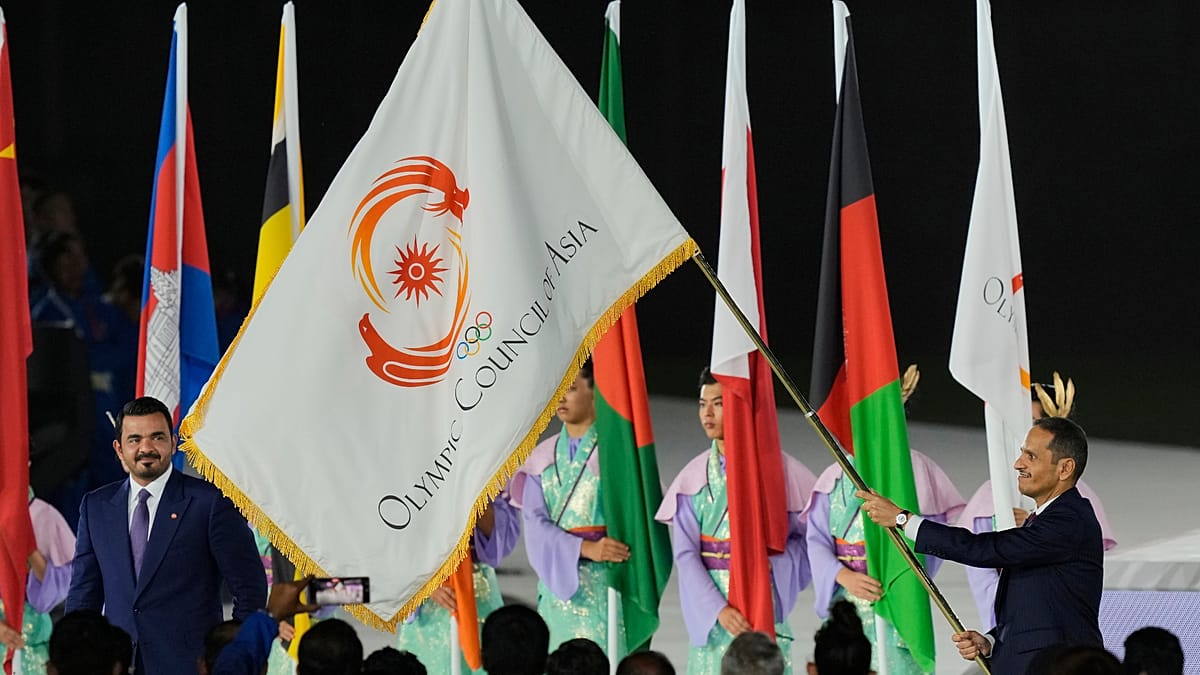
Qatar has taken a significant step towards becoming a permanent fixture on the global sporting calendar. At the closing ceremony of the Aichi-Nagoya Asian Games in Japan on Sunday, the Olympic Council of Asia (OCA) formally handed the flag to Doha, marking the start of the four-year countdown to the 2030 Asian Games. The Gulf state, which previously hosted the event in 2006, also unveiled its new identity and slogan, “The Games We Live For”.
Prime Minister Sheikh Mohammed bin Abdulrahman bin Jassim Al Thani received the flag from OCA President Sheikh Joaan bin Hamad Al Thani. The handover followed a Games that brought together around 11,000 athletes from 45 countries and regions across 43 sports. China dominated the medal table with 169 golds and 341 medals overall, while hosts Japan finished second with 83 golds.
Qatar’s ambitions, however, extend well beyond 2030. On Tuesday, the International Olympic Committee (IOC) confirmed that Qatar is among seven countries that have expressed interest in hosting the 2036 Summer Olympics. The others are India, South Africa, South Korea, Germany, Hungary, and Turkey. A decision is not expected for several years, but Doha’s inclusion underscores its growing reputation as a hub for major events, following the 2022 FIFA World Cup and its regular hosting of Formula 1 and MotoGP races.
Formula 1 confirms Gulf finale
Meanwhile, Formula 1 has brought some clarity to a season that has been disrupted by regional instability. CEO Stefano Domenicali confirmed on Saturday that the final two races of the 2026 calendar—the Qatar Grand Prix on 29 November and the season-ending Abu Dhabi Grand Prix on 6 December—will go ahead as planned. “Based on the information we have, everything is confirmed for Qatar and Abu Dhabi,” Domenicali told French broadcaster Canal Plus.
The announcement provides relief after months of speculation about the fate of the Gulf races. The Bahrain and Saudi Arabian Grands Prix were cancelled earlier in the season following the outbreak of the Iran war, and the Bahrain round was relocated to Malaysia, where it was held at Sepang this past weekend. There had also been discussions about moving the Abu Dhabi race to Imola in Italy as a contingency.
Drivers have offered contrasting views on the wisdom of racing in the region. Seven-time champion Lewis Hamilton, now with Ferrari, said last month that he hoped the season would finish in the Gulf as planned. “Personally, I want to go. I love going to the Middle East,” he said, while adding that he trusted Formula 1 to assess the security situation. In contrast, four-time champion Max Verstappen of Red Bull said last week that while he normally enjoys racing in Qatar and Abu Dhabi, he believed the sport should stay away if the regional conflict posed a risk.
The confirmation of the Gulf races comes as Qatar warns the global economy is paying the price for the Iran war, and as the IEA signals readiness to tap more oil reserves to stabilise markets ahead of winter. The region’s geopolitical tensions have already forced significant changes to the F1 calendar, and the decision to proceed with the final rounds reflects a careful balancing act between commercial interests and safety concerns.
For European fans and stakeholders, the confirmation is a welcome sign of continuity. The season has been anything but normal, with races cancelled, relocated, and rescheduled. The prospect of a traditional Gulf double-header to close the year offers a degree of predictability, even as the broader political situation remains fluid. As the UAE confirms Netanyahu's Abu Dhabi visit, the region continues to navigate a complex diplomatic landscape.
Qatar’s sporting ambitions are not limited to hosting. The country has invested heavily in infrastructure, from the Lusail International Circuit to the state-of-the-art venues built for the World Cup. Its bid for the 2036 Olympics would build on that legacy, though it faces stiff competition from established European candidates like Germany and Hungary, as well as emerging powers such as India and South Africa.
For now, the focus is on the immediate future. The Asian Games in 2030 will be a major test of Qatar’s ability to stage a multi-sport event on a scale comparable to the Olympics. The country’s experience with the World Cup, which was widely praised for its organisation if not its human rights record, will serve as a useful reference. But the Olympics present a different challenge, with a broader range of sports and a longer duration.
As the sporting world watches, Qatar is clearly positioning itself as a central player in the global events industry. Whether it ultimately secures the 2036 Games remains to be seen, but its determination is evident. The handover in Nagoya was more than a ceremonial moment; it was a statement of intent.