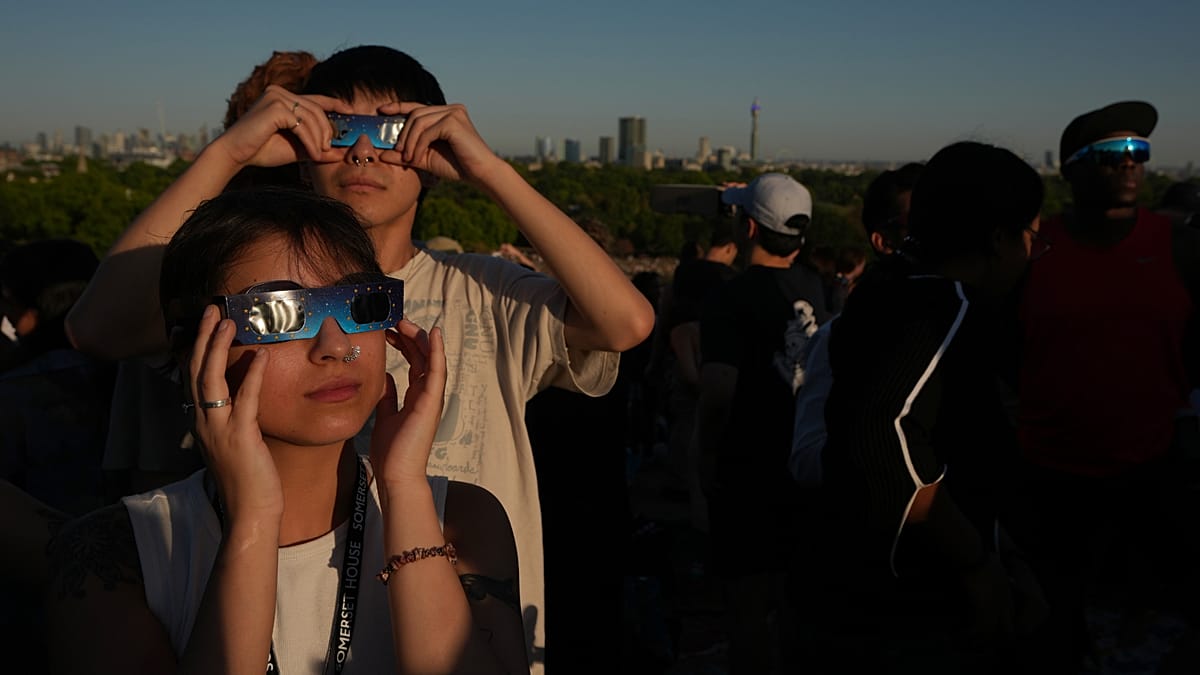
From the Atlantic coast of Portugal to the Baltic shores of Finland, Europeans turned their eyes skyward on Saturday as a rare solar eclipse swept across the continent. In cities such as Madrid, Paris, Berlin, and Warsaw, crowds gathered in parks, on rooftops, and along waterfronts, armed with certified eclipse glasses and pinhole projectors, to watch the Moon gradually obscure the Sun.
A celestial spectacle unites the continent
The partial eclipse, which peaked at different times depending on location, was visible across a broad swath of Europe. In London, the Royal Observatory in Greenwich hosted a public viewing event, where attendees observed the Moon take a significant bite out of the solar disk. In Reykjavík, Iceland, the eclipse was particularly deep, with over 70% of the Sun covered at maximum, casting an eerie twilight over the capital.
Astronomers had urged caution, emphasizing that direct viewing without proper protection can cause permanent eye damage. Local authorities and science museums distributed free eclipse glasses, and many schools organized supervised viewing sessions for students. In Berlin, the Zeiss Planetarium offered a live-streamed commentary, explaining the mechanics of the alignment as it unfolded.
The eclipse was a reminder of the precise celestial choreography that governs our solar system. As the Moon passed between Earth and the Sun, its shadow traced a narrow path across the North Atlantic, with the greatest obscuration occurring over the Faroe Islands and parts of Norway. There, observers experienced a dramatic dimming, with temperatures dropping slightly and birds falling silent—a phenomenon often noted during deep partial eclipses.
For many, the event was also a moment of collective wonder. In Paris, the esplanade of the Trocadéro filled with families and tourists, all gazing upward as the Eiffel Tower stood silhouetted against the partially darkened sky. Similar scenes unfolded in Rome, where the Colosseum provided a dramatic backdrop, and in Athens, where the Acropolis overlooked a city momentarily hushed by the spectacle.
While Saturday's eclipse was partial for most of Europe, it offered a tantalizing preview of the 2027 'eclipse of the century', which will bring a total solar eclipse to parts of Spain and North Africa. Astronomers are already planning expeditions to the path of totality, which will include cities like Cádiz and Málaga, where the Sun will be completely hidden for over four minutes.
The event also sparked a wave of amateur photography, with enthusiasts sharing images on social media. From the best images from Spain to St. Petersburg, the eclipse was captured in all its phases—from first contact to the final sliver of sunlight. In Britain, a timelapse from Greenwich showed the Moon's shadow racing across the solar disk, a mesmerizing sequence that quickly went viral.
Scientists used the occasion to remind the public of the Sun's importance and the need for ongoing solar research. The eclipse provided a rare opportunity to study the Sun's corona, the outer atmosphere that is normally invisible against the bright solar disk. Although the corona was not fully visible during a partial eclipse, instruments on satellites and ground-based observatories collected valuable data on solar activity, which is currently approaching its maximum in the 11-year solar cycle.
For those who missed Saturday's show, the next partial eclipse visible from Europe will occur in 2026, but the 2027 total eclipse will be the main event. As one astronomer in Madrid put it, "This was the appetizer; the main course is coming."
In the meantime, the images and memories from Saturday will linger. For a few hours, the continent shared a common experience, a reminder that even in an age of division, the sky can still bring us together.