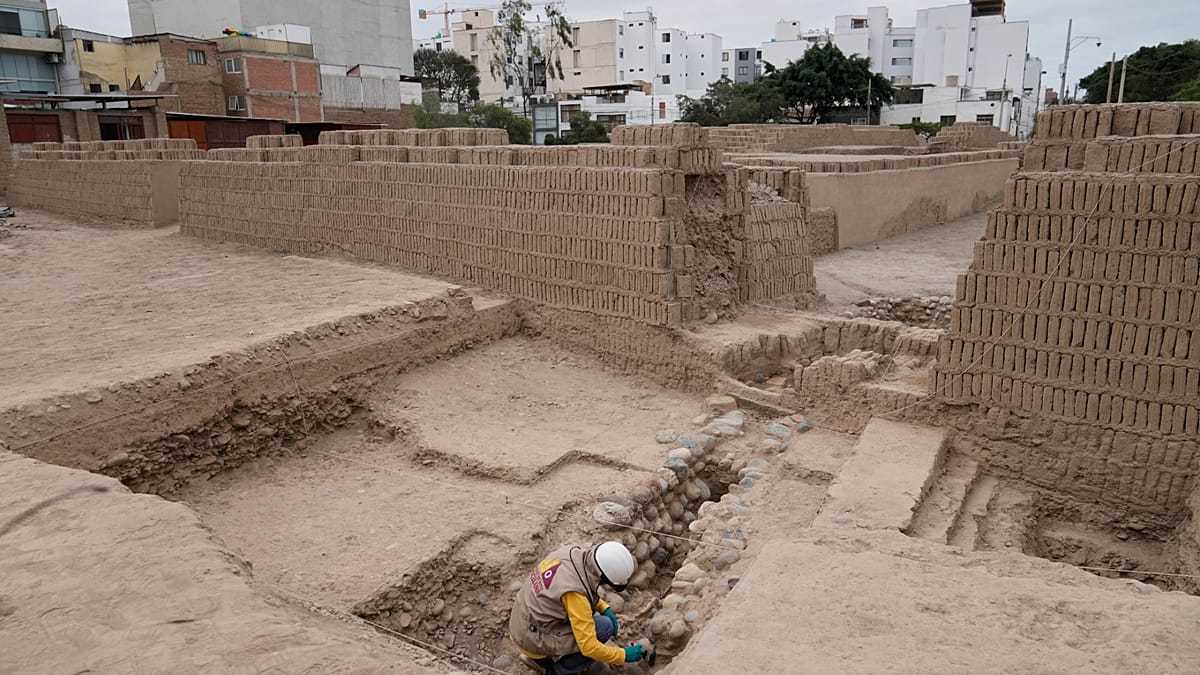
Archaeologists working in the heart of Peru's capital have unearthed the skeletal remains of an adult who appears to have been placed as a ritual offering more than 1,300 years ago. The find was made at Huaca Pucllana, a pre-Hispanic ceremonial and administrative complex that now sits amid the bustling streets of modern Lima.
The body was discovered inside an underground ceremonial canal, lying on its left side with the skull oriented westward toward the sea and a nearby mud pyramid. According to Gladys Paz, the lead archaeologist on the excavation, the positioning strongly suggests a deliberate ritual placement.
“We are looking at the discovery of a human offering found inside a ceremonial canal belonging to the Lima culture,” said Paz. “We are located at Huaca Pucllana, which corresponds to Sector B of Huaca Chica, at what would have been the main gate or entrance to the ceremonial center around 650 AD.”
The Lima culture thrived on Peru's central coast between roughly 100 and 700 AD, well before the rise of the Inca Empire. Huaca Pucllana was one of its principal ceremonial and administrative hubs, and this new discovery offers a rare glimpse into the rituals that took place there.
A window into ancient ceremonies
The excavation has also yielded ceramic fragments, including a snake head, adding further evidence of activity at the site. These artifacts, along with the human remains, are expected to help researchers better understand how ceremonies were conducted more than a millennium ago.
Huaca Pucllana is notable for its location—an ancient site surrounded by the homes, businesses, and infrastructure of a sprawling modern metropolis. Archaeologist Micaela Alvarez highlighted this contrast as one of the site's most striking features for visitors.
“It's a characteristic of Huaca Pucllana for quite a few decades now; in fact, it's almost what attracts people who come to visit us, to find such an ancient archaeological site right in the middle of the city; it's surprising, really,” said Alvarez.
The discovery is not an isolated case. According to official data, more than 400 sacred sites belonging to pre-Hispanic cultures are scattered across Lima, a testament to the region's deep history. Similar archaeological finds elsewhere in the Americas have drawn international attention, such as Rome's ancient Neronian bridge resurfacing during a drought, highlighting how urban environments often conceal layers of the past.
The remains are expected to be removed from the excavation site in the coming days for further analysis. For archaeologists, this find provides another piece of the puzzle about the beliefs and practices of the people who inhabited this area long before the founding of modern Lima.
While the story is rooted in Peru, it resonates with European audiences who appreciate the intersection of ancient heritage and contemporary life. The preservation of such sites is a shared concern, much like the efforts to protect Portugal's ancient olive trees or the Greek initiative to open ancient sites for public access. These parallels underscore a universal commitment to understanding our collective past.