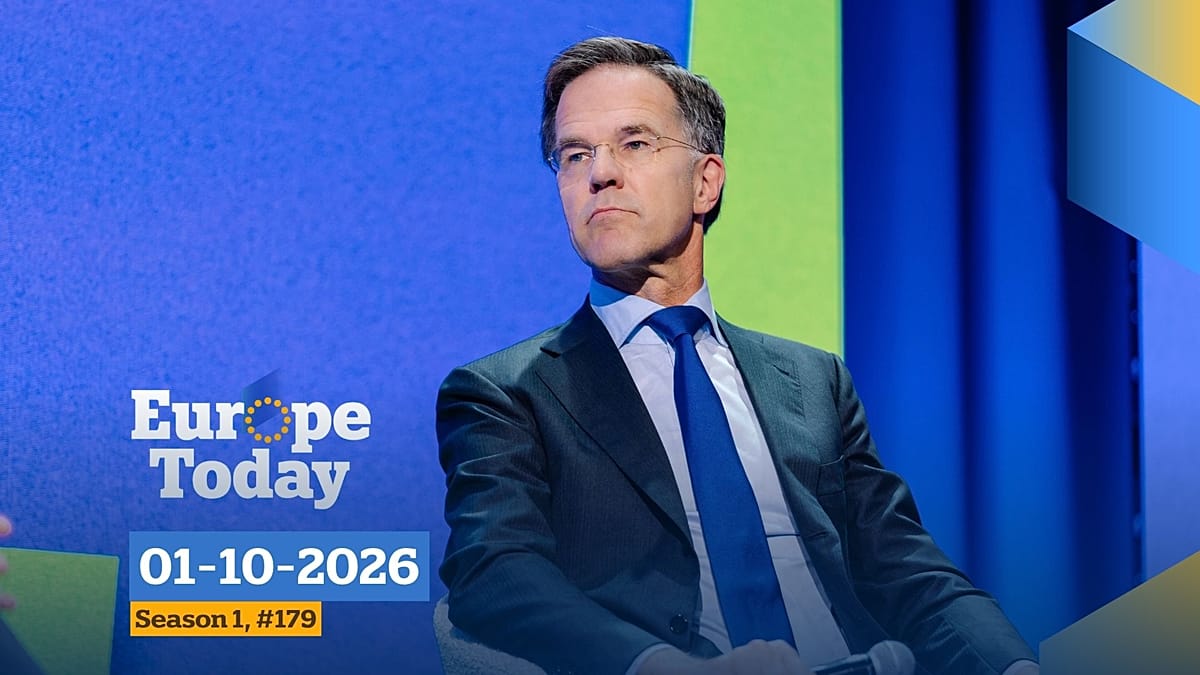
NATO Secretary General Mark Rutte used a high-profile appearance at the Euronews Defence and Space Summit to deliver a blunt message to the Kremlin: stop brandishing nuclear weapons. In an interview with Euronews Europe Editor Maria Tadeo, Rutte addressed Moscow's latest round of atomic sabre-rattling, which has intensified as European capitals face mounting pressure to shoulder more of the continent's defence burden.
The NATO chief's intervention came against a backdrop of fresh Russian warnings about its nuclear arsenal, a recurring tactic since the full-scale invasion of Ukraine in February 2022. Rutte made clear that such threats are unacceptable and that the alliance will not be intimidated. At the same time, he sought to calm nerves by stating that there is no imminent threat to NATO territory — a dual message designed to reassure allies without appearing complacent.
Belgium's defence minister sounds the alarm
Rutte's remarks were reinforced by Belgian Defence Minister Theo Francken, who told the summit that Russia represents Belgium's single biggest threat. Francken's assessment reflects a broader shift in European threat perceptions, particularly among countries that had long treated defence spending as a lower priority. His warning aligns with his recent call for Europe to accelerate its defence preparations amid what he described as a looming 'dark winter'.
The summit, held in Brussels, also featured interviews with the US and UK ambassadors to NATO, conducted by Euronews correspondent Shona Murray. Their contributions underscored the transatlantic dimension of the current security debate, as Washington and London watch closely whether European allies will translate rhetoric into capability.
Pressure on Europe to rearm
Rutte's appearance at the summit formed part of a wider push to persuade European governments to invest more in defence industrial capacity. The NATO chief has previously argued that the debate over whether Europe should prefer buying European or American weapons is a luxury the continent cannot afford at a time of acute threat. That message is likely to resonate in Paris, Berlin and Rome, where leaders are grappling with how to scale up production without fragmenting the single market.
Yet the road to rearmament is far from smooth. An Estonian MEP recently cautioned that Europe's defence industry is not ready for the kind of rapid expansion that the security environment demands. The warning highlights a structural problem: even with political will and increased budgets, factories, supply chains and skilled workforces cannot be summoned overnight.
Nuclear risk and the search for dialogue
While Rutte dismissed the immediate nuclear danger, not all European voices are as sanguine. Bulgaria's prime minister has urged the EU to open a channel of dialogue with Moscow specifically to reduce nuclear risk, arguing that a total absence of communication is itself a source of instability. That position sits uneasily with the harder line taken by many member states, but it reflects genuine anxiety in parts of southern and eastern Europe about the consequences of escalation.
The summit also touched on hybrid threats and the expansion of EU naval operations in the Mediterranean, where the bloc is seeking to counter Russia's so-called shadow fleet — a network of unregistered or opaque vessels used to circumvent sanctions and project influence. The expanded naval mission is one of several measures Brussels has taken to tighten the squeeze on Moscow's maritime logistics.
A continent on edge
Beyond the summit hall, the human cost of the war continues to mount. Recent Russian strikes on Kyiv killed four people and cut power supplies as winter approaches, a reminder that the conflict's humanitarian toll is far from abstract. Meanwhile, in Paris, President Emmanuel Macron faces his own political constraints, with analysts noting that he cannot use the war to extend his stay in power — a pointed reference to the fixed term of the Cinquième République.
Exiled Belarusian opposition leader Sviatlana Tsikhanouskaya has added another layer to the picture, warning that Russia is probing EU resolve before acting further. Her assessment suggests that Moscow's nuclear rhetoric may be less about imminent use and more about testing how far European governments can be pushed before they waver.
For Rutte, the task at the summit was to hold that resolve together. His message — stop the nuclear threats, but do not panic — is a delicate balancing act. Whether it will be enough to steady a continent that has spent nearly three years bracing for the worst remains an open question.