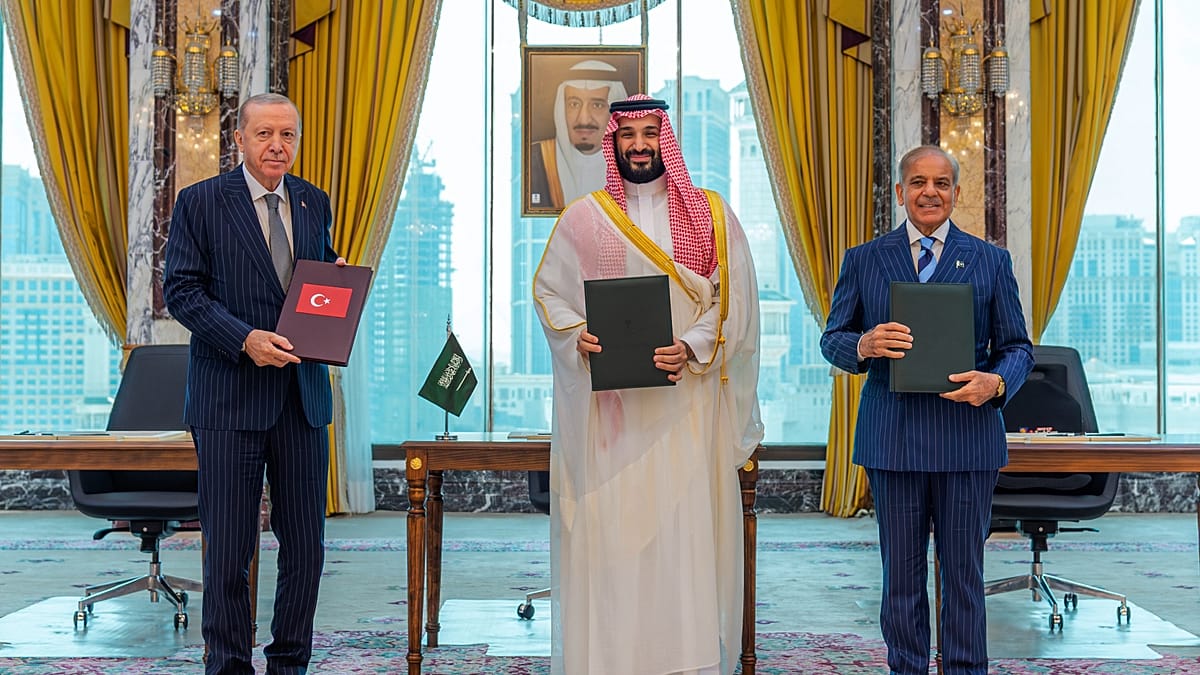
In a significant move for Middle Eastern and South Asian security architecture, Crown Prince Mohammed bin Salman of Saudi Arabia, Turkish President Recep Tayyip Erdoğan, and Pakistani Prime Minister Shehbaz Sharif convened in Mecca on Friday to formalize a trilateral defense agreement. The pact, described as landmark by officials, aims to deepen military cooperation and intelligence sharing among the three nations, a response to the volatile security environment shaped by the ongoing US-Iran confrontation.
Strategic alignment in a tense region
The meeting in the holy city underscores a broader realignment of regional powers. For Riyadh, the agreement reinforces its role as a pivotal security actor in the Gulf and the Red Sea, especially after recent Houthi missile and drone attacks on Saudi territory, which were intercepted by a Greek Patriot battery deployed in the kingdom. Ankara, meanwhile, seeks to expand its defense exports and political influence across the Islamic world, while Islamabad views the pact as a strategic counterbalance to its eastern neighbor India, with which it has a long-standing rivalry.
The agreement comes at a time when the US and Saudi Arabia have jointly struck Iran-backed militias in Iraq following a missile intercept, signaling a coordinated approach to deterrence. The trilateral pact is expected to include joint military exercises, arms transfers, and cybersecurity cooperation, though specific details remain under wraps.
European implications
For Europe, the pact carries notable implications. Turkey, a NATO member, is deepening its defense ties with non-NATO partners, a development that Brussels and allied capitals will watch closely. The agreement could affect the balance of power in the Eastern Mediterranean and the Middle East, regions where European states have significant security and economic interests. Moreover, the pact may influence the EU's own defense initiatives, as the bloc seeks to bolster its strategic autonomy amid shifting global alliances.
The timing is also sensitive for Europe's defense posture. As the EU grapples with internal debates over defense spending, such as Italy's delay on a €14.9bn loan, the Saudi-Turkish-Pakistani axis adds a new layer of complexity. European leaders may need to recalibrate their engagement with Ankara, which has often been a challenging partner on issues ranging from migration to maritime disputes.
Regional reactions and future outlook
Reactions in the region have been mixed. Iran, which views the pact as a potential threat, has yet to issue an official statement, but state media have framed it as a "Western-backed alliance" aimed at isolating Tehran. The Houthi movement in Yemen, which has been engaged in a prolonged conflict with Saudi Arabia, has threatened full escalation as Riyadh forms a Red Sea coalition.
Analysts suggest that the pact could also have economic dimensions, with potential joint investments in defense industries and infrastructure. For Pakistan, the agreement may provide access to advanced military technology and financial support, while Turkey could leverage its drone and naval capabilities to enhance the collective defense framework.
The Mecca summit is a clear signal that the three countries intend to coordinate more closely on security matters, a development that will be closely monitored in European capitals. As the US-Iran conflict continues to simmer, the new alliance could either stabilize the region through deterrence or further inflame tensions, depending on how it is operationalized.
For now, the pact remains a framework, with implementation details to be worked out in the coming months. But the symbolism of the meeting—held in the holiest site of Islam—cannot be overstated. It reflects a convergence of interests that may reshape regional security dynamics for years to come.