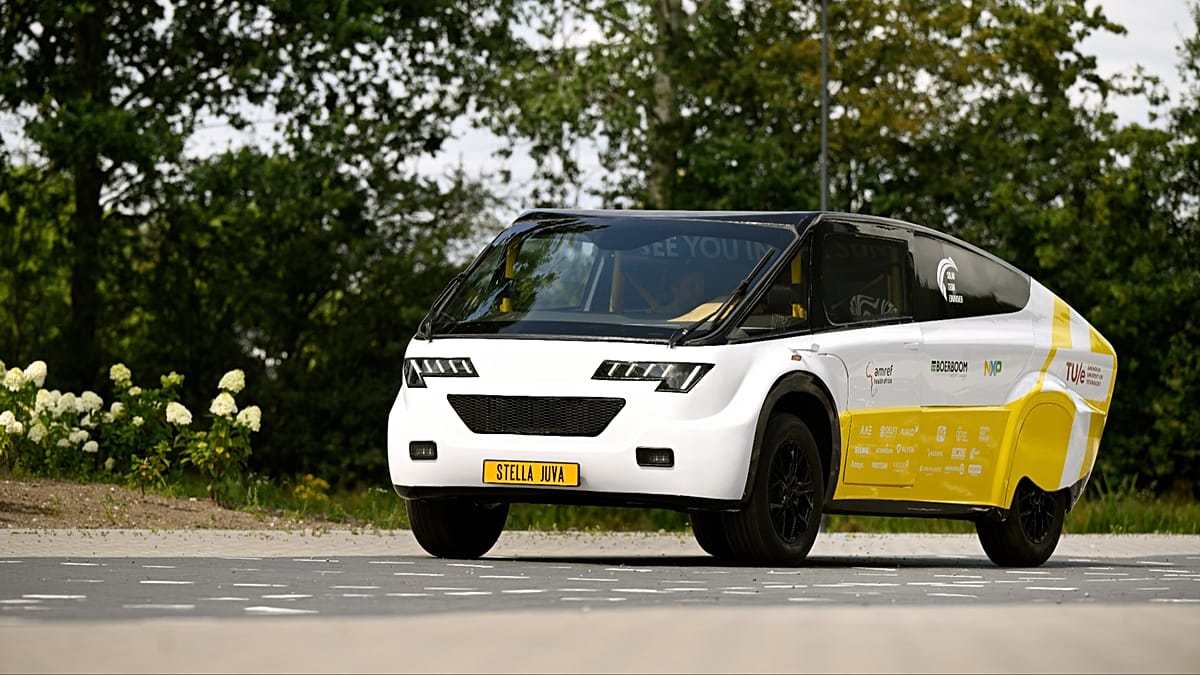
In a field in Narok County, Kenya, a white ambulance sits with solar panels unfolded like wings. Around it, healthcare workers from Amref Health Africa are running ultrasounds and checking vitals, powered entirely by the sun. This is Stella Juva, the world's first road-legal solar ambulance, developed by students at Eindhoven University of Technology in the Netherlands.
Stella Juva is not just an electric vehicle with panels on the roof. Its 50 kWh battery stores enough energy to keep driving and delivering care long after dark. Unlike conventional ambulances that rush patients to a hospital, this vehicle brings the hospital to the patient. When stationary, it can extend additional solar panels from its sides, generating more power than its medical equipment consumes. That means X-rays, ultrasounds, defibrillators, and vaccine coolers can run continuously, even in places with no grid connection.
From Dutch lab to Kenyan savannah
The vehicle's first real-world test took place in Kenya, where the team covered more than 800 km across Narok County, including a six-hour drive over rough terrain to reach the remote village of Mosiro. The journey was not without challenges. During an off-road stretch, the tie rod connecting the front wheels to the steering mechanism snapped. The team had designed that part to be the first to fail, and they replaced it in under half an hour, allowing Stella Juva to complete its mission.
Yarno Basten of Solar Team Eindhoven told European Pulse that the test proved the concept's viability. “When a healthcare professional arrives at a dispensary, they can extend the solar panels from the side of the ambulance,” he said. “This generates extra energy and provides shade for delivering care. While stationary, the ambulance produces more solar energy than the medical equipment uses, so healthcare workers can keep using the equipment at all times.”
During a two-day exercise, Stella Juva demonstrated it could have provided medical care to approximately 200 people. The team says this shows the vehicle can operate in an “energy independent manner,” a critical feature in regions where fuel and electricity are scarce.
Potential to save lives in high-risk areas
In Narok and nearby counties, maternal and child mortality rates remain high, largely because long distances and unreliable power make quality healthcare difficult to access. Geoffrey Sadera, a project lead for maternal and child health at Amref Health Africa, sees Stella Juva as a game-changer. “It can bring not only health workers to remote communities, but also the power and medical equipment needed to examine and diagnose people on the spot,” he said.
For example, a single outreach with Stella Juva could provide ultrasound scans for up to 40 pregnant women. Early detection of complications could mean the difference between life and death. “If we could deploy Stella Juva in these areas, the potential impact could be enormous: we could identify risks earlier, intervene sooner and ultimately save lives,” Sadera added.
The project also resonates with broader European efforts to expand solar energy use, from innovative financing for rooftop panels to large-scale installations like London's largest rooftop array. While those initiatives focus on urban infrastructure, Stella Juva shows how solar can reach the most off-grid corners of the world.
Mathijs van Gerven, team manager at Solar Team Eindhoven, said the Kenya trial exceeded expectations. “It is really great for the team to see the potential of Stella Juva in practice,” he said. “Not only to drive sustainably, but also to provide fully independent care. Especially in remote areas where energy is often scarce, this can make all the difference.”
The students are now refining the design, with an eye toward making Stella Juva more robust and affordable for health organisations. The next steps include longer trials and partnerships with NGOs across Africa and Asia. As Basten put it, “This is an important first step towards the future of sustainable healthcare.”