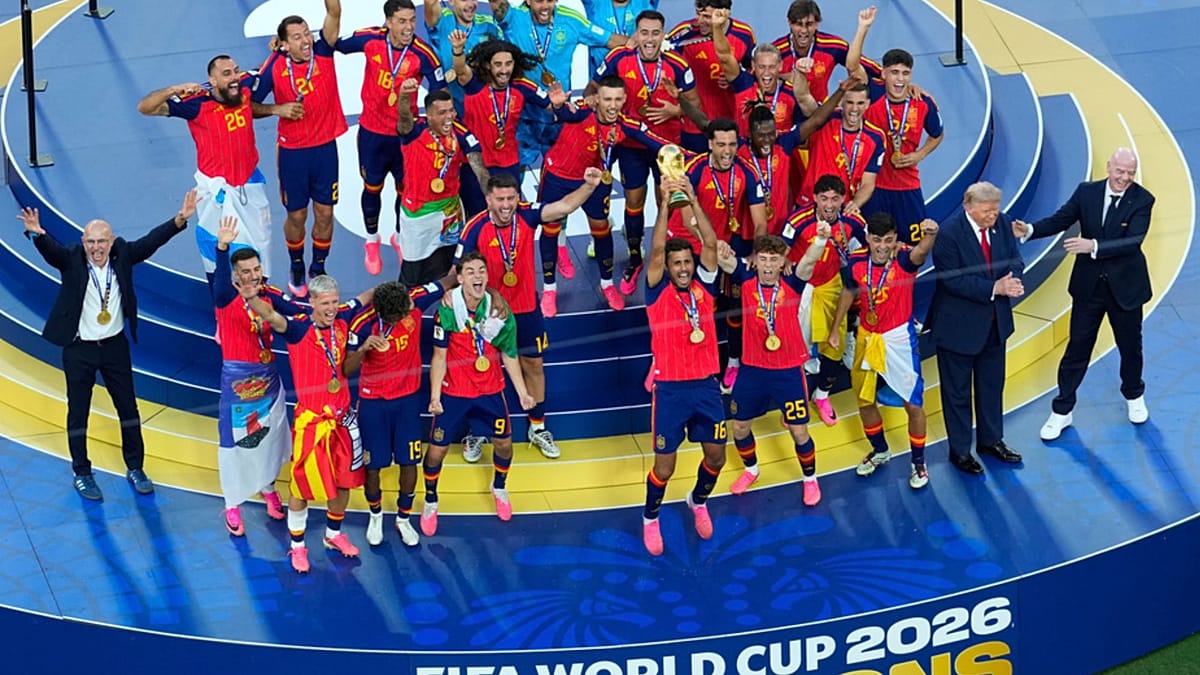
A week after Spain's 1-0 victory over Argentina in the FIFA World Cup final, a wave of conspiracy theories and false claims continues to spread across social media platforms. The vast majority of these narratives attempt to explain why Argentina lost, often alleging foul play by global football governing body FIFA or European football body UEFA.
One widely shared post, which has accumulated nearly 4 million views, claims that FIFA president Gianni Infantino struck a deal with UEFA to ensure Spain's victory in exchange for European support for his re-election in 2027. Infantino announced his candidacy for a fourth term in April. However, the post provides no evidence for the allegation, and a community note appended to it points out that Argentina failed to register a single shot on target during the match.
Moreover, more than 200 FIFA member associations have already endorsed Infantino, with only a handful of European federations—most notably Germany—withholding their backing. While UEFA and FIFA have clashed on issues such as the controversial reversal of US striker Folarin Balogun's one-game ban during the tournament, there is no indication that UEFA would support an alternative candidate, let alone engage in bribery to fix a World Cup final.
Falklands banner controversy resurfaces
Another conspiracy theory alleges that FIFA threatened Argentina with a 10-year World Cup ban unless they lost the final, after Argentine players unfurled a banner reading "The Falkland Islands are Argentine" following their semi-final victory over England. The Falklands, a British overseas territory in the southwest Atlantic, have been the subject of a sovereignty dispute between the UK and Argentina since the 1982 war.
There is no evidence that FIFA imposed any such threat. While reports indicate that FIFA is investigating the banner incident, no official sanction has been announced. World Cup regulations under Article 34.3 prohibit the display of political messages before, during, and after matches. UEFA has previously punished players for similar actions: Spanish internationals Álvaro Morata and Rodri were each banned for one match after chanting "Gibraltar is Spanish" during Euro 2024 victory celebrations. However, no such penalty has been applied to Argentina or its players thus far.
Claims that Argentina's players and their families were threatened before the final have also circulated, citing a clip of captain Lionel Messi telling his teammates to "stay calm" and "forget about everything." Social media users interpreted this as evidence of intimidation. Yet the full video shows Messi also saying, "Come on Nico, you're going to nail the whole game" and "Today is my day, today will be one for the history books," suggesting a motivational rather than fearful tone.
Argentina's manager Lionel Scaloni dismissed the conspiracy theories outright, while Claudio Tapia, president of the Argentina Football Federation, urged the public not to fall for "lies" and acknowledged that Spain deserved to win the final.
For a deeper analysis of how these narratives spread and their broader implications, see our post-truth case study on Argentina's World Cup conspiracy theories. Meanwhile, Spain's victory set global audience records, underscoring the tournament's massive reach.