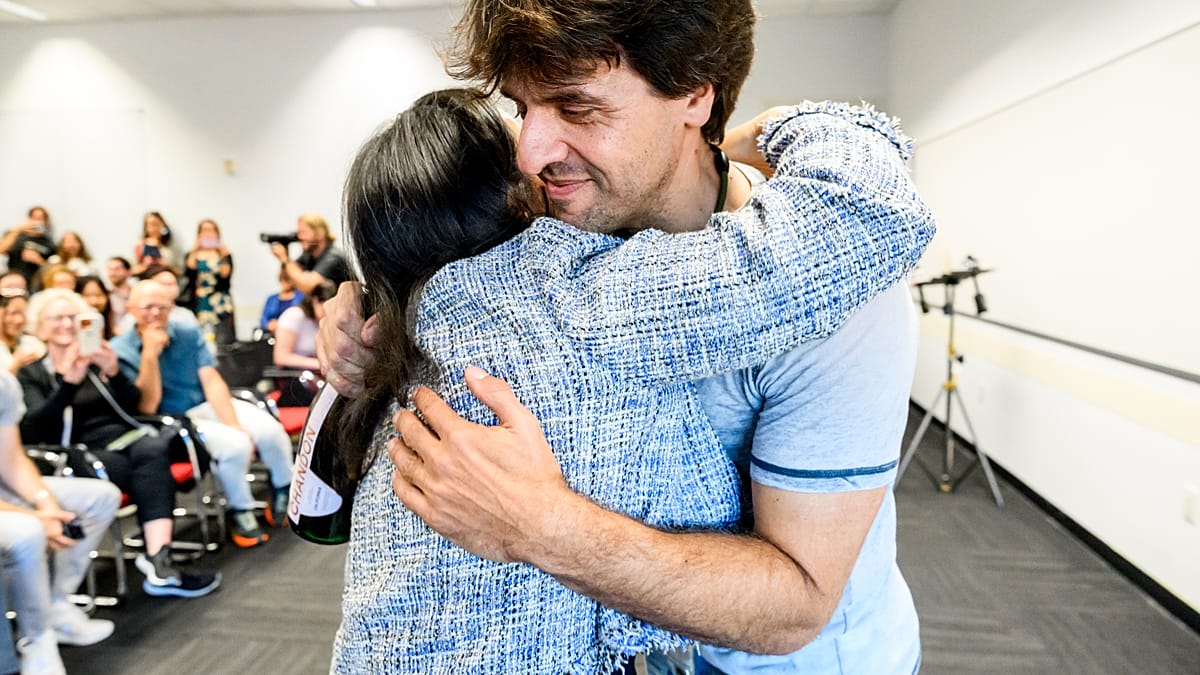
When Karl Deisseroth learned he had won the 2026 Nobel Prize in Physiology or Medicine, he chose a personal way to break the news: he told his two daughters and son directly, in a moment captured by Stanford University. The images show the American scientist sharing the honour with his family, a reminder that even the most prestigious scientific recognition begins at home.
Deisseroth, a professor at Stanford, is one of three laureates this year. He shares the prize with German scientists Peter Hegemann and Georg Nagel for their pioneering work on light-gated ion channels and the development of optogenetics—a technique that allows researchers to control the activity of individual neurons using light. Their combined efforts, spanning decades and multiple laboratories, have transformed neuroscience and opened new avenues for treating neurological and psychiatric disorders.
A European collaboration at the core
While Deisseroth is based in California, the prize underscores the deep transatlantic roots of this research. Hegemann, who leads a lab at Humboldt University in Berlin, and Nagel, at the University of Würzburg in Bavaria, provided the molecular tools that made optogenetics possible. Their work on channelrhodopsins—light-sensitive proteins found in algae—was essential for the technique's success. The collaboration between American and German institutions is a testament to how scientific breakthroughs often emerge from international networks.
The Nobel committee highlighted the trio's contribution to understanding how light can be used to manipulate cellular processes, a field with vast implications for medicine. Optogenetics has already been used to map brain circuits, study Parkinson's disease, and explore treatments for depression and chronic pain. The laureates' findings have also inspired new AI-driven laboratory tools that could accelerate future discoveries.
The prize amount is 12 million Swedish kronor—roughly €1.09 million—which will be shared among the three winners. The formal ceremony will take place in Stockholm on 10 December, the anniversary of Alfred Nobel's death, as is tradition. The choice of Stockholm, rather than Oslo (where the Peace Prize is awarded), reflects the original will of the Swedish industrialist.
Deisseroth's announcement to his children was not the only memorable Nobel moment this year. Earlier, Navi Pillay, the Nobel Peace Prize winner, expressed disbelief upon hearing the news, saying she still wanted to verify it. And in literature, Anne Carson's win was celebrated across the continent. The science prizes have also highlighted European excellence: French and Japanese chemists shared the Nobel for their work on mirror-image molecules, and a Belgian physicist won for transforming Antarctic ice into a neutrino telescope.
The 2026 Nobel season, which opened with the medicine announcement, has once again demonstrated the importance of cross-border collaboration. For Deisseroth, the moment of telling his children was a human counterpoint to the grand scientific narrative. In a video released by Stanford, he can be seen embracing his daughters and son, their reactions ranging from surprise to joy. It is a scene that resonates far beyond the laboratory, reminding us that behind every great discovery are personal stories of dedication and family support.
As the scientific community prepares to honour the laureates in December, the work of Deisseroth, Hegemann, and Nagel stands as a beacon for future generations of researchers. Their achievement is not just a triumph for optogenetics but a celebration of the collaborative spirit that defines modern science—a spirit that knows no borders, from Berlin to Stanford, and from Würzburg to the world.