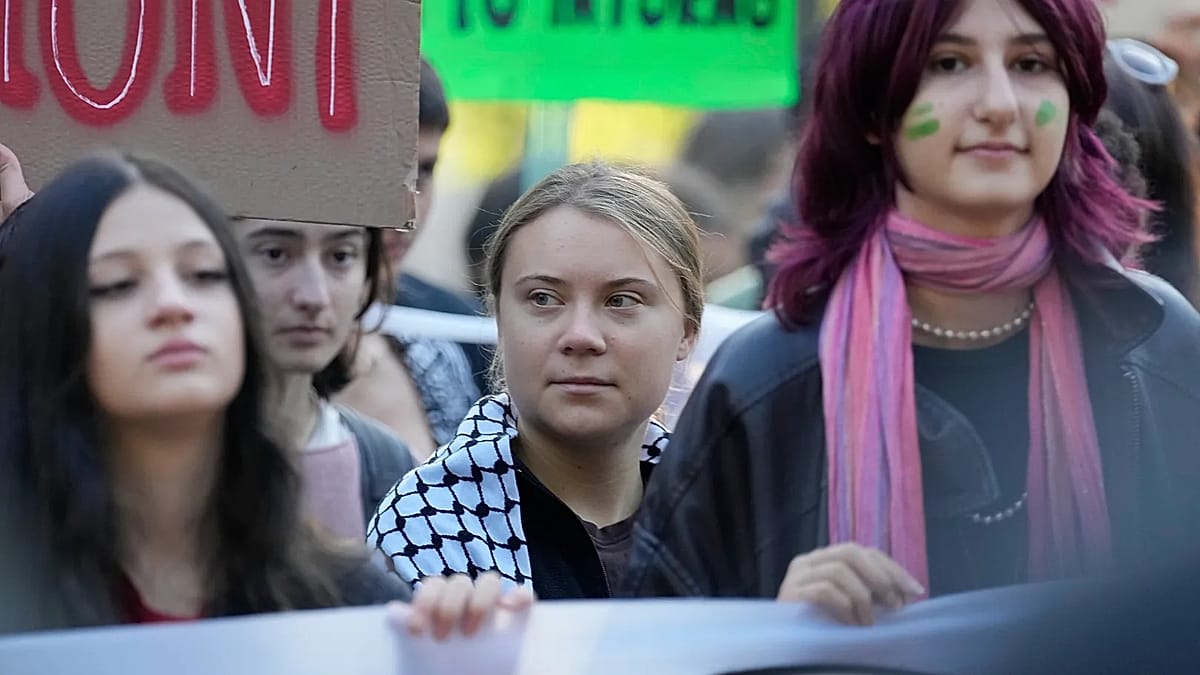
On a late summer Sunday, more than 10,000 demonstrators filled the streets of Stockholm, demanding that Swedish politicians treat the climate crisis as an immediate priority. The march comes just weeks before the country's 13 September general election, where opinion polls indicate that climate change is the issue voters care about most.
The protest was organized by a broad coalition of youth groups, sports clubs, trade unions, rural associations, and civil rights organizations. Among the speakers was Greta Thunberg, the Swedish activist whose school strikes helped spark a global youth movement. Thunberg told the crowd that no major Swedish party is offering policies consistent with what science demands. "There is absolutely no party in Sweden who are even proposing politics in line with anything close to what science says will take for us to avoid a climate disaster," she said. "If we continue like now, we will see collapse; we are already seeing collapse."
The demonstration reflects growing frustration with the centre-right government led by Prime Minister Ulf Kristersson, which took office in 2022. Since then, the administration has cut taxes on petrol and relaxed requirements for fuel suppliers to blend in low-carbon alternatives. It has also rejected recommendations from an official commission that proposed raising taxes on petrol and diesel as a way to phase out fossil fuels.
National targets under threat
Sweden has committed to cutting carbon dioxide emissions from domestic transport by 70 percent by 2030, compared with 2010 levels, and to reach net-zero emissions by 2045. But climate experts in Sweden and abroad have warned that current policies are putting those goals out of reach. The government defends its approach, arguing that a gradual transition is necessary to protect Swedish competitiveness and jobs.
Protesters, however, say the pace is far too slow. "The climate crisis is very real, and it is here," said Beatrice Rindevall, head of the Swedish Society for Nature Conservation, one of the co-organizers. In a statement, she pointed to the deadly heatwaves that have scorched parts of Europe this summer as evidence that urgent action is needed now. "It is time to put in place a climate policy that reduces emissions right now," she said.
Kliff Lindberg, a 21-year-old student at the rally, said he was "relieved" by the strong turnout. "We are so many people who are concerned about this problem," he told reporters. "That gives me a lot of strength, and it's beautiful to see."
The political stakes are high. A Verian opinion poll published by the public broadcaster SVT on Thursday showed the centre-left opposition leading the ruling right-wing bloc by ten percentage points. The same poll found that 37 percent of respondents ranked climate change as their top election priority, ahead of other issues such as the economy and migration.
Sweden is not alone in facing these tensions. Across Europe, governments are struggling to balance climate commitments with economic pressures. In Germany, for example, record sightings of praying mantises have been linked to a warming climate, a small but telling sign of the changes underway. Meanwhile, severe storms and floods in northern Italy after weeks of heat have underscored the continent's vulnerability to extreme weather.
As the election approaches, the question is whether Sweden's next government will adopt a more aggressive climate agenda. The current administration insists that its gradual approach is the right one, but with the opposition ahead in the polls, a change of government looks increasingly likely. For the thousands who marched in Stockholm, the message was clear: the time for half-measures is over.