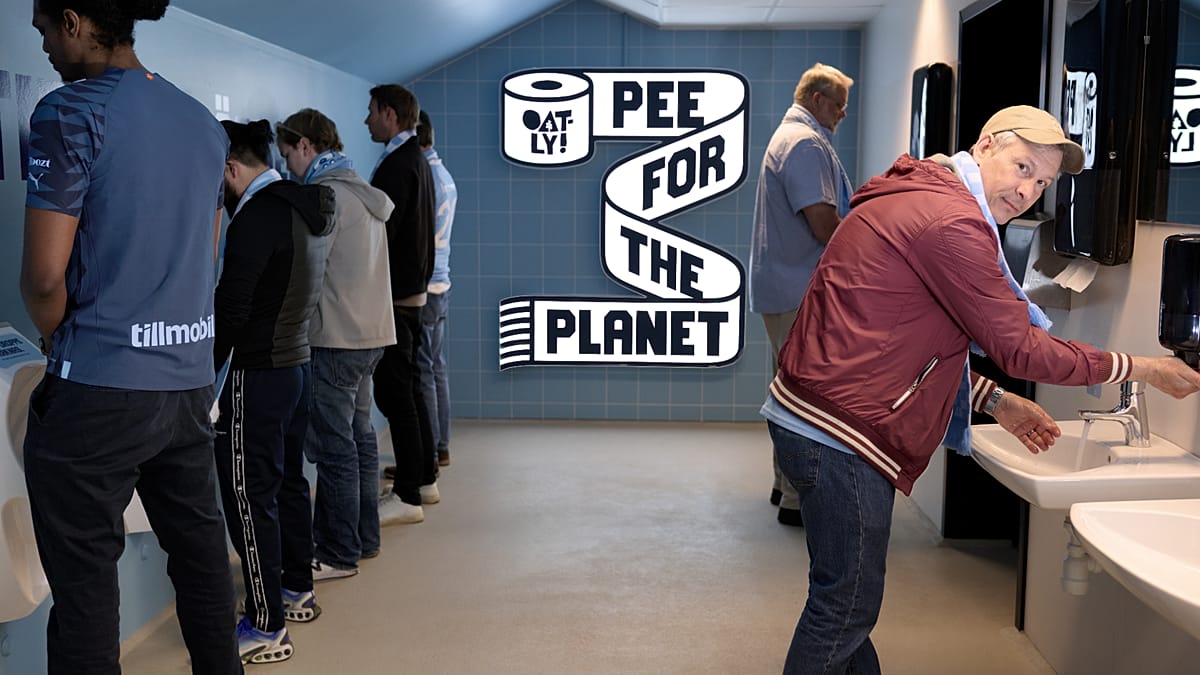
On Sunday 24 May, supporters of Malmö FF will participate in an unusual competition: peeing for the planet. At Eleda Stadion, the club has installed 15 specialised urinals and one toilet designed to capture human urine, with a target of 1,000 litres by the end of the Swedish football season on 29 November.
The initiative, a collaboration between the Swedish University of Agricultural Sciences (SLU), oat milk producer Oatly, Malmö FF, and sanitation start-up Sanitation360, aims to test whether human urine can serve as a viable, circular alternative to synthetic fertilisers. These nitrogen-based products currently generate 1.13 billion tonnes of CO₂ equivalents annually—more than the entire aviation sector, according to the Center for International Environmental Law (CIEL).
Why Urine?
Human urine is rich in nitrogen, phosphorus, and potassium—the three key nutrients in synthetic fertilisers. By diverting this resource from wastewater treatment plants, where it often ends up polluting lakes and seas, the project hopes to close a nutrient loop. “It’s about making use of a resource we currently waste,” says Björn Vinnerås, professor at SLU and expert at Sanitation360. “Collecting and reusing urine is really no stranger than doing the same with plastic. Today, we already use manure from cows, pigs and chickens as fertiliser—and that is completely normalised.”
The timing is critical. Geopolitical instability, including Iran’s continued blockage of the Strait of Hormuz, has disrupted around a third of global fertiliser trade. The strait is also vital for natural gas exports, a key input for synthetic nitrogen fertilisers widely used across Europe. The EU’s fertiliser plan has already highlighted the deep link between energy costs and food prices, making alternative sources more urgent.
The Malmö project will assess not only the logistics of urine collection at a 22,500-capacity venue, but also the safety of urine-derived fertiliser for food crops. Researchers must address concerns about pharmaceutical residues and pathogens before scaling up. If successful, the approach could reduce the burden on wastewater treatment systems and provide a local, circular supply of nutrients.
“We need to challenge the way we think,” adds Vinnerås. The researchers estimate that urine could theoretically replace up to 30% of the synthetic fertiliser used in Sweden. The project also aligns with broader European efforts to reduce dependence on imported fertilisers, as outlined in the EU’s fertiliser plan, which seeks to avert new farm protests amid soaring costs.
Malmö FF’s stadium will serve as a testing ground for the technology, hygiene protocols, and public acceptance. If the pilot proves viable, it could open the door to adapting toilet infrastructure across Europe, turning a waste product into a resource. As Vinnerås puts it, “It’s about making use of a resource we currently waste.”