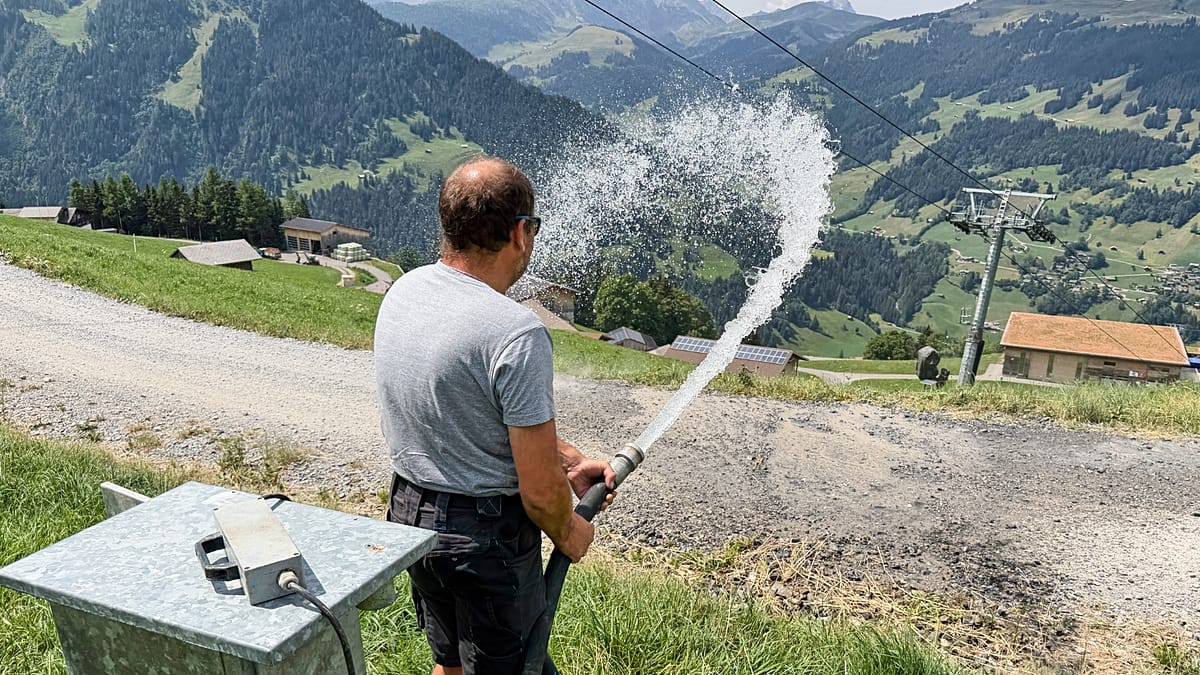
In the blazing August sun above Adelboden, there is barely a trace of snow, let alone skiers. But this Swiss resort may have found a new purpose for its snowmaking equipment as Europe endures hotter summers: helping to extinguish forest fires.
Glaciers across Switzerland and the Alps have been retreating rapidly in recent years, a trend attributed to human-induced climate change. Snowfall has become less frequent and less reliable over the past decades, posing a significant challenge for mid-altitude ski areas like Adelboden-Lenk, whose slopes range from 1,000 to 2,300 metres. Today, an estimated 70 per cent of the snow on its pistes is artificially produced.
Snow cannons and lances are the visible components of this network, but much of it lies underground: dozens of kilometres of water pipes that could prove valuable beyond the winter months as wildfire risk grows even in places like the Bernese Oberland.
From snowmaking to firefighting
Jürg Klopfenstein, who oversees snowmaking operations at Adelboden-Lenk, explains that the infrastructure can support firefighters. "We can help firefighters with our infrastructure," he says. "Not primarily with our snow cannons, which can mainly be used to water fields or aim at surrounding infrastructure. But firefighters can use our pipes, and helicopters can refill their tanks using our water reservoirs."
These reservoirs collect rainfall and melting snow during warmer months, storing water that is later used to produce snow in the ski season. The network connects 210 snow cannons and 50 snow lances across the area. In the event of a fire, the system could create wet buffer zones, slowing the advance of flames and buying time until emergency services and air support arrive.
So far this year, Switzerland has avoided the large-scale blazes seen in some neighbouring countries. However, the nation is suffering from drought, and authorities assess wildfire risk as high across almost the entire territory, including the Bern region where Adelboden is located. This follows a summer of record heat and wildfires across southern Europe.
Dry springs and a changing climate
The Bernese Oberland is not just a winter destination; it attracts mountain bikers, hikers, runners, and paragliders in summer. Stefan Buchs, operations manager at Adelboden-Lenk, notes that the vegetation and soil humidity in the Alps differ from southern Europe, so the risk of large, frequent fires cannot be directly extrapolated. Yet he warns, "Widespread wildfires are a likely scenario. We discussed this with the firefighters, and they recognised it already. They see that humidity is a real problem. It gets really dry even in the spring. Not just in the summer."
Adelboden's mayor, Willy Schranz, echoes this concern: "We must be prepared, because I am sure it won't be the last summer like this one."
Nathan Solothurnmann, a climate change expert with Greenpeace, cautions against overestimating the long-term benefits of such adaptations. "This watering system that they're planning in Adelboden might for sure help for a while," he says. "But of course the changes we're facing are much worse. All those types of adaptations, they just help for a while."
As Europe grapples with the effects of climate change, innovative uses of existing infrastructure may offer temporary relief. The situation in Switzerland also highlights broader concerns, such as water management across the Alps. For now, Adelboden-Lenk is preparing for a future where summer fires are part of the new normal, even in the snowy peaks of the Swiss Alps.