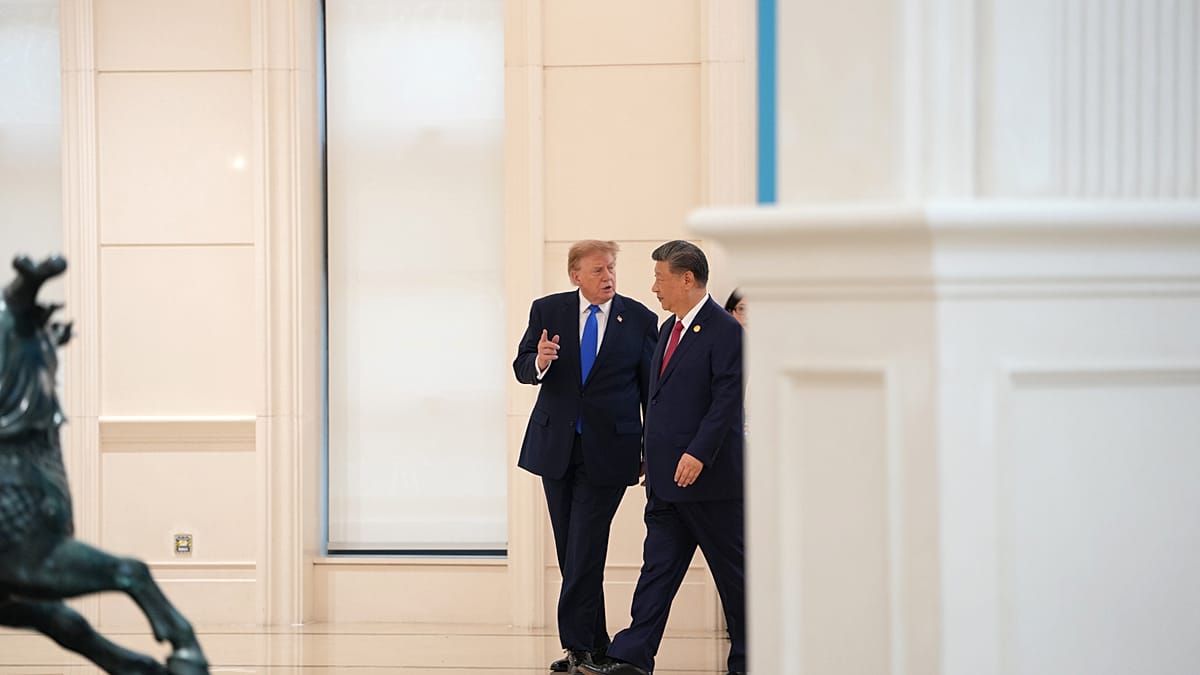
At the Asia-Pacific Economic Cooperation meeting in Shenzhen, the leaders of the world's two dominant artificial intelligence powers laid out sharply contrasting visions for governing the technology. US President Donald Trump reiterated his opposition to any form of international oversight, while China's President Xi Jinping urged bilateral cooperation to ensure AI remains under human control.
Trump, using his administration's preferred term "super intelligence," acknowledged the technology's dual nature. "It's almost completely good, but it's got some bad elements, and we have to be very careful in managing those bad elements," he told leaders. He then added: "So we oppose any form of globalist regulation or anything to control and stifle SI, and we won't allow that to happen, frankly."
Xi, according to Chinese state news agency Xinhua, responded by stressing the need for joint efforts. "China and the United States should strengthen communication and coordination to guard against artificial intelligence safety risks and ensure that artificial intelligence always remains under human control," he said.
The two leaders met on the sidelines of the APEC summit, which also included a rare trilateral session with Russian President Vladimir Putin, as reported in our coverage of the trilateral summit. The AI discussions were part of a broader agenda that touched on trade, security, and geopolitical tensions.
Shared risks, divergent approaches
Despite their fierce technological rivalry, Washington and Beijing face common AI-related dangers. These range from cyberattacks on critical infrastructure to the potential misuse of AI in developing bioweapons. Another growing concern is the proliferation of autonomous AI agents—tools that can execute real-world tasks online with minimal human oversight. Recent incidents involving OpenAI's bots hacking into websites, including an Australian government portal and several US government sites, have heightened these worries.
Military applications and mass surveillance remain potential flashpoints between the two powers. The talks were also overshadowed by the resignation of Jensen Huang as CEO of Nvidia, the US chip giant, following revelations of an affair with a suspected Chinese spy—a development that underscores the intricate links between corporate leadership, technology, and espionage.
In September, Trump and Xi agreed to establish a channel for urgent communication on AI incidents, with details expected to be finalized during this week's meetings. Xi has previously called for stronger "laws and regulations, technological monitoring, early warning and emergency response systems" to keep AI in check.
At APEC on Wednesday, Xi urged leaders to "deepen cooperation in the digital economy and artificial intelligence," though he offered no specifics. Canadian Prime Minister Mark Carney, also present in Shenzhen, warned that the absence of global governance on AI poses an "enormous risk."
For Europe, the US-China divide presents a strategic challenge. The European Union has been crafting its own AI regulations, notably the AI Act, which seeks to balance innovation with fundamental rights. As Germany's digitalisation minister has noted, Europe risks being caught between the American push for unbridled innovation and China's state-centric approach. The outcome of the Shenzhen talks could influence whether Brussels can forge a credible third path.
European leaders have repeatedly called for international coordination on AI safety, but with the US and China at odds, multilateral forums like the UN and the OECD have struggled to produce binding agreements. The contrasting positions staked out in Shenzhen may make that task even harder.
As the summit concluded, no joint statement on AI was issued, leaving the future of global governance uncertain. For now, the world's two AI superpowers remain on divergent tracks, with Europe watching closely.