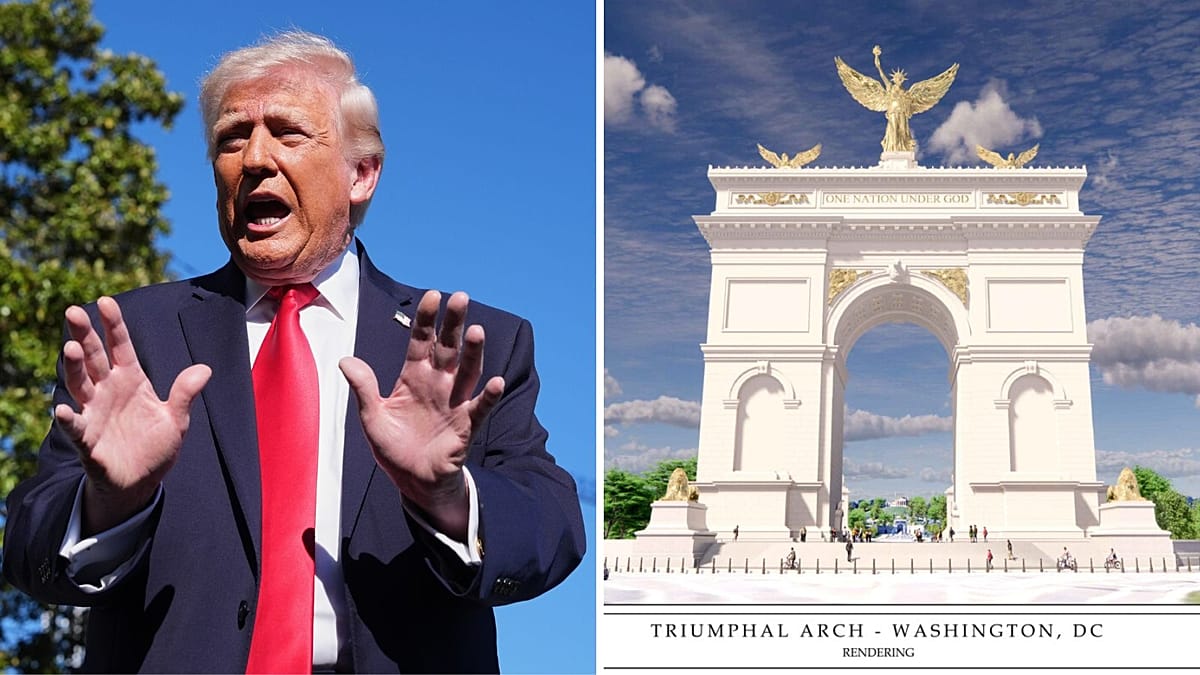
The administration of former U.S. President Donald Trump has formally submitted plans for a monumental 76-metre 'Triumphal Arch' in Washington, D.C., a proposal immediately met with derision and labelled the 'Arc de Trump' for its resemblance to Paris's Arc de Triomphe. The structure, as envisioned, would surpass the height of both the U.S. Capitol and the Lincoln Memorial.
Trump promoted the design on social media, declaring it would be "the GREATEST and MOST BEAUTIFUL Triumphal Arch, anywhere in the World" and "a wonderful addition to the Washington DC area for all Americans to enjoy for many decades to come!". The plans have been filed with the U.S. Commission of Fine Arts, a body whose current members were appointed during Trump's presidency.
Legal and Historical Challenges Mount
The project is not without formidable opposition. A coalition of Vietnam War veterans and an architectural historian have filed a lawsuit against the Trump administration to halt the arch. Their 19-page legal filing argues the monument would "clash with the Lincoln Memorial and Arlington National Cemetery’s message of unity after the Civil War."
They provide a specific grievance: "It will block historically significant reciprocal views between those two memorials that were consciously designed and that have existed for nearly a century. With the erection of the arch, Arlington House will no longer be visible from the Lincoln Memorial, and the view of the Lincoln Memorial from Arlington House will be obscured, disrupting the historic and symbolic link between the two." The group contends the plans violate the Commemorative Works Act of 1986, which governs commemorative works in the capital, and further warn it could interfere with air traffic at nearby Ronald Reagan National Airport.
This legal action follows a pattern of controversies surrounding Trump's aesthetic and commemorative projects, reminiscent of the backlash when Nancy Sinatra condemned Trump's use of Frank Sinatra's 'My Way' at political events.
A European Perspective on Monumental Ambition
From a European viewpoint, the proposed arch invites immediate comparison to the iconic Arc de Triomphe in Paris, a monument commissioned by Napoleon to celebrate military victories. The scale and intent behind Trump's version, however, strike many observers as a personal vanity project rather than a national commemorative act. The concept of a leader erecting a grand monument to their own legacy has historical precedents often viewed critically, a sentiment echoed in current European debates about the architectural footprints of long-serving leaders.
The controversy also touches on broader themes of fiscal priority and historical preservation that resonate in Europe. As governments from Berlin to Budapest grapple with budget constraints and the preservation of cultural heritage, the spectacle of a multi-million dollar monument advancing in the U.S. while domestic and global crises simmer draws sharp scrutiny. The situation parallels concerns in nations like Hungary, where the new government is scrutinising Orbán-era projects for potential financial and ethical irregularities.
Online criticism has been swift and severe. Many commentators have labelled the initiative "sickening" and an "embarrassing" misuse of resources. One typical response read, "Americans worried about inflation and Trump is using tax dollars for wars, arch and his pet projects." The timing of the proposal, amid international conflicts and economic pressures, has amplified this public ire.
The project's fate now rests with regulatory bodies and the courts. Its progression will test the strength of U.S. laws designed to protect the capital's commemorative landscape from political whims. For European observers, the saga underscores ongoing transatlantic discussions about leadership, legacy, and the appropriate use of public space and funds—themes equally relevant as the EU energy chief warns of prolonged price hikes from Middle East conflict, redirecting focus to more pressing continental concerns.