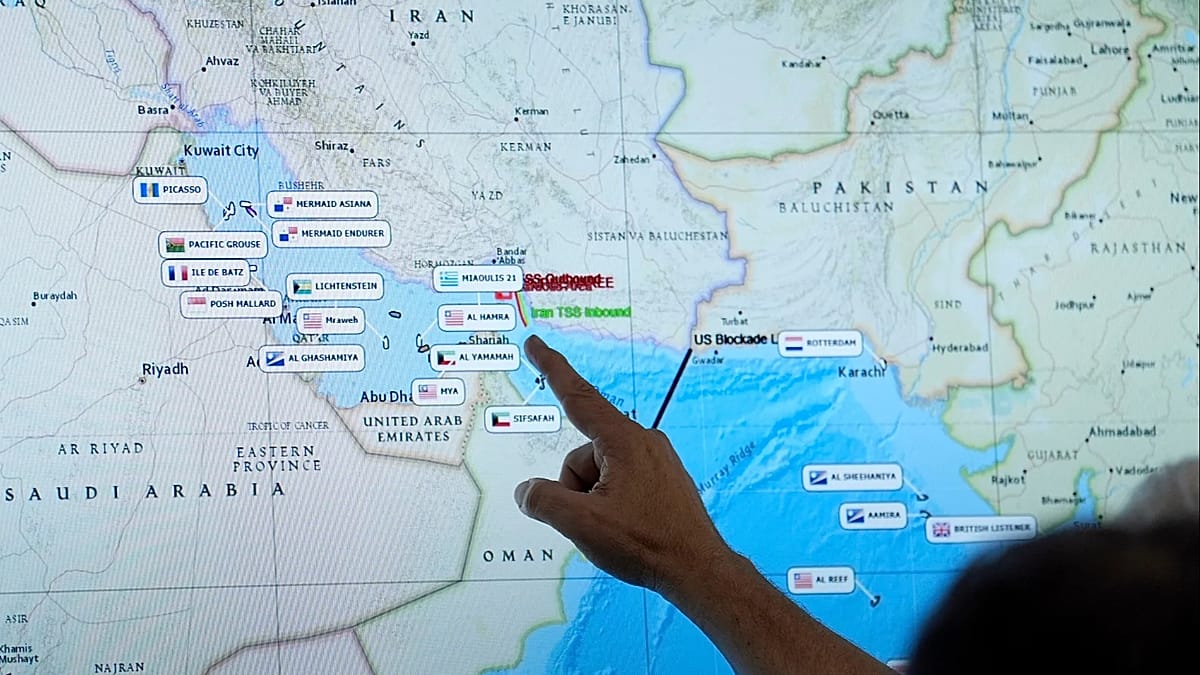
The United States is preparing to launch an international coalition aimed at restoring commercial shipping through the Strait of Hormuz, a senior State Department official confirmed on Thursday. The waterway, through which roughly one-fifth of the world's oil and liquefied natural gas normally passes, has been effectively sealed since Iran shut it down on 28 February following the outbreak of hostilities with the US and Israel.
The initiative, dubbed the "Maritime Freedom Construct" (MFC), will be a joint effort between the State Department and US Central Command (CENTCOM). According to a diplomatic cable reported by the Wall Street Journal, the MFC will "take steps to ensure safe passage, including providing real-time information, safety guidance, and coordination to ensure vessels can transit these waters securely." The official, speaking on condition of anonymity, told AFP that the Washington-based component will serve as a diplomatic operations hub, uniting partner nations and the commercial shipping industry.
European Allies Pursue Parallel Track
The UK and France have been leading separate talks on a maritime security effort, recently convening a meeting of over 50 countries to discuss the crisis. Their approach reflects a broader European concern about energy security and economic stability, as the blockade has sent crude prices soaring. Benchmark Brent crude for June delivery reached $126 (€107) per barrel on Thursday, the highest intraday level since Russia's full-scale invasion of Ukraine in 2022.
The European Union has already begun accelerating its renewable energy and nuclear power projects in response to the crisis, as detailed in a recent analysis of the bloc's energy strategy. Fuel prices have surged more than 20% in member states such as Latvia and Sweden, according to recent data, highlighting the direct impact on European consumers.
The US cable reportedly insists that collective action is "essential to demonstrate unified resolve and impose meaningful costs on Iranian obstruction of transit through the Strait." It describes the MFC as a "US-led" initiative, adding that participation will "strengthen our collective ability to restore freedom of navigation and protect the global economy."
President Donald Trump has repeatedly criticised allies for their reluctance to become directly involved in the conflict, urging oil-dependent nations to take greater responsibility for reopening the waterway. On Wednesday, Trump warned that the US naval blockade of Iranian ports—imposed on 13 April and covering the entire Iranian coastline—could last for months.
Iranian Leadership Defiant
Iran's Supreme Leader, Ayatollah Mojtaba Khamenei, who succeeded his father Ali Khamenei after the latter was killed in US and Israeli strikes on 28 February, issued a defiant message on Thursday. In a written statement read on state television, he declared that the United States had suffered a "disgraceful defeat" in its military plans. "Today, two months after the largest military deployment and aggression by the world's bullies in the region, and the United States' disgraceful defeat in its plans, a new chapter is unfolding for the Persian Gulf and the Strait of Hormuz," the message said.
Khamenei, who has not appeared in public since his appointment on 9 March, praised Iran's "new legal framework and management" of the strait, claiming it would bring "comfort and progress" for regional countries. He also dismissed the US naval presence, stating that American bases in the region "lack even the capacity to ensure their own security, let alone provide any hope of securing their allies."
Earlier on Thursday, Iranian President Masoud Pezeshkian described the US blockade as "doomed to fail," arguing that such measures "not only fail to enhance regional security, but are in fact a source of tension and a disruption to lasting stability in the Persian Gulf."
The standoff has stranded an estimated 20,000 seafarers on vessels unable to transit the strait, according to recent reports, compounding the humanitarian and economic toll. Meanwhile, Qatar has warned Iran against using Doha as a "political punching bag" in the crisis, as diplomatic efforts continue to find a resolution.
The US has not yet set a timeline for the MFC's operational launch, but the diplomatic push signals a determination to break the impasse. For European capitals, the stakes are clear: a prolonged closure of the Strait of Hormuz would deepen the continent's energy crisis and test the resilience of its economies already strained by high inflation and geopolitical uncertainty.