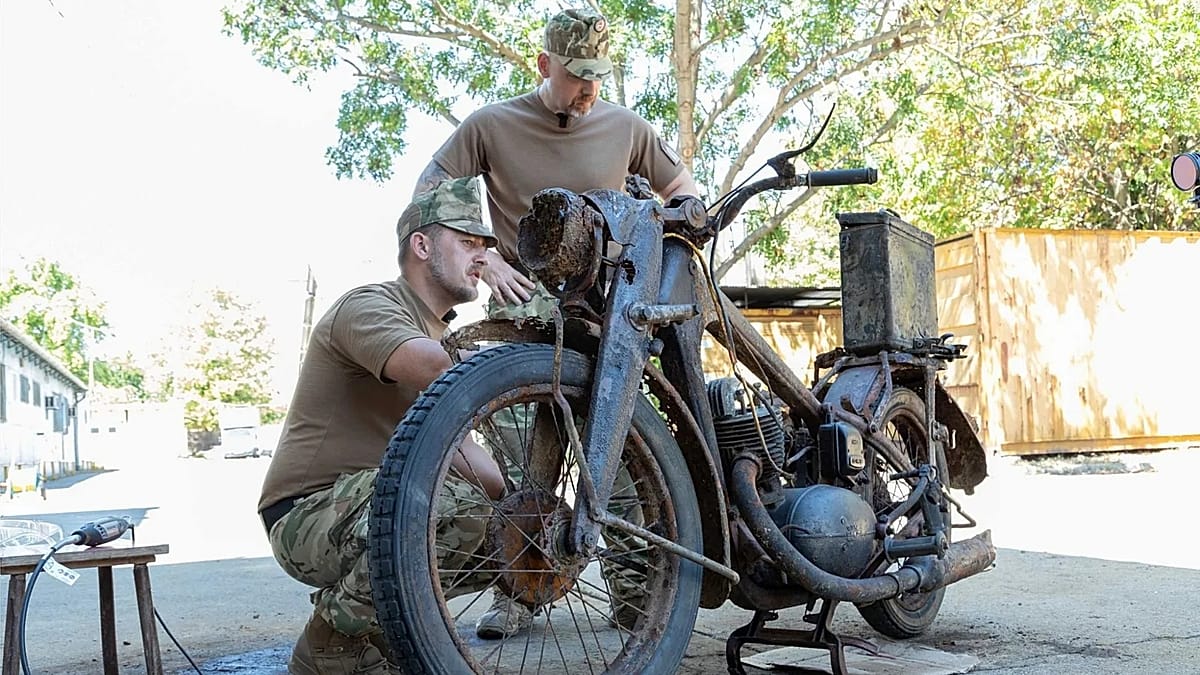
In early August, a remarkable relic of the Second World War emerged from the Danube in the heart of Budapest, near Batthyány Square. A DKW NZ-350-1 motorcycle, manufactured for the German Wehrmacht, was recovered from the riverbed, astonishing archaeologists and military historians alike. Such well-preserved artifacts from the conflict are exceptionally rare, and this one carries with it the weight of a city's most harrowing chapter.
The motorcycle serves as a tangible link to the siege of Budapest, a brutal 102-day battle in late 1944 and early 1945 that saw nearly 100,000 German and Hungarian soldiers become casualties. The siege was a desperate attempt by Nazi Germany to hold back the advancing Soviet Red Army, and its toll on the city and its inhabitants was immense.
Hungary had remained relatively untouched by the war until March 19, 1944, when German forces occupied the country. This occupation marked a turning point, not only for Hungary's Jewish population and civilians, but also for the soldiers who would be drawn into Hitler's failing war machine. The discovery of the motorcycle brings this period into sharp focus, prompting questions about the units that fought and the fates of the men who served.
Unraveling the motorcycle's origins
Lieutenant Colonel Dr. Norbert Számvéber, director of the Military History Archive at the Institute and Museum of Military History (HM HIM), has identified the motorcycle as belonging to one of the most significant German units trapped in Budapest: the Feldherrnhalle armored division (FHH). Specifically, it likely belonged to its armored pioneer battalion.
"The motorcycle may have entered the inventory of this unit, then in the process of being re-formed, in September 1944," Számvéber explained. "At the end of that month, or at the latest in early October 1944, it was renamed Panzer-Pionier-Bataillon Feldherrnhalle. The motorcycle and the vehicles that had already been marked with the unit insignia were not repainted one by one, perhaps for lack of time."
The recovery also brought to light anti-tank mines, ammunition, and the remains of two German soldiers. Their identity tags suggest they belonged to the 22nd SS Volunteer Cavalry Division, which defended the Buda embankment after the fall of the Pest bridgehead on January 18, 1945. Számvéber notes that these soldiers were likely not directly connected to the motorcycle, but their presence adds to the site's historical significance.
"Here they may have fallen in combat, or they may have been executed on the spot by the Soviets," he said. "The latter was by no means uncommon in the case of SS members, but since the Soviets typically removed identity tags before executions, the former scenario is more likely."
A vehicle lost to the river
Examination of the motorcycle revealed that its gearbox was stuck in second gear, indicating it was involved in a crash 81 years ago. Whether that crash occurred at the moment it entered the Danube remains unclear. Számvéber rules out the possibility of a ferry sinking, given the heavily iced river and the tactical situation during the siege.
"This type of motorcycle was used mainly for liaison tasks, for example to carry reports and orders," he said. "I assume that it became a loss near the riverbank while performing such a mission, but that it may only have found its way into the Danube after the end of the siege, during debris-clearing operations."
The DKW NZ-350-1 was a workhorse of the German military, with about 12,000 units produced in 1944-45. Due to wartime shortages, they were fitted with grey cast-iron engine blocks instead of aluminum. After the war, the Soviets dismantled the production line and shipped it to Izhevsk, where a further 127,000 were manufactured under the name Izs-350. Of the German-made machines, only an estimated 30 to 50 survive today, making this find particularly precious.
The motorcycle's discovery also highlights the role of pioneer battalions, which were not merely support units but heavily armed assault forces. Each company was equipped with two heavy machine guns, 18 light machine guns, two 8 cm mortars, and six backpack flamethrowers. "These were excellently equipped assault battalions designed for attacks against fortified positions and for fighting in built-up areas," Számvéber noted. "In a major city such as Budapest, units of this kind became particularly important."
The find resonates beyond military history, echoing the broader human cost of the siege. It also connects to other recent discoveries along the Danube, such as WWII soldiers' remains and identity tags revealed by low water levels. For Hungarians, the motorcycle is a poignant reminder of a conflict that tore the nation apart, a theme memorably captured in the 1965 film A tizedes meg a többiek (The Corporal and the Others), which portrays ordinary soldiers caught between two brutal armies.
As conservation work continues at the HM HIM, the motorcycle will eventually be displayed, offering future generations a tangible connection to a past that must never be forgotten. The story of this machine, from the factories of Nazi Germany to the muddy depths of the Danube, is a microcosm of Europe's darkest hour and its enduring legacy.