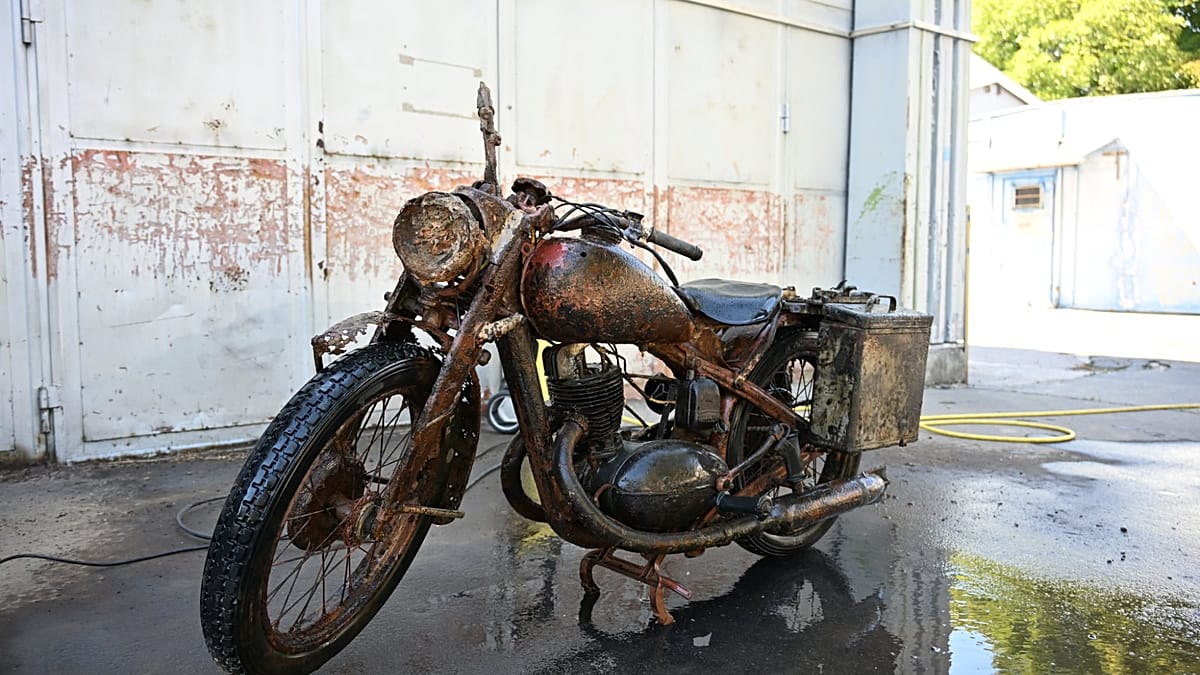
Budapest's Danube, its water level unusually low after a prolonged drought, has given up secrets hidden for over eight decades. Among the mud and debris on the riverbed, workers found the skeletal remains of two German soldiers from the Second World War, along with their military identity tags and a DKW motorcycle, a relic of the Wehrmacht's motorized units.
The two men had been listed as missing since the war's end, their families left without confirmation of their fate. Now, the discovery of their remains and the stamped metal discs that once hung around their necks could finally put names to the fallen.
The painstaking work of identification
Military identity tags were designed to ensure that even in death, a soldier could be accounted for. Each tag bore a unique number and was scored so it could be broken in two. If a soldier was killed, a comrade would snap the tag, leaving one half with the body and sending the other to the central records office, which would then notify the family.
Norbert Hambuch, cemetery manager at the Budaörs German war cemetery near Budapest, explained the procedure while translating for his colleague Gabor Kohlrusz, a reburial specialist for the German War Graves Commission (Volksbund Deutsche Kriegsgräberfürsorge). "If he had been killed, his comrades would have broken the identity tag," Hambuch said. "The upper part with the two holes stays with the soldier, and his comrades take the lower part and send it to the central office."
But finding a tag alongside remains does not automatically confirm identity. The position of the tag can be a crucial clue, as Diane Tempel-Bornett of the Volksbund told Euronews. "If an identity tag is discovered at chest level, it probably belongs to the dead soldier because he would have worn it around his neck," she said. "At hip level, an identity tag is more likely to indicate that it was in a trouser pocket and that the dead soldier had taken it from another dead comrade in order to return it to their unit."
The two tags recovered from the Danube belong to a Wehrmacht soldier and a member of the Waffen-SS. Investigators must now determine whether the tags actually match the remains. Any preliminary identification by the Volksbund will need to be confirmed by Germany's Federal Archives, the official authority for such records.
Wartime wreckage emerges from the river
The discovery is part of a wider unearthing of wartime debris as the Danube's water level drops. The DKW motorcycle, buried in the mud for more than 80 years, has drawn particular attention. Euronews visited the recovery site with Kohlrusz and Hambuch.
"There were a great many wrecks here, vehicles from the final phase of the war in Budapest. All this debris was pushed down here directly after the war, and only later were these rocks piled on top," Hambuch said.
The Battle of Budapest, which lasted 102 days in 1944 and 1945, claimed tens of thousands of lives, both military and civilian. The motorcycle is expected to become a centerpiece of an exhibition at the Institute and Museum of Military History, the Volksbund's Hungarian partner. Imre Kovacs, the Volksbund's representative in Hungary, called the motorcycle a "showpiece" for the museum. It has been cleaned and will go on display.
The soldiers' remains have been taken to the Volksbund's facilities at Budaörs, where they will be cleaned, documented, and anthropologically examined. "The bones have been collected and taken to the depot, that is, to the Volksbund's largest military cemetery in Hungary, Budaörs," Hambuch said. "There they are cleaned, recorded anthropologically, documented and, in the autumn, in October, they will be buried together with the other soldiers found this year."
The work of locating and identifying the missing from the Second World War is far from complete. Tempel-Bornett noted that on the territory of the former USSR alone, around two million soldiers remain missing. In Hungary, losses are estimated at 54,000, and since 1992 the Volksbund has exhumed and reburied 29,956 dead.
More than eight decades after their deaths, the two men recovered from the Danube may finally receive a grave, potentially bearing their names. The low water levels that exposed their remains are a stark reminder of the Danube's changing conditions, which have also forced Hungary to take emergency measures at the Paks nuclear plant.