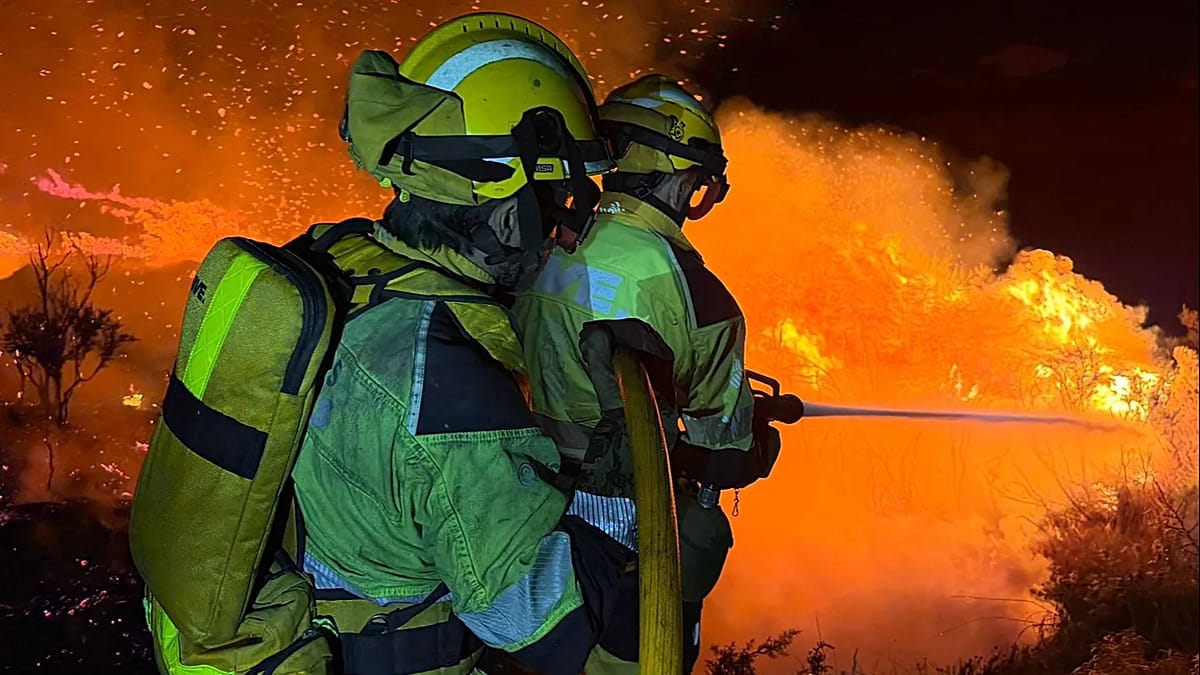
Firefighters across southern and eastern Spain are battling two major wildfires that have forced hundreds of residents from their homes and scorched thousands of hectares. The largest blaze, which ignited on Thursday near the town of Niebla in the province of Huelva, has now consumed more than 4,000 hectares and led to the evacuation of the population centres of Berrocal, El Membrillo, El Pozuelo and Marigenta, according to Andalusia's Forest Firefighting Service (INFOCA).
Around 400 people have been evacuated from the affected areas, which lie west of Seville. Overnight, 150 forest firefighters worked on the ground to stabilise the fire, but the operation remains extremely challenging. Antonio Sanz, Andalusia's regional minister for the Presidency, Health and Emergencies, said the fire remains at Level 2 — a designation indicating a situation that requires support from national resources — and described it as "extremely complex" 48 hours after it began. He attributed the difficulty to constant wind shifts and the spread of burning embers, which have made containment efforts unpredictable.
Spain's Third Vice-President and Minister for Ecological Transition, Sara Aagesen, is scheduled to visit the Advanced Command Post in Niebla on Sunday to meet with those leading the emergency response. The visit underscores the national significance of the blaze, which has drawn resources from across the region.
Air support returns to Tírig fire in Castellón
On Spain's east coast, a separate wildfire near the town of Tírig in Castellón has prompted the confinement of the municipality of Catí, home to around 700 residents. Aircraft joined firefighting operations at dawn on Sunday, after ground crews worked through the night to contain the blaze. The Castellón Provincial Fire Consortium said the terrain, characterised by a succession of ravines, has hampered efforts.
Juan Carlos Valderrama, the Valencian regional government's Minister of Emergencies and Interior, said the fire has burned 395 hectares within a 15-kilometre perimeter. He reported that 300 personnel, 19 aircraft, and 50 ground units have been deployed. Valderrama noted that the northern and southern sectors of the fire are of greatest concern, and that it is too early to speak of stabilisation, although forecast conditions for the coming night should be favourable, as they were the previous night.
The Tírig fire is one of four blazes declared on Friday afternoon in inland Castellón, which together have affected around 244 hectares, according to the latest provisional data. The working hypothesis for the cause is that lightning strikes during Friday's storms ignited the fires, pending an investigation by the Seprona environmental unit.
Meanwhile, a separate fire declared on Friday in the Sierra Engarcerán, south of Tírig, is now under control, the Emergency Coordination Centre of the Valencian Community confirmed on Sunday. That fire has affected 45 hectares within a 4-kilometre perimeter.
The outbreaks come as Spain and much of southern Europe grapple with an intense heatwave that has heightened wildfire risk. Similar blazes have been reported elsewhere on the continent, including wildfires in the Balkans and a fire above Lake Garda in Italy that forced evacuations. The situation underscores the growing pressure on European emergency services as climate change intensifies fire seasons.
Experts point to the need for longer-term strategies to reduce wildfire risk. Regenerative farming practices are emerging as a potential shield against such fires, while some researchers are exploring the role of European bison in making forests more resilient. These approaches may become increasingly important as the continent faces more frequent and severe fire events.
For now, the immediate priority remains protecting lives and property. The Level 2 status of both major fires means that national military resources, such as the Military Emergency Unit, can be called in if needed. Local authorities have urged residents to follow evacuation orders and stay informed through official channels.